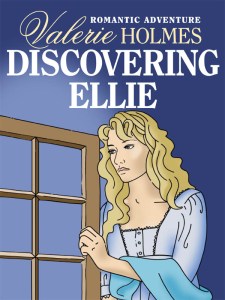
Discovering Ellie

Discovering Ellie KECBuy and read now!

US Readers: Kindle / iTunes / Nook / Kobo

UK Readers: Kindle / iTunes / Nook / Kobo

Early nineteenth century North Yorkshire, England.

Ellie has recurring nightmares, always waking to a life devoid of love, but still she dreams. Living in the old hall with her Aunt Gertrude and cousins Cybil and Jane, the scandal of her mother’s elopement with a Frenchman cast a long shadow over her life. Until Mr William Cookson arrives to shine new light onto her past opening the way to an exciting future…

An Interview with Freda Lightfoot

Freda L-close up 6My very special guest for Christmas is prolifically successful historical author, Freda Lightfoot, with an insight into her career and sharing with us how she now enjoys the best of two worlds.
You have served a very interesting writing apprenticeship in order to attain the success you now enjoy. Could you share some of the key moments with us?

My first published piece was called An Elizabethan Toothache, published by Today’s Guide in 1972. I followed this small success with pieces on how to pass various badges, how-to’s, crosswords, quizzes and puzzles, then short stories and a serial, all of which sold to Guide and Brownie magazines and annuals. Fiction was what I really wanted to write but amidst all the child rearing and running a book shop, time to write was hard to come by. It wasn’t until I sold the business and moved out into the country that I started writing articles and short stories for adult magazines. My first success with a novel was a historical romance for Mills & Boon called Madeiran Legacy. I went on to write four more before my plot lines were becoming far too complicated and I wanted to write about real women.

Polly Pride-webYour Lancashire routes have provided a strong background for your Sagas. Have you used some of your own family’s historical experiences within the fiction?
Indeed I have, many times. My grandmother was the spark for Big Flo in Polly Pride. She’d had a hard life but was a real stoic, as Lancashire women were in those days. And the idea for the story came from my Great Aunt Hannah, who did exactly as Polly did and sold or pawned her furniture in order to buy a piece of carpet from a ship in Liverpool. Then she cut it up and sold the squares on the market. But her husband didn’t object as Polly’s did. Family stories may be the inspiration, but the story is fiction.

I often advise new writers that in order to succeed you need to be determined and dedicated. You seem to have these attributes in abundance as you have owned a small holding and a bookshop as well as becoming a successful writer and now live in an olive grove in Spain. Do you have a strong work-ethic, which you apply to your writing routine? 

I dare say that is true, maybe I inherited it from my grandmother, and a long line of Lancashire and Yorkshire weavers. But then I love my work so it is no hardship to spend hours each day at the job. I put my heart and soul into my stories, which is absolutely essential. You must lose your inhibitions and be entirely sincere, but yes, it does take hard work and dedication. I’d say it demands the three p’s, which stand for practise, persistence, and passion for your craft.

Lady of PassionYour fictionalised biographies must need meticulous research, even more so than historical sagas. How long do you spend researching a new project? Roughly how long do you take to write a completed first draft? 

When I reach a certain stage with my work in progress, I start a little preliminary research on the next book, which gradually builds, taking several months altogether. All my books demand a good deal of research, for which I have a substantial library, plus interviews for my sagas. I’ve met some marvellous old folk who share their working lives and memories with me. The biographical historicals do take longer though, as you can’t make it up, and I like to be as accurate as possible. It’s rather like detective work trying to build the character and life of a real person. Fascinating.

Breaking into the eBook market was another bold move, which has certainly worked. Could you share any tips on how you made this a success? 

I entered the digital market back in 2010, which were pioneering days for ebooks but I taught myself how to do the necessary formatting and put them up by way of experiment to see what would happen. Nothing much did at first but when the UK came on board in December 2011 and Santa Claus delivered a load of Kindles, they really took off. The more books you publish, the more you sell. But they must be good, page-turning stories, well-written and not rushed, error-free and properly edited with good commercial covers.

You now live in Spain. How did this move come about? 

It all began back in 1997 when we bought a holiday home here, a little village house high in the mountains 20 kilometres from the coast. We fell in love with the village and found we were spending more and more time here, so finally bought a piece of land with an olive grove on it and built ourselves a house for our so-called retirement. Of course, writers don’t retire, but we love spending our winters here, and summers in the UK.

Will Spain feature more in your future novels?

I do have one or two ideas, so watch this space. It could happen.

You have the best of both worlds – Would you share a couple of things that you love most about your home country and your new one?

We do have the best of both worlds as here in Spain we can avoid the British winter. Almeria is the last designated desert in mainland Europe so in the daytime we can enjoy some sunshine and gardening, and as the nights grow cold we can light a fire and be cosy. The Spanish people are very friendly and we have a good life here with many friends of all nationalities. In the UK I love taking part in writer’s events, talks and conferences, visiting stately homes, and enjoying all things British.

Could you give a seasonal insight as to how Christmas in Spain varies to our traditional one in England?

l-ayuntamiento_valencia_navidad-reidrac-14_12_08-cc20.jpg

One of the joys of living in Spain is that there isn’t the same commercial fuss made. Feliz Navidad will be up there in twinkling lights, and pontsettias everywhere, the Nativity scene ‘Nacimiento’ can be seen in plazas as well as many Spanish homes and shop windows, but Christmas itself is fairly low key.

Christmas Eve, Nochebuena, is when the main Christmas meal is taken, often roast lamb or suckling pig, a feast that takes place quite late, as do all Spanish fiestas, starting around 10 p.m. and going on until the small hours. Some families will sing carols around the nativity scene which remains without the baby until the stroke of midnight. Others go to midnight Mass ‘La misa del Gallo’, Rooster Mass, named after the bird who announced the birth of Christ. Many people, of course, like the rest of us, just watch the Christmas programme’s on TV while enjoying the traditional Turrón (nougat), or mantecas (a range of butter-based biscuits) with cava.

The big celebration for the Spanish is Fiesta de Los Reyes, Three Kings Day on January 6th. What we would call Epiphany. Traditionally, this is when Spanish children get their presents, not on Christmas Day from Papa Noel, although these days some enjoy gifts on both days. By then we’re packing our Christmas decorations away, but the Spanish are still partying.

What is next for Freda?

I’m currently working on another saga, which I never talk about until it is done. After that I plan to write a sequel for Polly Pride, and also another biographical historical in my royal mistresses series about Sarah Lennox, who had the chance to marry George III, but blew it. I do like to have lots to look forward to.

More by Freda:

An Interview with Nicola Cornick

Nicola Cornick - profileWelcome to my blog, Nicola. I must confess that your childhood interests me. I have visited many stately homes and heritage sites over the years and the idea of going to school in the dower house of C18 Harewood House fascinates me. Was this where your love of history and academic research began?
Thank you very much for inviting me to visit today! It’s a pleasure to be here.

I think I was very lucky to go to school in an 18th century house! It was definitely inspirational. There was a very grand staircase, a beautiful “winter garden” where we took our art lessons and lots of old nooks and crannies to explore. The house was surrounded by parkland too so we could run wild in the grounds and we could tell each other scary ghost stories on the dark winter evenings! I think that being in such a historic atmosphere intrigued me and sparked my curiosity; I wanted to learn about the house and its past occupants and from there my love of history developed.

Could you tell us about the work you do at the National Trust’s Ashdown House?

I’d love to! I work as a guide and historian at Ashdown House, a stunning 17th century hunting lodge in Oxfordshire. I show people around the house and give them a guided tour telling them about the history of the house and the Craven family who owned it. It’s a fabulous, romantic-looking place and the history is rich and romantic too! I also do lots of research into the history of the house. I’m learning about it all the time and the more I discover the more fascinating it becomes. We’ve just found some secret tunnels leading off from the wine cellar!

Your first Regency novel was published in 1998. What is it about this era that appeals to you so much?

I’ve always loved the Regency era as a writer and a reader. Like so may readers I started with the books of Georgette Heyer and their wit and the beautiful way that Heyer evokes the era really enthralled me. I love the elegance and the manners and the fascinating contrast between the outward show and the intense emotions that may be hidden beneath the surface. One of the challenges for a writer is to find a way for those emotions to be expressed within the constraints of the behaviour of the time.

How did your breakthrough into publication happen?

I had a long journey to publication. My first book, True Colours, was twelve years in the writing because I was also working full time and could only snatch short periods of time to write. Mills & Boon rejected my first attempt as having too much adventure and not enough romance. I re-wrote it twice more before they finally accepted it.

Who or what was your biggest inspiration in becoming a fiction author?

There have been so many people who have inspired me. The writing of authors such as Mary Stewart and Daphne Du Maurier fired me with the desire to be a writer when I was in my teens. My teacher, Mrs Chary, inspired in me a huge love of history and for that I will always be grateful to her. I always knew that it was historical fiction that I wanted to write. The other big influence was my wonderful grandmother, whose collection of historical novels I devoured and with whom I watched costume dramas on a Sunday night!

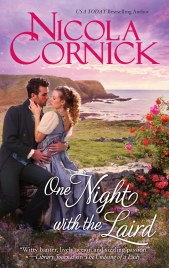
One Night with the Laird - US copyYou are an enthusiastic traveller on a world-wide scale, but for your latest series you have headed north of the border and changed period for The Lady and the LairdOne Night with the Laird out this month and the final book Claimed by the Laird, which will be published next year. What triggered this change in location and direction?

I do love travelling and have been lucky enough to visit some amazing places all around the globe. One of my favourite places, though, is Scotland and I have wanted to set a book there for years. It was fascinating to research Scotland in the early 19th century and see the similarities and differences in politics and culture compared with south of the border. It was huge fun to write the Scottish Brides trilogy!

What is next for Nicola?

I have lots of exciting plans for next year.  There are several new Regency ideas I’m going to be working on, plus a book inspired by Ashdown House!

Thank you for taking the time to answer my questions and for sharing some of your unique experiences with us.

Thank you!
More by Nicola:

An interview with Trisha Ashley

267398_163150827092202_2914025_nI am excited to welcome the lovely Trisha Ashley, an award-winning and best-selling author of humorous romantic fiction. 
How much have your entertaining novels been influenced by your own studies, hobbies and work experience?

There are elements of my interests and experiences woven in all of them, of course, but like most novelists I tend to use turning points and situations in my own life as jumping off points to explore new directions my characters can take – because after all, they’re not me and they would do things very differently.  They constantly surprise me.

      There is, of course, rather a lot about food in my books and all the research has taken its toll on my figure – but then, you have to suffer for your art.   I also love animals and gardens – especially roses – and often, too, my novels reveal the enduring power of good friendships and the supporting love of families, however dysfunctional they may at first appear.

      I’ve had a series of part time jobs over the years to support my writing and I think probably the seasonal work for the National Trust was the most useful.  For a few years I spent six days a week either in the draughty front hall of a large gloomy mansion, or in a little wooden hut at the entrance to the lovely Bodnant Garden in North Wales.  Now, those gardens were really inspiring and I was lucky enough to be there when a new young (and handsome) head gardener, Troy Scott Smith, had just taken over and was slowly revitalising it.  I think you can date my passions for roses, mazes and knot gardens to this time…

      But all of life’s experiences, good or bad, can be composted down and used to grow something fresh and new: nothing need be wasted.

When did the Muse enter your life? I hope he gets on with Dog.

I don’t think I can do better than to quote the update I put at the top of my quarterly newsletters for new subscribers:

      The plot so far: Except when she is occasionally let out to enjoy a couple of days of frenetic partying in London, or to give a talk, Trisha lives in beautiful North Wales, together with the neurotic Border Collie foisted onto her by her student son and an equally neurotic but also vain, bad-tempered and chancy Muse.  Muse, whose first name is Lucifer, slipped into her head and took up residence while she was reading Paradise Lost at school and refuses to leave.  He is male, steely-blue, wears a lot of leather, is winged, has talons (so that’s where her blue nail varnish went, then) and is devilishly handsome, if you like that kind of thing.  He only eats words, but gets through a lot of Leather Food and Trisha is starting to suspect that he does more with it than just rub it into his wings…

     Lately, Muse has been writing a hiss-and-tell account of his life with Trisha, called The Muse Report, though due to the fact that he eats his words almost as fast as he writes them, it could be quite some time before this appears in print.

      Muse takes little notice of Dog, except to eye the name tag on his collar when hungry…

Meeting your agent, Judith Murdoch, was a major turning point in your career.  What key advice would you offer to, as yet, unpublished authors?

There’s too much temptation now to rush out your first novel yourself as an e-book, so if you take that route I’d advise you to have your novel independently edited, and consider the constructive criticism you receive very carefully.  You want your novel to be perfect and whole, not some poor, half-formed creature, and with a first novel you aren’t going to spot what’s wrong with it yourself.

      If you’re lucky enough to be taken on by an agent or publisher, of course, they will tell you what’s wrong with it and being able to accept and work with constructive criticism is something you need to embrace if you’re taking writing seriously.

Are you a very planned and disciplined writer, plotting an outline in advance or do you start with a scene, character or situation and go from there?

I am character driven and, since I write in first person, must get to understand my heroine and her background first. Then I put her into a situation and see where she goes, and the book unrolls before me as I write like a magic carpet.  I don’t know where we’re going until we get there.

You have achieved success as a writer despite having macular degeneration. For those unfamiliar with the condition, would you  please share with us how you have worked around this?

 I have had myopic macular degeneration and very poor eyesight (minus 20) for many years, but the MD has been getting increasingly worse recently.  Macular degeneration means that blind patches increasingly appear on your retina and although I automatically focus around them, when tired that gets harder to do and my vision generally blurs.

      I have little night sight either, so tend to fall off kerbs etc and have been known to try and flag down any dark and vaguely taxi-shaped vehicle in London at night…

      There’s currently no treatment for my kind of MD and I’m supposed to take regular breaks from the computer screen…

      I am exploring new ways of writing at the moment in case I ever get to the point where I can’t see the screen at all, but this isn’t easy since I’ve been touch typing my books since I was fifteen and made the transition to word processors and then computers as soon as they appeared.

      At the moment, I write on screen in large print, but still have lots of room to increase the font size if necessary, so it’s okay.  I print everything out to work on.  But then, I’ve always needed to see my words on paper before they become real.

Please tell us about your new novel?

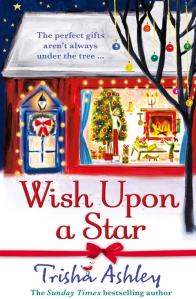
Wish Upon a Star jacketWish Upon a Star will be released on November 7th and has a Sticklepond setting, the village in West Lancashire where some of my other books are set.  It’s very much about following your star, wherever it may lead you and however hard the going gets.

    Single mum Cally’s life revolves around her little girl, Stella, who has serious health problems and when her condition suddenly worsens, they move in with her mother in the remote village of Sticklepond, while she tries to raise enough money to take Stella to America for a potentially life-saving operation.

      Cally only realises quite how tough it’s been shouldering everything alone when all the villagers – and especially laid-back and charming baker Jago – rally round to help.  All Cally wants for Christmas is a miracle to save Stella and with Jago’s help she may yet discover that all the best presents aren’t always found under the Christmas tree…

What is next for Trisha Ashley?

      I’m very happy to say that next year Avon will be doing a new edition of one of my long out of print novels, Every Woman for Herself.  I know you shouldn’t have favourites among your children, but I have to admit that this book is the closest to my heart.  It’s set in Yorkshire, where the Rhymer family, Emily, Charlotte, Anne and Branwell (the result of a failed attempt by their father to recreate the Bronte family situation) slowly return home, one by one to the haven of Upvale – only to find that things are about to change, forever.

      Every Woman for Herself was voted one of the three best romantic novels of the last fifty years in a reader poll, which was a truly wonderful moment, and I’m constantly being asked by readers where they can buy a copy, so I’m delighted it will soon be out again in paperback and e-book formats.  I’m adding a couple of new recipes to the end, too and it will also, of course, have a lovely new cover.

Thank you so much for having me on the blog, Valerie, and I wish everyone lots of very happy reading!

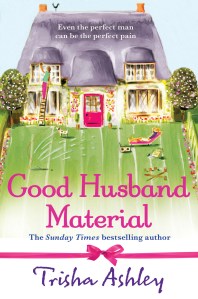
Good husband material high resMore by Trisha:

Another warm, wise and witty offering from Sunday Times bestseller Trisha Ashley.

James is everything Tish has ever wanted in a husband – she’s married a man who even her mother approves of. He’s handsome, dependable, and will make an excellent father – unlike Tish’s first love, the disreputable Fergal. Her teenage sweetheart abandoned her for a music career and now lives a typical celebrity lifestyle. Fergal broke her heart – James helped mend it.

Now, they’ve bought a cottage in the country. The next step – kids and a lifetime of domestic bliss. Well, that’s the plan. And even if James has a slight tendency to view the village pub as a second home, their relationship is still in pretty good shape after seven years of marriage. So why is marriage to Mr Right making her long for Mr Wrong?

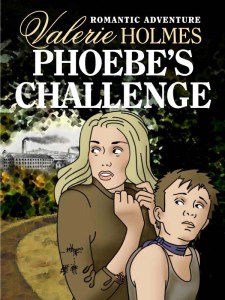
Phoebe’s Challenge

Phoebe's Challenge KEC (1)

Buy and read now!

US Readers: Kindle / iTunes / Nook

UK Readers: Kindle / iTunes / Nook

Early nineteenth century North Yorkshire, England.

Phoebe and her brother, Thomas, have to flee the evil regime of overseer Benjamin Bladderwell because an accident results in them being labelled machine breakers. Hunted with nowhere to run, the mysterious wagon driver, Matthew, his them and saves their lives. They soon discover that he is a man of many guises who Phoebe instinctively trusts, but Thomas does not. Their future depends upon this stranger, on their own they will be captured or starve. Phoebe must trust or challenge Matthew unaware that he is also tied to their past.

An interview with Bill Spence, a.k.a. Jessica Blair

090

This month’s guest is both prolific and successful saga author, Bill Spence a.k.a. Jessica Blair.

You have such a broad spectrum of life experience on which to draw: from teacher training, to Bomb Aimer in the RAF, to journalist. What triggered your initial venture into fiction?

Brought up among books and magazines; encouraged to read from an early age,  I think, unknown to me, stimulated in me a desire to write.  On leaving the RAF in 1946, I wrote a few articles but I always had the desire to write a book. Liking fact and liking fiction I thought I would write a novel based on my experiences as a Bomb Aimer during the war. I really wrote it  for my own satisfaction. I had no idea of the publishing world at that time. After a chance sighting of a short piece in a local evening newspaper, saying a paperback company was looking for war novels, I thought I might as well send mine. They offered a contract to publish (1959) which of course, knocked me sideways and made me think what do I do next. I had always been interested in the West, knew a lot about its history and had read numerous Westerns, so I wrote one! That eventually landed on John Hale’s desk and he offered to publish (1960)  36 followed, the last in 1993. During that time I also wrote two more War novels. A Romance and 3 non-fiction books about aspects of Yorkshire and had become interested in the history of whaling.

Jessica Blair was a pseudonym created in 1993. Why did you switch both genre and gender at this point in your career?

070The study of the history of whaling over a considerable period of time resulted in Harpooned – the Story of Whaling being published in 1980. It was highly illustrated and writing it and gathering the illustrations was a very interesting experience. I decided I would use the knowledge I had gained as background to fiction. The result was the first Jessica Blair novel, The Red Shawl. (1993) It was submitted under my own name but the publisher, Piatkus, who offered me a contract, wanted to publish it under a female name and suggested Jessica Blair.  The reason, I believe, was all to do with marketing.  It has paid off for me — the twenty-third  Jessica Blair novel will appear early next year.

Whitby is a pivotal town in Jessica Blair’s novels. How and when did your interest in this beautiful northern seaside town begin?

Whitby was an important whaling port in the 18th and 19th centuries and this was the background I used for The Red Shawl. Whaling does appear in other Jessica Blair novels but not in everyone.  I knew Whitby from my school days and then after the war. I realized there was a wealth of stories there, throughout its history and into recent times and I am fortunate to be able to absorb the atmosphere of the times I use.

WHITBY GIRL FINALEvery author has their own preferred method of working. For the benefit of aspiring writers would you share yours with us?
I look into a background I would like to use. I place my main female and male characters against that background and ask myself, ‘What if …?’ That question will keep recurring as the book develops. I work from a brief outline and sample three chapters. If my publisher, Piatkus, like those and the idea behind them they will issue a contract – then my computer gets working over-time ! I cannot work to a detailed outline because at that stage there are aspects of the story I know nothing about. Characters react to circumstances, and to each other – so the story develops as those change.

During your extensive research you must have come across some fascinating local characters. Do you ever use real people within your novels or are they all fictitious?

Yes I have met many interesting characters throughout life and whilst they might stimulate ideas I don’t use real people in my novels.

Of all your published work do you have a ‘favourite child’ or is it impossible to choose?

Probably The Red Shawl; it led me much deeper into the worlds of writing and publishing and extended a fascinating life. I must say that my first Western led me to meet my first other writer and that brought a long friendship.

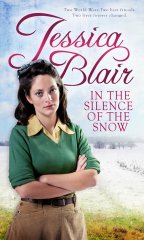
InTheSilenceOfSnow_DemyHB_9780749956295_LRRecent releases have been The Road Beneath Me and In The Silence Of The Snow. Could you tell us something of your upcoming novel, A Tapestry of Dreams, to be released in 2014?

A Tapestry of Dreams is based in the West Riding of Yorkshire (woollen industry) and the Lincolnshire countryside (sheep farming). Set in the 1850s these were the backgrounds against which I placed my two leading characters and asked myself ‘What if?’

What project are you working on next?

That has yet to be decided wit h my publisher, Piatkus.  Ideas are out there but I don’t want to mention them yet as I don’t know what road they will take.

Many thanks for your time in answering my questions and sharing your career with us.

More by Bill:

An interview with Jo Beverley

001I am both delighted and privileged to welcome award winning international romance author Jo Beverley as my guest this month. Jo is a member of the Romance Writers of America Hall of Fame and has been described as:-
Arguably today’s most skilful writer of intelligent historical romance.”
Publisher’s Weekly

“One of the great names of the genre.”
Romantic Times.

When and where did your passion for writing begin?

Too early to remember! I used to make up stories when I was very young — mostly about horses — but when I was about sixteen I wrote a historical romance in a school exercise book. I still have it! Not good at all, but it showed promise.

You have written books set in Medieval, Regency and Georgian times, but what was it that triggered your love of these particular periods?

That teenage effort was medieval, and I’ve always had a love of that period. Though it wasn’t as grim as sometimes portrayed, it was life on the edge that demanded strength and resilience from anyone who was to survive. My other two periods, Georgian and Regency, owe a lot to Georgette Heyer. I loved her books as a teenager and reread them many times. I truly wanted to be her when I grew up, which meant to me, giving the same sort of reading pleasure. Heyer’s influence led me to Regency, which was where I was first published, but I always had a yen for the Georgian age, with the fabulous costumes, especially the men’s. I love manly men in silk and lace. So totally cool.

Your period research is impeccable, however, you keep the hero and heroine attractive and the dialogue accessible, giving a flavour that it is true to the period. How carefully do you have to balance historical accuracy against modern taste to keep the appeal to a contemporary readership?

It can be tricky, especially as my readership covers a broad range from scholars to those who want the story and don’t much care about dates and details. Mostly I try to know as much as possible and use only what I need, letting the story rule. However, many stories are based on realities, so what I know shapes the stories! I certainly try to avoid info-dumps, but I usually include an author’s note at the end for those readers who are interested in the background. For example, the author’s note to Seduction in Silk includes details about a famous stone carver of the time, because marble memorials play a part.

I also try to avoid archaic language because I don’t much like to read it. I use “time neutral” language, which means avoiding both obviously modern language and archaic. If it works, the reader should enjoy the book without noticing.

You have been quoted as saying you do not get along with ‘stupid heroines’. How do you study the social attitudes of the period to avoid applying modern values to a heroine’s outlook on life?

Awareness of the social attitudes comes along with knowing the period, because I try to read primary sources — ones written at the time. That gives a pretty good feel for how people felt and thought. The good thing is there’s quite a range, just as there is now. We can have realistic heroines who don’t create waves. We can also have eccentric ones, rebellious ones, and downright weird ones, but then we  can have everyone around them thinking they are wonderful. That’s unrealistic, then and now.

Stupid is a whole other matter. For me, it’s no fun to spend time with a character who keeps saying and doing bubble-headed things, especially if they’re creating pain and problems for others and don’t care. Another type of character who doesn’t work for me is the selfish one, the one who reckons if they want it they should have it regardless.

Each author has their own favoured way of working – would you share yours with us?

Firstly, I “fly into the mist.” This means that I don’t pre-plot my books. I get an idea for characters and situation and start writing to see where it goes. It might be easier to plot out my books and know where I’m going, but that doesn’t work for me.

I write on the computer and rarely print work out along the way, though I generally do print it out about half way to read through, and then at the end before the final edit. Reading in print does throw up interesting things. I do these printouts in faux galley style. This means landscape, two columns and justified, so it ends up looking like the pages of a book. That helps, too.

I start writing early in the morning and continue until lunch because this is my most creative time. Sometimes I do edits and research in the afternoon and evening, but I rarely do first draft writing then.

However, there’s no rule to this, for me or anyone else. Each writer needs to find her own way, and for new writers that usually means trying many ways, some of them crazy. You never know! I do believe that we know it when we find it.

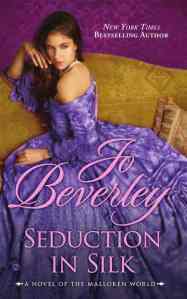
This month sees the release of Seduction in Silk another story from the Malloren world. Could you tell us what triggered the idea and motivation behind this latest novel?

I wanted to write about Perry Perriam. He appeared in An Unlikely Countess as the hero’s friend, and in A Scandalous Countess as the heroine’s brother, and readers asked for his story. I was happy to oblige, because I like him a lot. He’s not titled, but he is aristocratic — he’s the younger son of an earl. He’s very bright and very charming, and earns his living by using his talents in London, at court, in politics, and in society.

London — or rather Town, as fashionable London was called — is his life, so he’s not pleased when a distant relative names him heir to Perriam Manor, with the condition that he marry Claris Mallow, a clergyman’s daughter, within the month. Perry doesn’t give a penny for the manor, but getting it back is an obsession of his father’s, so he has no choice. He doesn’t think it will be difficult, especially when he learns that Claris is impoverished and raising two young brothers. He’ll marry her, install her and her family at the manor with free use of the income from it, and get back to his life.

Claris, however, has survived her parent’s tormented marriage and has no intention of marrying anyone, least of all an elegant stranger who assumes she’ll fall at his feet! She chases him off at pistol point. And thus their dance begins.

Readers can enjoy a free sample here.

002

Romantic Times has made Seduction in Silk a Top Pick for August.

With her talent for writing powerful love stories and masterful plotting, Beverley delivers the latest addition to her Malloren World series… emotional, sensual and highly satisfying historical romance.

What project are you working on next?

I’ve returned to the Regency, to the Company of Rogues, to pick up the story of David Kerslake, the heroine’s brother from The Dragon’s Bride. That book left him both the Earl of Wyvern and the leader of the local smuggling gang, The Dragon’s Horde. To make matters worse, both the earldom and the smuggling band are broke. He has to marry money, and Lucinda Potter, only child of a wealthy City of London merchant seems the ideal choice.

Lucy has other ideas, but then, David is a fascinating handsome man and the more she comes to know him, the more fascinating he becomes. However, it also becomes clear that he has secrets, possible dark and dangerous ones. She’s far too sensible to give herself and her money to such a man. She hopes.

This novel is called A Shocking Delight, and it will be out in April 2014.

Many thanks for your time in answering my questions and sharing some insight into your vast experience.

More by Jo:

An interview with Pia Fenton, a.k.a. Christina Courtenay

ChristinaCourtenayMarch2013I am delighted to welcome award-winning author and new chair of the Romantic Novelists’ Association, Pia Fenton, who writes as Christina Courtenay.
Congratulations on becoming the chair of the RNA. How much of an influence has the RNA had on your own career?
I think it’s safe to say that without the RNA I wouldn’t be published at all!  I found my way to the association at a time when I was about to give up on writing and it changed everything for me.  When I sent in my first m/s to the New Writers’ Scheme and got a critique back from someone who took my writing seriously and liked what I’d done, it was an amazing feeling.  And although there was a lot wrong with that first novel, I was basically on the right track and needed to be told what my mistakes were, so that was really helpful.  The other thing the RNA has done for me is give me wonderful writing friends and critique partners – I can never thank them enough!

Childhood is a time when imaginations really develop. Do you think that yours influenced your writing style and interests?

 Yes, absolutely.  I was hooked on fairy tales with handsome princes and happy ever afters and that’s what I want now too, albeit a grown up version.  I was also always interested in history, so for me writing historicals was inevitable.

Would you agree that your work reflects your unique cross-cultural experience?

I think so, yes, as most of my books feature heroes and heroines from different cultures who have to overcome their differences and realise that we are all the same underneath.  Also that no one culture is necessarily right about everything, we have to compromise.  Being half Swedish and half English I can see things from two sides, and having lived abroad has given me a different perspective on things as well.

Could you give us an insight into your own preferred way of working when you set out on a new novel adventure?

It’s a bit messy I’m afraid!  It usually starts with a scene that appears in my head, often triggered by something or someone (a handsome actor?) and then the rest of the story develops from there.  That scene can be anywhere in the book, so sometimes I work backwards, sometimes forwards.  As I said, it’s a bit chaotic but somehow it always works out in the end!  And incidentally, I always know how I want it to end, even if I don’t know anything else.

In August your first YA novel is published by Choc Lit. Could you tell us about it and if this is a permanent change of direction for you?

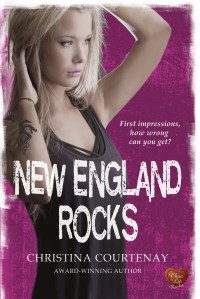
As I’d been writing historicals for many years, with all the research that entails, I decided to give myself permission to write something else just for fun last year.  The result was a contemporary YA book that needed no research and reflected the sort of high school experience I would have liked to have had myself.  Here is the blurb for New England Rocks:-

NER FrontFirst impressions, how wrong can you get?

When Rain Mackenzie is expelled from her British boarding school, she can’t believe her bad luck. Not only is she forced to move to New England, USA, she’s also sent to the local high school, as a punishment.
Rain makes it her mission to dislike everything about Northbrooke High, but what she doesn’t bank on is meeting Jesse Devlin…
Jesse is the hottest guy Rain’s ever seen and he plays guitar in an awesome rock band!
There’s just one small problem …  Jesse already has a girlfriend, little miss perfect Amber Lawrence, who looks set to cause trouble as Rain and Jesse grow closer.
But, what does it matter? New England sucks anyway, and Rain doesn’t plan on sticking around…
Does she?

I hadn’t intended to send it to my publisher, but eventually I did and Choc Lit decided they wanted to start a YA line, which was great!  I’ve since allowed myself some more time off from the historicals, so this is the first in a series.  The second one will hopefully be out next year.  But I’ll still be writing historicals and time slips as well.

What is next for Christina Courtenay?

I’ve just finished writing the third book in the Kinross trilogy, Monsoon Mists.  It’s gone off to Choc Lit to see if it passes muster, so now I can concentrate on something else for a while.  In February next year I have another time slip novel coming out, The Secret Kiss of Darkness – I love time slips, so am very excited about that – and as I said, after that hopefully number two in the YA series.

Sincerest thanks for taking the time to complete this interview.

Thank you very much for inviting me!

More by Christina:

  • New England Rocks, paperback out on 7th August:-

An interview with Henriette Gyland

Author photo - HNS Conference 2012, v2 - cropped (1)I have the pleasure of welcoming novelist Henriette Gyland as my guest of the month. Her second novel, The Elephant Girl is due to be published on the 7th July 2013. 

I read in a recent interview that you have an ‘ideas box’. How and when did this begin?

I’ve had this box for years. I used to toss anything in there – newspaper clippings, notes from talks, overheard conversations etc. Even conversations I’d “heard” in my own head. I then discovered that I had real problems deciphering my own reasons for keeping a particular item and ended up throwing stuff away. Now I carefully date the note or clipping, and scribble my reasons in the margin, whether it’s a short story idea or an idea for a longer piece. I also bundle notes together if they relate to the same idea or theme. So there’s a certain method now to what used to be just madness!

How would you describe your work?

Some genres are easier to pin down than others, but mine is tricky because it straddles two of them – crime and romance. Romantic suspense or romance mystery explains it quite well, but I also add a hefty dose of difficult family or personal issues, social topics, political comment. The Elephant Girl is a very loose reworking of Cinderella, which is a fairy tale with a LOT of family stuff going on in it!

What has been your proudest or most memorable moment of your career to date?

There have been a few – being awarded the Katie Fforde Bursary, winning the New Talent Award at the Festival of Romance – but I think the absolute proudest moment to date was when my first novel Up Close was heralded as “Nora Roberts territory” by Sarah Broadhurst in The Bookseller. I’m a huge fan of Nora Roberts, so this was really the best kind of compliment.

I love the cover design of The Elephant Girl. What inspired the idea for this intriguing novel? Did it start by rummaging through your ideas box?

9781781890202

The idea is based on a real-life horrific murder, witnessed by the victim’s young child, and also the old maxim that elephants never forget anything, hence the title. The pendant on the cover is one the main character, Helen, inherits from her dead mother. This story didn’t come from the Ideas Box because I wrote it very shortly after the real crime had happened, and although in some ways I feel a bit strange about creating a story out of another person’s tragedy, I think as writers we just can’t help ourselves sometimes.

Is there one piece of advice that you were given as a new writer which you consider helped you to make the breakthrough as a writer?

When I met the lovely Katie Fforde, about ten years ago, she told me to “keep the faith”. And I she was right. Perseverance and the belief that one day you will get published is the only way to survive the numerous rejections leading up to it.

What do you choose to read to relax?

I’ve just finished Scarlet, the second in a series by Marissa Meyer and now have to wait until 2014 for the next one (sigh). I’m also hoping that C J Sansom will write another Tudor mystery novel in his Shardlake series, but in the meantime I’ve started reading Blackout by my favourite writer, the American sci-fi author Connie Willis. As always, I find every sentence of hers a genuine delight.

What is next for Henriette?

THD_front4 - shaded eyesMy next novel is a complete departure from anything I’ve written so far. It’s a swash-buckling historical tale set in the Georgian period, with highwaymen, a spirited heroine, and a mystery at its core. Well, mystery is my trademark, isn’t it?

My thanks for being my guest. I wish you every further success with your fascinating novels.

More by Henriette:

An interview with Jean Fullerton

June 2013 Web 1Welcome, Jean!

In 2006 you won the Harry Bowling Prize. How much of an impact upon your writing career did this have?

I can’t even begin to tell you how much winning the Harry Bowling changed my life and writing career. It was my big break. It got me my lovely agent Laura and my first two book contract with Orion. It literally changed everything.

Your love and passion for the history of the East End of London is obvious through your work. Growing up in the shadow of The Tower of London must have been amazing, when did the inspiration come to you to create stories within this setting?

I absolutely adore my birth place of East London and use real places and have my characters walking past actual shops and houses if I can. My family have lived in and around the Hawksmoor church of St George’s in the East since the 1820s. I have drawn on my family heritage for my stories, such as the local charity school, public houses and market. I even had my first heroine Ellen O’Casey living in the old house I lived in as a child.

Do you always create the characters and place them in the accurate historical setting, or do you also use real life personal histories as a basis for them?

I am passionate about historical accuracy and do put my characters in the right time and place. I don’t push the edges of history and so if there weren’t steam boats on the Thames until 1842 then I won’t put one in a story set in 1840.

What is your favourite period of history to read or write about?

My life-long love of all things historical started when I was about 5 or 6 and a very young Roger Moore rode on to our 10 inch black and white TV screen as Ivanhoe. This love grew to fruition when I read Katherine by Anna Seton as a teenager. I love all areas of European history and before settling on East London as my place to weave stories I wrote books set in 10th century Wales, 13th century Scotland, during Hereward the Wake’s rebellion in the Fenlands, in Boston just before the American War of Independence and in the Caribbean during the ages of piracy.

I’m still an avid historical reader and as long as the story is historically accurate and pulls me in I’m happy to read any period. I’m also very fond of alternative histories i.e. what would have happened if Harold had won the Battle of Hastings?

You work very hard as a full-time lecturer as well as a writer. Does this affect the way in which you work? Do you plot ahead and schedule, or still let the story evolve on the page/computer screen?

The only way my full-time job really impacts on my writing is that I have to write in the evenings and at weekends. I do plot out my work on a grid as you can see from the first chapter of Call Nurse Millie below. With so many subplots in my books I find it easy to keep track of characters by plotting out the story. I even colour code the scenes on a grid with a particular colour for some characters to ensure I keep an eye on how often they appear.

Scene Events date
1 VE day Millie delivers a baby as street prepares for a Victory party. blancmange pilchards 8/5/45
2 Gets back & has to take over as the superintendent is drunk.
3 Argues with one of the nurses. Phone rings to say her father’s ill
4 At her father’s bedside with her mother as peace is announced. Churchill spoke at 3pm
5 Calls her Aunt Ruby. King at 9pm?
6 Ch2 Goes back to work and meets her friend Connie

Of course, it’s not written in stone and it changes as I go along but it helps keep me on track. It’s very easy to get lost in a 140,000 word novel. Even your own!

I also have a work schedule on which I mark dates when I should have reached a certain point of the story. I usually start writing for a February deadline after Easter with an aim to finish before Christmas. Of course it doesn’t always work out that way but so far the system has helped me hit my deadline with a week or two to spare.

You are an inspiration to many, overcoming dyslexia to become an author. Have you any advice you could give as to how you determinedly set about achieving this goal?

I’m quite happy having dyslexia as I feel it is one of the components of my creativity. If you’re dyslexic at college or work there has to be provision made for you. There’s no such arrangements are in place in publishing. You just have to work very hard and get professional to edit your work.

The aim for any unpublished writer is to get off the slush pile and to do this your submission to an agent or editor must be word perfect. I would advise anyone who has dyslexia to have their manuscript professionally copy edited. And note that doesn’t mean your friend who’s better than you at English. I know it costs money but it is an investment. I actually did a night duty in a care home each month to fund my copy edits.

As a fellow graduate of the RNA’s New Writers’ Scheme I still remember some of the advice that I was given whilst being an unpublished author. What advice do you consider helped you to make the breakthrough into print?

Firstly, if it took me three years to become a nurse, another two to qualify as a district nurse and a further three to become a lecturer, why on earth would I think I could learn the craft of writing overnight?  Very few first books are of a publishable standard. Mine wasn’t. Learn your craft!

Write what you love. If you’re chasing a bandwagon by the time you’ve jumped on its left town.

And persevere. Getting published is a long, hard road but you’ll never achieve it unless you stick with it.

Click to view this book on Amazon.co.uk

Susan Lamb, the Head of Fiction at Orion books asked me to write this book. Orion publishes Call the Midwife along with Jennifer Worth’s other three books. Susan thought as I’m a District and Queen’s Nurse and an East Ender I would be the perfect person to write a fictitious account of a District Nurse and Midwife’s life and work in post-war East London.

I was apprehensive at first but my wonderful editorial team were so sure I could bring the duel strands of my background and profession together in Millie’s story I decided to give it a go. I’m so glad I did because I had a wonderful time researching my own profession and creating Millie’s family, friends and patients.

I started Millie’s story on VE day May 1945. As the troops begin to return home we see the inhabitants of London attempt to put their lives back together.

For 25-year-old Millie, a qualified nurse and midwife, the jubilation at the end of the war is short-lived as she tends to the needs of the East End community around her. But while Millie witnesses tragedy and brutality in her job, she also finds strength and kindness. And when misfortune befalls her own family, it is the enduring spirit of the community that shows Millie that even the toughest of circumstances can be overcome.

Through Millie’s eyes, we see the harsh realities and unexpected joys in the lives of the patients she treats, as well as the camaraderie that is forged with the fellow nurses that she lives with. Filled with unforgettable characters and moving personal stories, this vividly brings to life the colourful world of post-war East London.

What is next for Jean Fullerton?

Well hopefully a new contract very soon for Millie’s friend and fellow nurse, Connie Byrne’s story set this time in and around Spitalfields and Shoreditch again in the immediate post-war period. Then who knows? I have dozens of stories in my head that I’d like to write so that should keep me out of trouble for a good while yet.

Thanks for such very good questions, Val, and giving me the chance to tell people about my writing life.

More by Jean: