An Interview with Peter Lovesey

DSC_2534Thank you for taking the time to discuss your fascinating career and share some of your experiences with us.

Your love of the English language shines through the quality of your work and the complexity of the plots you weave through your books. When did your love of storytelling begin?

I was a dreadful fibber as a child, so it must have been there from the start. I led a Walter Mitty existence, top of the class, popular, brilliant at games and with a girlfriend called Dahlia, the prettiest in school. None of it was true and Dahlia didn’t even exist. From there it was a smooth progression to making up stories for what was then called composition.

You also had a keen interest in sport which led to your first breakthrough as an author. Can you describe how this came about and if it is still one of your proudest moments?

At twelve I was taken to the post-war Olympic Games in London. There’s a lot of talk about legacy from the recent Olympics and for me the 1948 Games were a rich legacy indeed. I was hopeless at sport but desperately wanted to be a part of it, so I wrote about it, doing unpaid articles for small magazines. Out of it eventually came a book on distance running and then two years later, using distance running as a background, I entered a competition for a first crime novel. Wobble to Death won me £1000 and publication in England and America. A dream start to my career.

Stone Wife (2)From your initial breakthrough, how did you then go on to develop the successful series of Sergeant Cribb and Peter Diamond?

Cribb was the Victorian detective I created to clear up the mystery in that first novel and he went on to seven more, using Victorian entertainments such as boxing, the music hall, boating, spiritualism and Madame Tussaud’s as the backgrounds to whodunits. The eighth, called Waxwork, won the CWA Silver Dagger and was turned into a pilot for a TV series, made by Granada, starring Alan Dobie as Cribb.  Two series followed, based on the books and original scripts written together with my wife Jax.

The more recent series features a contemporary police detective called Peter Diamond, who is with Bath CID. The first book was going to be a one-off, called The Last Detective, and he resigned from the police. But it won the Anthony for best novel at the Toronto Bouchercon and I was asked to follow it up. So I contrived a story called The Summons in which the police needed him back and were forced to ask him to return and reinvestigate an old case. He’s been going ever since. The fourteenth, called The Stone Wife, is published this spring.

In which era do you prefer setting your novels – historical or contemporary, and why?

I wouldn’t say I have a preference. I enjoy the challenges of each. The Victorian period had a rich, rather daunting tradition to work in, thinking of Dickens, Wilkie Collins and Conan Doyle, and the task was to avoid a pale pastiche of those great writers. The research was enjoyable, mainly using the British Library newspaper library. Today, with the internet, it would be quicker and easier. Turning to the contemporary police novel was scary, too. I wasn’t sure how I would cope with modern policing and the huge advances in forensic science, so I made Diamond a bit of a dinosaur. I get a lot of pleasure from using little known historical anecdotes in these modern books. Examples are Jane Austen’s shoplifting Aunt Jane and Mary Shelley’s writing of Frankenstein in lodgings right next to Bath Abbey.

You have had work both televised and filmed. When this happens, do you become involved in the process and maintain control of what the producers can change?

I doubt if any producer allows the author control. They do take liberties and will tell you it’s necessary in visual terms. But I was lucky enough to attend read-throughs of the Cribb series and of Rosemary & Thyme, as the consultant. I was fortunate, too, that the adaptations of my books kept pretty faithfully to the plots – and that includes the movie Goldengirl and the TV drama Dead Gorgeous.

Do you write stand alone novels to have a break from the series, as a kind of refresher?

Yes, it’s fun to break out from time to time. I’ve written several from the point of view of the killer – and that’s very liberating. The False Inspector Dew won the Gold Dagger  and has been translated into more than twenty-five languages, but the one I’m proudest of is The Reaper, a black comedy about a rector called Otis Joy, who murders the bishop in chapter one.

Every writer has their own way of working. Do you plot in detail first and then set wordage targets, or do you let the story grow as it builds on the page?

When I started I would plan meticulously and write the synopsis before beginning Chapter One. I don’t write in drafts. The pages I write each day aren’t altered, except in minor ways, so it’s a slow process. If I tell you how few words I manage in a day you won’t believe me. It has to be right before I can move on. These days I carry much more of the plot in my head, but it’s basically all there. It’s not a method I would recommend to anyone.

I first met you when you did a local library talk, which was both interesting and inspiring. Do you intend to tour again in 2014?

If I’m asked, yes. I’ve done several recent US tours, visiting cities I wouldn’t ever have known otherwise. And it’s lovely to meet readers who enjoy the books. Plus, of course, the occasional writer such as you – and that’s a bonus.

Thanks, Peter! Of all the accolades and achievements you have received in your career to date, which one(s) stand out as something very special to you?

Difficult. The CWA Cartier Diamond Dagger in 2000 was a great honour, but couldn’t quite match the thrill of that first competition win with Wobble to Death. Another unforgettable moment came when I was Chair of the CWA and presented the Diamond Dagger to one of my early inspirations, Leslie Charteris, the creator of The Saint.

The Tooth TattooThe Tooth Tattoo also shows that you have a love and understanding of classical music. The humour within the book works on many levels, which balances the much darker twists of the plot. What inspired this book?

I can answer this with more certainty than any of your questions. A 2004 article in the arts section of the Guardian by David Waterman had this intriguing headline: HOW DO THE MEMBERS OF A STRING QUARTET PLAY TOGETHER AND TOUR TOGETHER YEAR IN, YEAR OUT, WITHOUT KILLING EACH OTHER? The piece stayed in my mind for eight years until I was ready for Peter Diamond to investigate. I’m glad to say The Tooth Tattoo was well received, not least by the writer of the article, who still plays with the Endellion quartet. And it’s just out as a February paperback.

What is next for Peter?

The fourteenth Diamond novel, The Stone Wife, will be in the shops in April and I’m halfway through the one I’m currently calling Diamond Fifteen. Thanks, Valerie, for this stimulating interview.

My sincerest thanks for taking the time to answer my questions. 

Meet the talent behind Valerie Holmes eBook covers, Jan Marshall!

jan_in_hat_picI am delighted to share an interview with Jan Marshall, the talented book-designer who has created the Valerie Holmes eBook covers.
What inspired you to become a graphic designer?

First of all, Val, thank you for inviting me to take part in this interview; I’m so flattered you asked me.

I suppose the simple answer to your question is I didn’t really do much choosing; graphic design rather chose me. Creative pursuits – mainly drawing with a pencil – had always been in my blood. So, all I had to do was pin down a way of converting my creative obsession into a way of making a living, and graphics was my answer.

You have a vast experience within the industry. How did you learn the job?

Art college was a great starting point, and I’d recommend it to anyone embarking on a career in the business – it taught me how to ‘think’ like a designer – but, like learning to drive, as soon as your training’s over, although you’re qualified, you’re not necessarily good at it yet. My first job, in an ad agency, made me aware of gaps in my art college education – mainly technical skills. So I spent some years in the typesetting and pre-press industry, where I absorbed essential hands-on skills, some of which I still use today: typography, artwork, hand-lettering, proofreading. Learning doesn’t ever end of course; especially since the advent of computers and rapidly changing software, designers’ skills must constantly be reinforced and updated.

What have been your personal highlights so far?

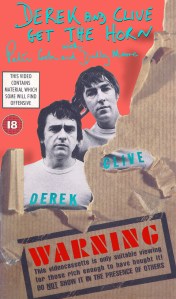
Derek & Clive cover pinkThe most rewarding time in my career has to be the ten years I spent immersed in the world of movies, creating designed materials for mainly Universal and Paramount films, ranging from huge outdoor posters to video covers and film-based interactive teaching aids for schools. I was privileged (and extremely proud) to work on movies as diverse as: Babe, The Rugrats Movie, Apollo 13, the three Pierce Brosnan Bond movies, The Addams Family Values; Dragonheart, Twister, Twelve Monkeys, and The Mummy. On a more personal note, another highlight came in the shape of a short thank you message. It was from the late, truly adorable Peter Cook, who, having briefed the job to the team in a safari suit and pith helmet, later described my design for the ‘Derek & Clive Get The Horn’ video sleeve as: “…the best I have ever seen on a video pack. I cannot tell you how thrilled I am”. I was thrilled too.
If I may, I’d like to give credit here to the rest of the talented design team from those days, especially the lovely Lizy Thompson, my hard-working right-hand woman and loyal friend.

 Of the various styles and techniques you use, which is your favourite?

The movie work taught me how to use photoshop to comp images and type in intricate detail – large media can be unforgiving of less than perfect retouching; a tiny error on screen can be seen at ten feet tall on a supersite poster! And that attention to detail has stayed with me; I get a great deal of enjoyment out of combining images and type to make tight, detailed book covers.

What is the technique used for the beautiful Valerie Holmes ebook covers?

Thank you for your lovely compliment, Val. When we embarked on this big project – to repackage more than 30 titles plus some new stories – we decided between us that, for speed, economy and ease, it would be best to ‘keep it simple’.

Your covers are incredibly enjoyable to illustrate, not least because, in the same way that characters in a novel seem to take on their own personalities, the people I draw for your delightful Valerie Homes stories emerge, almost accidentally, from their scribbly beginnings into fully formed ‘human beings’ with their own individual characteristics.

What other interests/hobbies do you enjoy?

In my work life, I’m embarking on an exciting (to me, anyway!) new venture to run alongside the cover design, that of proofreading and copy-editing, a discipline I used to love so much while working in typesetting all those years ago; I’m presently working through a certification course.

And I have lots of hobbies and pastimes: I sew, make jewellery, up-cycle junk, grow bonsai trees, cook, paint, draw… And I walk miles every day. But the most important thing I’m doing in my free time right now is writing: I’m attempting my first novel. And it’s an amazing experience – it’s like nothing else I’ve ever done. Pure escapism. I can see why you love writing so much, Val!

Thanks so much for all your dedicated work and I look forward to seeing yet more original covers in 2014. Happy New Year!

Jan Marshall

I’ve been a graphic designer for many years more than the requisite ten thousand hours. Specialising in book cover design at present, I’ve worked on all sorts of graphic design projects in my time – some simple, and some utterly extraordinary, from key rings for the CBI Conference to supersite outdoor posters for Universal and Paramount movies. “It’s been an amazing journey, and I’m not even there yet!”

Services

Cover design: I’m not the cheapest designer you’ll find, but I do go the extra mile to provide a premium service: I’ll send you a questionnaire/brief sheet about your book, read your manuscript, produce concept after concept until we find the one we both like the most, then hone it (in high resolution) until it’s perfect. And I guarantee we’ll end up with a cover you’ll love.

Cover critique: Creating your own cover design? Why not get some expert advice to help you along the road. Send me a jpeg of your cover design at any stage in its completion and I’ll give you an idea of how you’re doing. Critiques start at £20/$35 for a 10-point ebook cover checklist. Contact me for a quote if you’d like an in-depth report or if you want help with a particular aspect of your project.

Proofreading and copy-editing: Please contact me at thecopyeditor@btinternet.com. Although this service is available now, my formal training and certification will be completed late Spring 2014.

You can follow me on Twitter here: @Jan_Marshall and visit my website here: jan-marshall.wix.com/thebookdesigner. There’s a contact page on the website or you can email me at bookcoverdesign@btinternet.com – I’d love to hear from you.

An Interview with Cindy A. Christiansen

Photo - Cindy A. Christiansen (1)

My first guest of 2014 is Cindy A Christiansen. To work as an author takes dedication and determination. Cindy appreciates this more than most as she has had to overcome life-changing illness to achieve her ambitions. She has kindly taken time out of her busy schedule to share her experiences with us.

How dramatic was the illness that caused you to change from your original profession to becoming an author?

It was devastating and confusing. I had no idea what was wrong with me. I got sick all the time and was missing way too much work. I kept falling asleep at my desk. I was a programmer/analyst and I soon found that I couldn’t follow the logic of a simple piece of code. I was sick for my bridal shower and during my honeymoon. I finally ended up in the ER with an enlarged liver and spleen, Mononucleosis and Epstein-Barr virus. The doctor said I had to make a life-changing decision about my future. He said I needed total bed rest.

However after a month of following his instructions, I was even worse. Despite seeking the help of thirteen different doctors, no one could tell me what was wrong with me. I finally had to quit my job. The illness continued to progress. Six or seven years later, I was finally diagnosed with Chronic Fatigue Immune Dysfunction Syndrome, Fibromyalgia, and Chronic Epstein-Barr virus. Since that time, I’ve been diagnosed with over thirty other health-related illnesses that affect me physically and cognitively.


What inspired you to turn around the situation into a positive step by entering the world of fiction?

Having been raised on a farm with a strong work ethic, staying in bed was one of the hardest things I’ve ever done. My self-esteem and self-worth plummeted and depression set in. My husband was working and pursuing hobbies. I felt alone, isolated and down-right bored to death. I needed something else with which to think of in my life.

I got a yellow writing tablet and started writing. Articles and stories soon turned into a book. Sometimes I could barely move my hand across the paper, but I felt such a rush of accomplishment. Then I rescued and adopted a Wire-haired Fox Terrier puppy and my life began to change in the most positive ways.


Did your childhood fuel your imagination and love for animals – especially dogs?

Absolutely! After twelve books, I still haven’t run out of life experiences to use in my books. Growing up on a farm but within a city, I’ve experienced the best of both worlds. Living in Utah, I have enjoyed the most beautiful diverse landscape that has made the setting for every book unique without leaving the state.

I haven’t begun to share all the wonderful experiences I have had living on our farm and loving and working with dogs. Just to give you an idea of my imagination as a kid, I’ll share that our old hay wagon made a very nice stagecoach and our two-horse trailer made an excellent jail for all those desperate outlaws of the west. Our mixed-breed dog, Poncho, quickly became Lassie or Rin-Tin-Tin on a whim.

When did you first break into publication?

Publication didn’t come quickly. I began taking classes, joining writing groups, and doing tons of rewrites on the same book. Although doctors said I would never have children, I found myself in a high-risk pregnancy. Motherhood took everything I had, and when my son was eighteen months he was diagnosed with learning disabilities and special needs. Another child followed three years later, and he was also special needs. My writing was on hold until one day when I read Seabiscuit by Laura Hillenbrand and found out she had one of the illnesses I had. It totally inspired me to seek publication, and I began writing again and submitting to publishers.

I published three books with a publisher but later pulled my rights and published with Sweet Cravings Publishing. I have seven full-length books published with them, not including the two additional books in A Merchant Street Mystery series that will follow. I also have independently published three novellas, one novelette, and a non-fiction book on writing.

When starting a new novel do you begin with the title, plot outline or character profiles? Or just a blank page and the first word?

I start with a plot idea and have a whole batch of worksheets I fill out before actually beginning to write.

Could you describe what experience a reader can expect from one of your books?

I want readers to know exactly what they are going to get from one of my books, especially since I write outside the box. As part of my marketing plan, I developed a list and post it in as many places as I can. Here it is:

  • A clean read with no bedroom scenes or offensive language.
  • A tantalizing, fast-paced plot.
  • A story without a lot of boring description.
  • Down-to-earth heroes and heroines with everyday jobs.
  • A rollercoaster ride of emotions you face right along with the characters.
  • A special dog to steal your heart.
  • A few added facts, a good message, and that important happily-ever-after ending.

German shorthaired pointer posing in the field

What is next for Cindy?

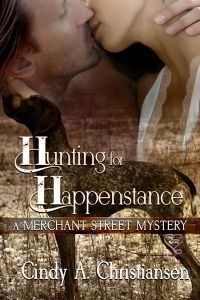
I am right in the middle of my first series. Time Will Tell: A Merchant Street Mystery Book 1 came out in September 2013 and Hunting for Happenstance, the second book in the series, will be released January 6, 2014. It’s been exciting but also a challenging task with my health issues, my two autistic children, and an ill dog.

Hunting for Happenstance is about high-spirited Daniela Estrada. She is tired of waiting for life and love to come to her in her poppa’s butcher shop. She wants to open her own doggie grooming business on Merchant Street and get practical Duston “Buck” Cooper, who owns the Bird Dog Gun Shop, to step out of his shell and ask her out.

Instead, while her Uncle Benito is deer hunting, he ends up missing and the area is swarming with aggressive black bears which holds up the search party. Duston and his dog, Ruger, have helped the police on other cases, and he is training a Karelian Bear dog. Will he help Daniela find her uncle?

Duston adores Daniela but secrets about his brother prevent him from getting close to anyone. He believes that if something is meant to be, it will just happen. Is Daniela’s missing uncle just the shot in the dark the two need to find love and happiness?

I already have plot ideas for other books and plan to continue writing and helping abused and abandoned dogs.

More by Cindy:

Sweet Cravings Publishing – Amazon – Barnes and Noble

Discovering Ellie

Discovering Ellie KECBuy and read now!

US Readers: Kindle / iTunes / Nook / Kobo

UK Readers: Kindle / iTunes / Nook / Kobo

Early nineteenth century North Yorkshire, England.

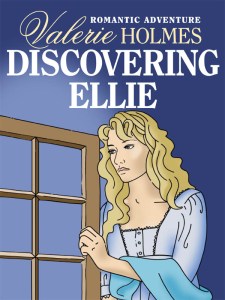
Ellie has recurring nightmares, always waking to a life devoid of love, but still she dreams. Living in the old hall with her Aunt Gertrude and cousins Cybil and Jane, the scandal of her mother’s elopement with a Frenchman cast a long shadow over her life. Until Mr William Cookson arrives to shine new light onto her past opening the way to an exciting future…

An Interview with Freda Lightfoot

Freda L-close up 6My very special guest for Christmas is prolifically successful historical author, Freda Lightfoot, with an insight into her career and sharing with us how she now enjoys the best of two worlds.
You have served a very interesting writing apprenticeship in order to attain the success you now enjoy. Could you share some of the key moments with us?

My first published piece was called An Elizabethan Toothache, published by Today’s Guide in 1972. I followed this small success with pieces on how to pass various badges, how-to’s, crosswords, quizzes and puzzles, then short stories and a serial, all of which sold to Guide and Brownie magazines and annuals. Fiction was what I really wanted to write but amidst all the child rearing and running a book shop, time to write was hard to come by. It wasn’t until I sold the business and moved out into the country that I started writing articles and short stories for adult magazines. My first success with a novel was a historical romance for Mills & Boon called Madeiran Legacy. I went on to write four more before my plot lines were becoming far too complicated and I wanted to write about real women.

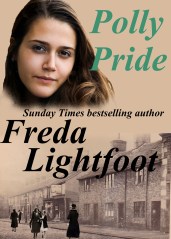
Polly Pride-webYour Lancashire routes have provided a strong background for your Sagas. Have you used some of your own family’s historical experiences within the fiction?
Indeed I have, many times. My grandmother was the spark for Big Flo in Polly Pride. She’d had a hard life but was a real stoic, as Lancashire women were in those days. And the idea for the story came from my Great Aunt Hannah, who did exactly as Polly did and sold or pawned her furniture in order to buy a piece of carpet from a ship in Liverpool. Then she cut it up and sold the squares on the market. But her husband didn’t object as Polly’s did. Family stories may be the inspiration, but the story is fiction.

I often advise new writers that in order to succeed you need to be determined and dedicated. You seem to have these attributes in abundance as you have owned a small holding and a bookshop as well as becoming a successful writer and now live in an olive grove in Spain. Do you have a strong work-ethic, which you apply to your writing routine? 

I dare say that is true, maybe I inherited it from my grandmother, and a long line of Lancashire and Yorkshire weavers. But then I love my work so it is no hardship to spend hours each day at the job. I put my heart and soul into my stories, which is absolutely essential. You must lose your inhibitions and be entirely sincere, but yes, it does take hard work and dedication. I’d say it demands the three p’s, which stand for practise, persistence, and passion for your craft.

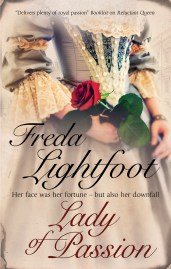
Lady of PassionYour fictionalised biographies must need meticulous research, even more so than historical sagas. How long do you spend researching a new project? Roughly how long do you take to write a completed first draft? 

When I reach a certain stage with my work in progress, I start a little preliminary research on the next book, which gradually builds, taking several months altogether. All my books demand a good deal of research, for which I have a substantial library, plus interviews for my sagas. I’ve met some marvellous old folk who share their working lives and memories with me. The biographical historicals do take longer though, as you can’t make it up, and I like to be as accurate as possible. It’s rather like detective work trying to build the character and life of a real person. Fascinating.

Breaking into the eBook market was another bold move, which has certainly worked. Could you share any tips on how you made this a success? 

I entered the digital market back in 2010, which were pioneering days for ebooks but I taught myself how to do the necessary formatting and put them up by way of experiment to see what would happen. Nothing much did at first but when the UK came on board in December 2011 and Santa Claus delivered a load of Kindles, they really took off. The more books you publish, the more you sell. But they must be good, page-turning stories, well-written and not rushed, error-free and properly edited with good commercial covers.

You now live in Spain. How did this move come about? 

It all began back in 1997 when we bought a holiday home here, a little village house high in the mountains 20 kilometres from the coast. We fell in love with the village and found we were spending more and more time here, so finally bought a piece of land with an olive grove on it and built ourselves a house for our so-called retirement. Of course, writers don’t retire, but we love spending our winters here, and summers in the UK.

Will Spain feature more in your future novels?

I do have one or two ideas, so watch this space. It could happen.

You have the best of both worlds – Would you share a couple of things that you love most about your home country and your new one?

We do have the best of both worlds as here in Spain we can avoid the British winter. Almeria is the last designated desert in mainland Europe so in the daytime we can enjoy some sunshine and gardening, and as the nights grow cold we can light a fire and be cosy. The Spanish people are very friendly and we have a good life here with many friends of all nationalities. In the UK I love taking part in writer’s events, talks and conferences, visiting stately homes, and enjoying all things British.

Could you give a seasonal insight as to how Christmas in Spain varies to our traditional one in England?

l-ayuntamiento_valencia_navidad-reidrac-14_12_08-cc20.jpg

One of the joys of living in Spain is that there isn’t the same commercial fuss made. Feliz Navidad will be up there in twinkling lights, and pontsettias everywhere, the Nativity scene ‘Nacimiento’ can be seen in plazas as well as many Spanish homes and shop windows, but Christmas itself is fairly low key.

Christmas Eve, Nochebuena, is when the main Christmas meal is taken, often roast lamb or suckling pig, a feast that takes place quite late, as do all Spanish fiestas, starting around 10 p.m. and going on until the small hours. Some families will sing carols around the nativity scene which remains without the baby until the stroke of midnight. Others go to midnight Mass ‘La misa del Gallo’, Rooster Mass, named after the bird who announced the birth of Christ. Many people, of course, like the rest of us, just watch the Christmas programme’s on TV while enjoying the traditional Turrón (nougat), or mantecas (a range of butter-based biscuits) with cava.

The big celebration for the Spanish is Fiesta de Los Reyes, Three Kings Day on January 6th. What we would call Epiphany. Traditionally, this is when Spanish children get their presents, not on Christmas Day from Papa Noel, although these days some enjoy gifts on both days. By then we’re packing our Christmas decorations away, but the Spanish are still partying.

What is next for Freda?

I’m currently working on another saga, which I never talk about until it is done. After that I plan to write a sequel for Polly Pride, and also another biographical historical in my royal mistresses series about Sarah Lennox, who had the chance to marry George III, but blew it. I do like to have lots to look forward to.

More by Freda:

An Interview with Nicola Cornick

Nicola Cornick - profileWelcome to my blog, Nicola. I must confess that your childhood interests me. I have visited many stately homes and heritage sites over the years and the idea of going to school in the dower house of C18 Harewood House fascinates me. Was this where your love of history and academic research began?
Thank you very much for inviting me to visit today! It’s a pleasure to be here.

I think I was very lucky to go to school in an 18th century house! It was definitely inspirational. There was a very grand staircase, a beautiful “winter garden” where we took our art lessons and lots of old nooks and crannies to explore. The house was surrounded by parkland too so we could run wild in the grounds and we could tell each other scary ghost stories on the dark winter evenings! I think that being in such a historic atmosphere intrigued me and sparked my curiosity; I wanted to learn about the house and its past occupants and from there my love of history developed.

Could you tell us about the work you do at the National Trust’s Ashdown House?

I’d love to! I work as a guide and historian at Ashdown House, a stunning 17th century hunting lodge in Oxfordshire. I show people around the house and give them a guided tour telling them about the history of the house and the Craven family who owned it. It’s a fabulous, romantic-looking place and the history is rich and romantic too! I also do lots of research into the history of the house. I’m learning about it all the time and the more I discover the more fascinating it becomes. We’ve just found some secret tunnels leading off from the wine cellar!

Your first Regency novel was published in 1998. What is it about this era that appeals to you so much?

I’ve always loved the Regency era as a writer and a reader. Like so may readers I started with the books of Georgette Heyer and their wit and the beautiful way that Heyer evokes the era really enthralled me. I love the elegance and the manners and the fascinating contrast between the outward show and the intense emotions that may be hidden beneath the surface. One of the challenges for a writer is to find a way for those emotions to be expressed within the constraints of the behaviour of the time.

How did your breakthrough into publication happen?

I had a long journey to publication. My first book, True Colours, was twelve years in the writing because I was also working full time and could only snatch short periods of time to write. Mills & Boon rejected my first attempt as having too much adventure and not enough romance. I re-wrote it twice more before they finally accepted it.

Who or what was your biggest inspiration in becoming a fiction author?

There have been so many people who have inspired me. The writing of authors such as Mary Stewart and Daphne Du Maurier fired me with the desire to be a writer when I was in my teens. My teacher, Mrs Chary, inspired in me a huge love of history and for that I will always be grateful to her. I always knew that it was historical fiction that I wanted to write. The other big influence was my wonderful grandmother, whose collection of historical novels I devoured and with whom I watched costume dramas on a Sunday night!

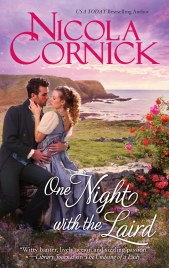
One Night with the Laird - US copyYou are an enthusiastic traveller on a world-wide scale, but for your latest series you have headed north of the border and changed period for The Lady and the LairdOne Night with the Laird out this month and the final book Claimed by the Laird, which will be published next year. What triggered this change in location and direction?
I do love travelling and have been lucky enough to visit some amazing places all around the globe. One of my favourite places, though, is Scotland and I have wanted to set a book there for years. It was fascinating to research Scotland in the early 19th century and see the similarities and differences in politics and culture compared with south of the border. It was huge fun to write the Scottish Brides trilogy!

What is next for Nicola?

I have lots of exciting plans for next year.  There are several new Regency ideas I’m going to be working on, plus a book inspired by Ashdown House!

Thank you for taking the time to answer my questions and for sharing some of your unique experiences with us.

Thank you!
More by Nicola:

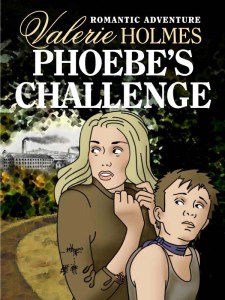
Phoebe’s Challenge

Phoebe's Challenge KEC (1)

Buy and read now!

US Readers: Kindle / iTunes / Nook

UK Readers: Kindle / iTunes / Nook

Early nineteenth century North Yorkshire, England.

Phoebe and her brother, Thomas, have to flee the evil regime of overseer Benjamin Bladderwell because an accident results in them being labelled machine breakers. Hunted with nowhere to run, the mysterious wagon driver, Matthew, his them and saves their lives. They soon discover that he is a man of many guises who Phoebe instinctively trusts, but Thomas does not. Their future depends upon this stranger, on their own they will be captured or starve. Phoebe must trust or challenge Matthew unaware that he is also tied to their past.

An interview with Bill Spence, a.k.a. Jessica Blair

090

This month’s guest is both prolific and successful saga author, Bill Spence a.k.a. Jessica Blair.

You have such a broad spectrum of life experience on which to draw: from teacher training, to Bomb Aimer in the RAF, to journalist. What triggered your initial venture into fiction?

Brought up among books and magazines; encouraged to read from an early age,  I think, unknown to me, stimulated in me a desire to write.  On leaving the RAF in 1946, I wrote a few articles but I always had the desire to write a book. Liking fact and liking fiction I thought I would write a novel based on my experiences as a Bomb Aimer during the war. I really wrote it  for my own satisfaction. I had no idea of the publishing world at that time. After a chance sighting of a short piece in a local evening newspaper, saying a paperback company was looking for war novels, I thought I might as well send mine. They offered a contract to publish (1959) which of course, knocked me sideways and made me think what do I do next. I had always been interested in the West, knew a lot about its history and had read numerous Westerns, so I wrote one! That eventually landed on John Hale’s desk and he offered to publish (1960)  36 followed, the last in 1993. During that time I also wrote two more War novels. A Romance and 3 non-fiction books about aspects of Yorkshire and had become interested in the history of whaling.

Jessica Blair was a pseudonym created in 1993. Why did you switch both genre and gender at this point in your career?

070The study of the history of whaling over a considerable period of time resulted in Harpooned – the Story of Whaling being published in 1980. It was highly illustrated and writing it and gathering the illustrations was a very interesting experience. I decided I would use the knowledge I had gained as background to fiction. The result was the first Jessica Blair novel, The Red Shawl. (1993) It was submitted under my own name but the publisher, Piatkus, who offered me a contract, wanted to publish it under a female name and suggested Jessica Blair.  The reason, I believe, was all to do with marketing.  It has paid off for me — the twenty-third  Jessica Blair novel will appear early next year.

Whitby is a pivotal town in Jessica Blair’s novels. How and when did your interest in this beautiful northern seaside town begin?

Whitby was an important whaling port in the 18th and 19th centuries and this was the background I used for The Red Shawl. Whaling does appear in other Jessica Blair novels but not in everyone.  I knew Whitby from my school days and then after the war. I realized there was a wealth of stories there, throughout its history and into recent times and I am fortunate to be able to absorb the atmosphere of the times I use.

WHITBY GIRL FINALEvery author has their own preferred method of working. For the benefit of aspiring writers would you share yours with us?
I look into a background I would like to use. I place my main female and male characters against that background and ask myself, ‘What if …?’ That question will keep recurring as the book develops. I work from a brief outline and sample three chapters. If my publisher, Piatkus, like those and the idea behind them they will issue a contract – then my computer gets working over-time ! I cannot work to a detailed outline because at that stage there are aspects of the story I know nothing about. Characters react to circumstances, and to each other – so the story develops as those change.

During your extensive research you must have come across some fascinating local characters. Do you ever use real people within your novels or are they all fictitious?

Yes I have met many interesting characters throughout life and whilst they might stimulate ideas I don’t use real people in my novels.

Of all your published work do you have a ‘favourite child’ or is it impossible to choose?

Probably The Red Shawl; it led me much deeper into the worlds of writing and publishing and extended a fascinating life. I must say that my first Western led me to meet my first other writer and that brought a long friendship.

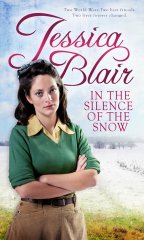
InTheSilenceOfSnow_DemyHB_9780749956295_LRRecent releases have been The Road Beneath Me and In The Silence Of The Snow. Could you tell us something of your upcoming novel, A Tapestry of Dreams, to be released in 2014?

A Tapestry of Dreams is based in the West Riding of Yorkshire (woollen industry) and the Lincolnshire countryside (sheep farming). Set in the 1850s these were the backgrounds against which I placed my two leading characters and asked myself ‘What if?’

What project are you working on next?

That has yet to be decided wit h my publisher, Piatkus.  Ideas are out there but I don’t want to mention them yet as I don’t know what road they will take.

Many thanks for your time in answering my questions and sharing your career with us.

More by Bill:

An interview with Jo Beverley

001I am both delighted and privileged to welcome award winning international romance author Jo Beverley as my guest this month. Jo is a member of the Romance Writers of America Hall of Fame and has been described as:-
Arguably today’s most skilful writer of intelligent historical romance.”
Publisher’s Weekly

“One of the great names of the genre.”
Romantic Times.

When and where did your passion for writing begin?

Too early to remember! I used to make up stories when I was very young — mostly about horses — but when I was about sixteen I wrote a historical romance in a school exercise book. I still have it! Not good at all, but it showed promise.

You have written books set in Medieval, Regency and Georgian times, but what was it that triggered your love of these particular periods?

That teenage effort was medieval, and I’ve always had a love of that period. Though it wasn’t as grim as sometimes portrayed, it was life on the edge that demanded strength and resilience from anyone who was to survive. My other two periods, Georgian and Regency, owe a lot to Georgette Heyer. I loved her books as a teenager and reread them many times. I truly wanted to be her when I grew up, which meant to me, giving the same sort of reading pleasure. Heyer’s influence led me to Regency, which was where I was first published, but I always had a yen for the Georgian age, with the fabulous costumes, especially the men’s. I love manly men in silk and lace. So totally cool.

Your period research is impeccable, however, you keep the hero and heroine attractive and the dialogue accessible, giving a flavour that it is true to the period. How carefully do you have to balance historical accuracy against modern taste to keep the appeal to a contemporary readership?

It can be tricky, especially as my readership covers a broad range from scholars to those who want the story and don’t much care about dates and details. Mostly I try to know as much as possible and use only what I need, letting the story rule. However, many stories are based on realities, so what I know shapes the stories! I certainly try to avoid info-dumps, but I usually include an author’s note at the end for those readers who are interested in the background. For example, the author’s note to Seduction in Silk includes details about a famous stone carver of the time, because marble memorials play a part.

I also try to avoid archaic language because I don’t much like to read it. I use “time neutral” language, which means avoiding both obviously modern language and archaic. If it works, the reader should enjoy the book without noticing.

You have been quoted as saying you do not get along with ‘stupid heroines’. How do you study the social attitudes of the period to avoid applying modern values to a heroine’s outlook on life?

Awareness of the social attitudes comes along with knowing the period, because I try to read primary sources — ones written at the time. That gives a pretty good feel for how people felt and thought. The good thing is there’s quite a range, just as there is now. We can have realistic heroines who don’t create waves. We can also have eccentric ones, rebellious ones, and downright weird ones, but then we  can have everyone around them thinking they are wonderful. That’s unrealistic, then and now.

Stupid is a whole other matter. For me, it’s no fun to spend time with a character who keeps saying and doing bubble-headed things, especially if they’re creating pain and problems for others and don’t care. Another type of character who doesn’t work for me is the selfish one, the one who reckons if they want it they should have it regardless.

Each author has their own favoured way of working – would you share yours with us?

Firstly, I “fly into the mist.” This means that I don’t pre-plot my books. I get an idea for characters and situation and start writing to see where it goes. It might be easier to plot out my books and know where I’m going, but that doesn’t work for me.

I write on the computer and rarely print work out along the way, though I generally do print it out about half way to read through, and then at the end before the final edit. Reading in print does throw up interesting things. I do these printouts in faux galley style. This means landscape, two columns and justified, so it ends up looking like the pages of a book. That helps, too.

I start writing early in the morning and continue until lunch because this is my most creative time. Sometimes I do edits and research in the afternoon and evening, but I rarely do first draft writing then.

However, there’s no rule to this, for me or anyone else. Each writer needs to find her own way, and for new writers that usually means trying many ways, some of them crazy. You never know! I do believe that we know it when we find it.

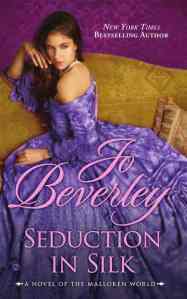
This month sees the release of Seduction in Silk another story from the Malloren world. Could you tell us what triggered the idea and motivation behind this latest novel?

I wanted to write about Perry Perriam. He appeared in An Unlikely Countess as the hero’s friend, and in A Scandalous Countess as the heroine’s brother, and readers asked for his story. I was happy to oblige, because I like him a lot. He’s not titled, but he is aristocratic — he’s the younger son of an earl. He’s very bright and very charming, and earns his living by using his talents in London, at court, in politics, and in society.

London — or rather Town, as fashionable London was called — is his life, so he’s not pleased when a distant relative names him heir to Perriam Manor, with the condition that he marry Claris Mallow, a clergyman’s daughter, within the month. Perry doesn’t give a penny for the manor, but getting it back is an obsession of his father’s, so he has no choice. He doesn’t think it will be difficult, especially when he learns that Claris is impoverished and raising two young brothers. He’ll marry her, install her and her family at the manor with free use of the income from it, and get back to his life.

Claris, however, has survived her parent’s tormented marriage and has no intention of marrying anyone, least of all an elegant stranger who assumes she’ll fall at his feet! She chases him off at pistol point. And thus their dance begins.

Readers can enjoy a free sample here.

002

Romantic Times has made Seduction in Silk a Top Pick for August.

With her talent for writing powerful love stories and masterful plotting, Beverley delivers the latest addition to her Malloren World series… emotional, sensual and highly satisfying historical romance.

What project are you working on next?

I’ve returned to the Regency, to the Company of Rogues, to pick up the story of David Kerslake, the heroine’s brother from The Dragon’s Bride. That book left him both the Earl of Wyvern and the leader of the local smuggling gang, The Dragon’s Horde. To make matters worse, both the earldom and the smuggling band are broke. He has to marry money, and Lucinda Potter, only child of a wealthy City of London merchant seems the ideal choice.

Lucy has other ideas, but then, David is a fascinating handsome man and the more she comes to know him, the more fascinating he becomes. However, it also becomes clear that he has secrets, possible dark and dangerous ones. She’s far too sensible to give herself and her money to such a man. She hopes.

This novel is called A Shocking Delight, and it will be out in April 2014.

Many thanks for your time in answering my questions and sharing some insight into your vast experience.

More by Jo:

An interview with Pia Fenton, a.k.a. Christina Courtenay

ChristinaCourtenayMarch2013I am delighted to welcome award-winning author and new chair of the Romantic Novelists’ Association, Pia Fenton, who writes as Christina Courtenay.
Congratulations on becoming the chair of the RNA. How much of an influence has the RNA had on your own career?
I think it’s safe to say that without the RNA I wouldn’t be published at all!  I found my way to the association at a time when I was about to give up on writing and it changed everything for me.  When I sent in my first m/s to the New Writers’ Scheme and got a critique back from someone who took my writing seriously and liked what I’d done, it was an amazing feeling.  And although there was a lot wrong with that first novel, I was basically on the right track and needed to be told what my mistakes were, so that was really helpful.  The other thing the RNA has done for me is give me wonderful writing friends and critique partners – I can never thank them enough!

Childhood is a time when imaginations really develop. Do you think that yours influenced your writing style and interests?

 Yes, absolutely.  I was hooked on fairy tales with handsome princes and happy ever afters and that’s what I want now too, albeit a grown up version.  I was also always interested in history, so for me writing historicals was inevitable.

Would you agree that your work reflects your unique cross-cultural experience?

I think so, yes, as most of my books feature heroes and heroines from different cultures who have to overcome their differences and realise that we are all the same underneath.  Also that no one culture is necessarily right about everything, we have to compromise.  Being half Swedish and half English I can see things from two sides, and having lived abroad has given me a different perspective on things as well.

Could you give us an insight into your own preferred way of working when you set out on a new novel adventure?

It’s a bit messy I’m afraid!  It usually starts with a scene that appears in my head, often triggered by something or someone (a handsome actor?) and then the rest of the story develops from there.  That scene can be anywhere in the book, so sometimes I work backwards, sometimes forwards.  As I said, it’s a bit chaotic but somehow it always works out in the end!  And incidentally, I always know how I want it to end, even if I don’t know anything else.

In August your first YA novel is published by Choc Lit. Could you tell us about it and if this is a permanent change of direction for you?

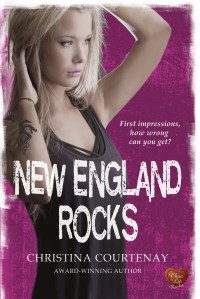
As I’d been writing historicals for many years, with all the research that entails, I decided to give myself permission to write something else just for fun last year.  The result was a contemporary YA book that needed no research and reflected the sort of high school experience I would have liked to have had myself.  Here is the blurb for New England Rocks:-

NER FrontFirst impressions, how wrong can you get?

When Rain Mackenzie is expelled from her British boarding school, she can’t believe her bad luck. Not only is she forced to move to New England, USA, she’s also sent to the local high school, as a punishment.
Rain makes it her mission to dislike everything about Northbrooke High, but what she doesn’t bank on is meeting Jesse Devlin…
Jesse is the hottest guy Rain’s ever seen and he plays guitar in an awesome rock band!
There’s just one small problem …  Jesse already has a girlfriend, little miss perfect Amber Lawrence, who looks set to cause trouble as Rain and Jesse grow closer.
But, what does it matter? New England sucks anyway, and Rain doesn’t plan on sticking around…
Does she?

I hadn’t intended to send it to my publisher, but eventually I did and Choc Lit decided they wanted to start a YA line, which was great!  I’ve since allowed myself some more time off from the historicals, so this is the first in a series.  The second one will hopefully be out next year.  But I’ll still be writing historicals and time slips as well.

What is next for Christina Courtenay?

I’ve just finished writing the third book in the Kinross trilogy, Monsoon Mists.  It’s gone off to Choc Lit to see if it passes muster, so now I can concentrate on something else for a while.  In February next year I have another time slip novel coming out, The Secret Kiss of Darkness – I love time slips, so am very excited about that – and as I said, after that hopefully number two in the YA series.

Sincerest thanks for taking the time to complete this interview.

Thank you very much for inviting me!

More by Christina:

  • New England Rocks, paperback out on 7th August:-