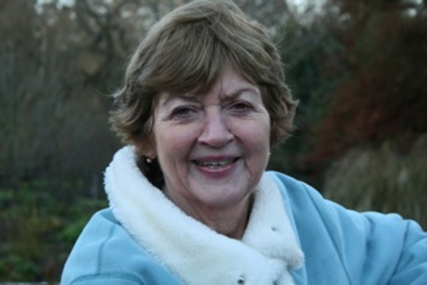
An Interview with Eileen Ramsay

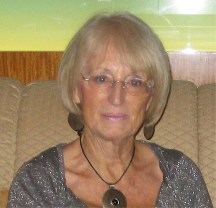
Eileen RamsayThank you, Eileen, for taking the time out of your busy schedule to be my guest this month.

You have had a fantastic breadth of life experiences from teaching the children of international politicians and celebrities in the USA to working in Migrant Education. What lasting impressions did this contrast leave you with?
One fact that has remained with me through all my years of teaching is that, no matter the social position of the parents, the wealth or lack of it, education or lack of it, ALL good parents want the best for their children. Another is that poor parents – and I’m not talking finance here – come from every strata of society. I have had extremely wealthy parents leave seriously ill children in hospital while they jetted off to join some celebrity at a ski resort and I have had really poor Mexican parents turn up at my door begging for “Trabajo ahora?” whenever there was a school outing that cost a little money. They didn’t want a hand-out, they wanted to work to earn the money.

What is it about Mexico that appealed to you so much?

I visited Mexico often and studied Spanish language and Mexican music there. I love its fascinating and sometimes sad history. It is incredibly beautiful. The people are proud and they are generous and full of humour and you have just given me ideas for articles!

Would you agree with the observation that despite having lived with the lifestyle of the very privileged, you always seem to have kept your focus on what is important in life – family and reality?

You’re right, I did enjoy some incredible experiences and my upbringing was certainly not among the privileged but one wonderful woman in Washington DC reinforced all my early lessons. I had just met the man who was to become my husband and I wanted to impress him – shallow person that I am – with my ‘new’ family. I was taking him to lunch – to be introduced – and we walked into the house to see the lady of the house on her hands and knees washing a floor.  It turned out that the resident ‘cleaning lady’ wasn’t feeling well and had been sent to bed.

‘But why are you washing the floor?’ I asked.

She looked up at me and laughed. ‘Dirt,’ she said, ‘is no respecter of persons.’

My husband, of course, fell in love with her on the spot.
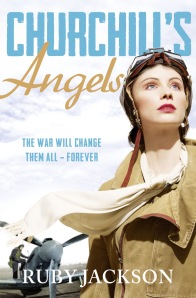
Churchills AngelsWhen did you break away from teaching to develop a career in writing?

Teaching and writing marched together for years. I wrote stories for Sunday School magazines and I wrote reading materials for primary schools. I was able to use knowledge of Native Americans I had gained while living in the US to write something a little different – Bud and the Hunkpapas was a favourite. For a few years I wrote from 4am to 6am but resigned when our younger son went to university.

Are you a very disciplined writer in the way you organise your day?
Organise?  I can already hear the laughter of those who know me.
I am disciplined. If possible I write every day; some days I write all day and well into the evening – that’s research time too. I use a laptop that has no internet because I can’t resist an email pinging in. My husband is learning to cook – our sons and lovely daughters-in-law sent him on a course – and he does one meal a day and he helps with housework – does all the heavy things and brings me a cup of coffee in bed first thing – and so I have 30 mins of ‘fun’ reading.

How and when did your first breakthrough as a published writer occur?
I went to a writing conference at USC where the great Michael Shaara, Clive Cussler, and the editor Charles Block were speakers. A friend typed up part of a Scottish Regency novel I’d been writing – I had even fewer technical skills then – and Charles Block read it. He was waiting outside a lecture room for me on the last day, handed me the script and said, “I think this will go but have chapters one and two change places.”

I had introduced the heroine in chapter two and he advised that the heroine should always be right there in chapter one. We returned to live in Britain that summer; I managed to get an agent – long story and sent her the finished, rewritten manuscript. A few days later she called and said she’d attended a party the evening before and an American editor had asked her about the availability of Scottish Regencies.  She showed her the typescript and it was bought! I looked at it a few years ago and it was rather dire – wouldn’t be published today. I rewrote it, correcting errors, and published it on Amazon!

You were established as a saga writer and then made the bold and successful move to writing romances based around the world of opera and music. What inspired this departure?

I had written children’s books, Regencies, Sagas and serials and I wanted to write contemporaries. I went to an artist chum’s exhibition and found myself thinking – What if all these paintings were of one person? The idea stayed and grew like Topsy and I wrote a book about an artist who loved a tenor – my favourite voice!  It was read by several reputable editors and agents but no one wanted it but almost everyone made sensible points. (I occasionally bump into one or two at an RNA party and we chat perfectly happily!)

            At a book launch I found myself standing beside a lovely woman who asked me if I wrote books like those of the superb writer onstage. I said “no” and told her my friend’s publisher had just, that very day, rejected me.

            “I didn’t reject you,’ said the woman and gave me her card. “Send it to me and I’ll have a look.’

            I dithered for days and eventually rang my friend, telling her I felt badly about, even inadvertently, using her launch to contact a very senior editor. She looked at me and said. “Don’t be stupid; if anyone holds out a hand to you in this business, grab it.”

            I grabbed, sent it and received the manuscript back with a “NO” for which she gave her reason. She also told me I really needed a good agent and suggested three. Two had already rejected me but I had not heard of the third and so I had one more go.

            The agent accepted me as a client, and, with her guidance, I rewrote a few scenes. The agent, the brilliant Theresa Chris, sent the manuscript to auction. It went for an amazing amount of money and was then bought by several foreign publishers.
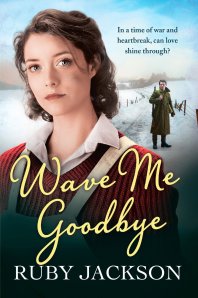
Wave Me GoodbyeLast year, ‘Wave me Goodbye’ was published under the name of Ruby Jackson, which I understand is the first of a series of novels ‘Churchill’s Angels’.  Please tell us something about this new project?
I suppose, like many writers, after five best-selling books, I fell out of favour. Theresa stayed with me, encouraging me, advising me.  A few years ago, she asked if I would like to revisit WW11 and after much thought, I said yes. I did not know, of course, that  an editor at Harper Collins had conceived the idea of publishing a series of books about the courageous women who did everything from catching rats to ferrying Spitfires; the women she calls Churchill’s Angels.  Using the pseudonym, Ruby Jackson, I have now written four books; two have been published so far.  It’s been an enormous privilege. I’ve met land girls, pilots, nurses, etcetera and been awed by every one of them. Their stories need no exaggeration – they were quite simply – superb.

You obviously love historical fiction and research your chosen topic thoroughly. What advice would you give to anyone who was considering writing a historical novel?
Advice would depend on which era and which country but obviously I’d say, find out as much as you possibly can about the person the time and the place. Read everything, especially newspapers of the time, and don’t be afraid to ask questions. Archivists and librarians are great sources and remember there are archivists in famous department stores, in grand hotels and in universities.  They know what you don’t know you don’t know!

What is next for Eileen?

I have no idea; my head is spinning – that way, or that way but I did visit a conductor friend at the Royal Opera House earlier this year. He has been keeping me accurate about conducting and conductors for several years as I have an idea. He asked me about progress.

‘I’m afraid, for the past four years, the poor man has been standing on a rock looking out to sea.’

He shrugged. ‘Well, there are worse places for a conductor to stand.’

Now, wouldn’t you want to discover the worse places?!

More from Eileen

Website: eileenramsay.co.uk
Blog: Eileen’s Blog

Sharing Places – Part 4

Whilst researching social history for my stories I visit some fascinating places. Here are some of the places that have triggered plots, created characters or inspired a mood or a desire to return to the keyboard and write.

4. Whitby, North Yorkshire, England.


Whitby Abbey
Whitby Abbey, an iconic image on the headland.

One of my favourite places to explore on the North Yorkshire coast is the unique, atmospheric town of Whitby. This ancient port situated on the northeast coast of England is famous for many reasons.

St Hilda founded a double monastery (for monks and nuns) here in 657 AD, making it a valued seat of learning. The famous Synod of Whitby was held here in 664 AD.

Whitby became a famous whaling port with such famous seafaring names associated to it as the Scoresby‘s.

Whitby's 99 steps
The famous 99 steps, better going down than up!

The James Cook Museum is housed in the C17 house where he lived as an apprentice. It is an atmospheric place overlooking the River Esk. There is a large car park nearby so exploring this side of the harbour is not a problem if arriving by car. If you walk into the East side of the harbour from here you can wander through the old cobblestoned streets and explore the many yards and snickets.

Passing the old inns and market square you will reach the bottom of the famous 99 steps which lead up to the unique church of St Mary and then to the abbey beyond. The views across the harbour from here are magnificent.

St Mary's Church
The unique St Mary’s church in front of Whitby Abbey has pride of place on the horizon.

To experience staying in one of the original inns, The Whitehorse and Griffin has been lovingly restored and offers excellent food.

Whitby sporadically comes into my stories, either in passing as in Abigail Moor, or as a setting in itself, such as Amelia’s Knight, which is still to be released as an eBook.

Whatever your reason for visiting this fascinating location, being prepared to walk and explore its narrow alleyways, historic places, or the more usual shops and eateries on the west side of the harbour, then there is plenty for everyone to enjoy.

Whitby houses
A glimpse of the red pantile rooves that characterise bay town houses.

For excellent seafood and a great place to eat it, looking back across the harbour to the abbey is The Magpie.

Other places of interest in the area can be found on these helpful websites:


An Interview with Louise Allen

A photo of Louise Allen

When did you first decide to become a writer or discover your love for the written word?

I’ve always had a vivid imagination and loved fiction but I think academic work knocked the urge to actually write it out of me. Then I started for all the wrong reasons – I was a librarian and saw how popular Mills & Boon novels were. I thought it would be easy money – idiotic of me, of course. However, by the time I sorted myself out and took it seriously I was hooked.

What appealed to you about the romance genre?

It is a great genre for exploring relationships, which is always interesting, and when I discovered historical romance, there was no stopping me – two passions in one!

Your research is impeccably thorough. At what point do you take a step back from it and begin to write the book?

Walks Through Regency London Cover LARGE EBOOKThe story and the characters have to come first, always, although some plot lines can be sunk from the start if the historical premise is incorrect – 18thc characters getting an easy divorce, for example or a sub-plot that involves getting from London to York in a day. Generally I know what I don’t know and therefore what to research – politics, for example. I’ve got a huge personal reference library. But once I know I have a plot that will work in a particular historical context then I leave the research until afterwards and go back to it so it doesn’t take over. When I wrote a story set in AD410 during the Sack of Rome (Virgin Slave, Barbarian King) I just left questions in red for bits I needed to check and went back to them to be sure my characters left Rome by the right gate onto the right road and I’d got the layout of a bath house correct and so on.

I also write historical non-fiction – Walking Jane Austen’s London (Shire), Walks Through Regency London (Kindle), Stagecoach Travel (Shire, July) and I’m working on something on the Great North Road at the moment, so I can channel the hard facts somewhere they won’t take over.

You must have visited some fantastic locations and discovered some unusual facts during your research. Could you share some of the most memorable with us?

Finding three of the houses that Jane Austen stayed in when she was in London was a thrill. Only one, in Covent Garden has a Blue Plaque, but I discovered the other two when I found a pamphlet about research that was done after the war which revealed that her brother Henry’s homes in Sloane Street and Hans Place were not demolished by the late Victorians, but simply refaced and had new upper floors added. The originals are still there under the later shell.

Practical research is great too – I took carriage driving lessons, for example and I’m about to go on a practical osteoarchaeology course handling real skeletons. Goodness knows when that will come in useful…

Do you have a strict writing routine?

Yes, or I’d never get anything done! I write every afternoon until I have hit at least the minimum number of words I need to do to make sure I finish a week before the deadline, and hopefully a few more. That way I have some time in the bank for catching flu or unexpected commitments.

How do you balance the need of keeping your work accessible to contemporary readers against your desire for historical accuracy?

I won’t distort history but it is possible to use it to appeal to contemporary readers. For example I tend to write heroines who are older and who have the freedom to act in a more assertive, interesting way. They may be widows, or following one of the career paths open to women at the time. Where there are strong differences in beliefs and norms between the time I am writing about and the present – the fact that many wealthy families in the 18th century owed their fortunes to slavery in the West Indies, for example – I simply avoid putting my characters into those situations. On the other hand, the ‘long Regency’, which is the period I usually write about, saw the beginnings of many of the freedoms we are concerned about now, or at least the fight for them. Education for women, abolition of slavery, prison reform, concern for child welfare can all be woven in to some plots and engage the sympathy of readers.

As the New Writers’ Scheme Organiser for the RNA, what key advice would you give to someone who wanted to break into the romantic fiction market?

Read widely in the genre you are interested in and do so analytically as well as for pleasure. What works, what doesn’t? Why? Then work at developing your own voice – there is no substitute for practice!

Please tell us about your latest release?

UnlacingMy latest book is Unlacing Lady Thea (Harlequin Mills & Boon. April). I got the idea for it when we took a small-ship cruise down the eastern coast of Italy. My heroine is no great beauty, and thoroughly practical with it (and I had some fun with the fact that, unlike many romantic heroines, she doesn’t fool the hero for a moment when she disguises herself as a boy). My hero begins the book seriously the worse for drink and talking to the kitchen cat. He’s so drunk that he agrees it would be a good idea to allow Thea to accompany him on his Grand Tour so she can join her godmother in Venice. By the time he sobers up, it is too late and he is stuck with escorting his childhood friend for whom, of course, he has no amorous feelings… None at all, he tells himself.

What is next for Louise?

Scandal’s Virgin is out in June and Beguiled By Her Betrayer, which is set in Egypt in 1801, is released in August. Stagecoach Travel comes out in July.

Currently I’m working on book three in a trilogy, provisionally called Battlefield Brides. Book one is by Sarah Mallory and book two by Annie Burrows. The three books are set before, during and just after the battle of Waterloo and will be released to coincide with the bicentenary of the battle in 2015.

More from Louise

Website: louiseallenregency.com
Blog: janeaustenslondon.com
Twitter: @LouiseRegency

Sharing Places – Part 3

Whilst researching social history for my stories I visit some fascinating places. Here are some of the places that have triggered plots, created characters or inspired a mood or a desire to return to the keyboard and write.

3. Ormesby Hall, North Yorkshire, England.

DSC04426DSC04400
This interesting Georgian mansion belonged to the Pennyman family for nearly four centuries and is now open to the public. It is nestled in its own grounds hidden away from the busy modern environment surrounding it.

I was delighted to be shown around the servant’s passageways when I visited. They thread through the house so that the daily running of the hall did not get in the way of the family who lived there.

The Victorian launderette is not as grand as the larger hall of Beningborough near York that gave rise to Chloe’s Friend, but the estate is a joy to walk around. You can visit the local church further up the lane and the stables which are used to this day by The Cleveland Mounted Police.

Also, there is a permanent exhibition for the model railway enthusiast and fine cakes in the tea room.

Sharing Places – Part 2

Whilst researching social history for my stories I visit some fascinating places. Here are some of the places that have triggered plots, created characters or inspired a mood or a desire to return to the keyboard and write.

2. Saltburn Gill, North Yorkshire, England.

67113_135084629972080_1860012131_n534704_137209683092908_823309552_n

A ten mile, fine sandy bay sweeps between Huntcliffe and the mouth of the River Tees on the once remote northeast coast of England. The town of Saltburn nestles in the shadow of the headland and has a fascinating historical connection with smuggling in the region.

I borrowed the location for some of my nineteenth century titles. Saltburn became ’Ebton’ and the headland ‘Stangcliffe’. The location of the actual Ship Inn was used as the heart of the old fishing village. The Saltburn Gill, which runs through an ancient natural oak and ash woodland behind Cat Nab, has a rich undergrowth of Holly and Hazel and a myriad of flowers and wild birds that vary throughout the seasons making it a vibrant and beautiful place to visit at any time of the year.

It was a route used in times past by smugglers and my version of it appears in such stories as Phoebe’s Challenge and many other titles of my back list, many are yet to be converted to their eBook format.


Sharing Places – Part 1

Whilst researching social history for my stories I visit some fascinating places. Here are some of the places that have triggered plots, created characters or inspired a mood or a desire to return to the keyboard and write.

 1. Nunnington Hall, North Yorkshire, England.

Blog1Blog2

Twenty one miles north of the beautiful city of York is the historic estate of Nunnington Hall. Its history stretches back from Tudor times through the family’s sympathies with the Jacobite’s cause to modern day.

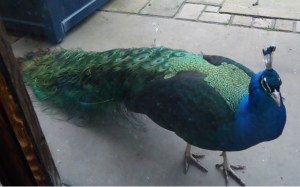
Built on the banks of the river Rye, it is a beautiful location to explore where peacocks roam free. I loved exploring the period rooms and also the old servant’s rooms and attic where the hall houses a fine miniature collection. The views are magnificent. It feels as if the hustle of modern day life has been left behind as you explore this beautifully preserved walk through history.

Roses Are Dead

Roses Are Dead KECBuy and read now!

US Readers: Kindle / iTunes / Nook / Kobo

UK Readers: Kindle / iTunes / Nook / Kobo

Jen, a teacher, has broken away from a stifling relationship with Harris, who runs a gym. Naively, she tried to help him sort out his life, but did not realise that the man was a liar and a control freak until it was too late. Jen walked out on him determined to enjoy her independence once more when strange gifts begin to arrive. With Valentine’s Day approaching, the mystery of who is sending them disturbs her deeply. She fears it could be Harris. When they turn sinister Jen is frightened and does not know who should she trust: her ex, his friend, her neighbour, Sergeant Aidan Lee or just herself? When Jen needs help who will come?

An Interview with Peter Lovesey

DSC_2534Thank you for taking the time to discuss your fascinating career and share some of your experiences with us.

Your love of the English language shines through the quality of your work and the complexity of the plots you weave through your books. When did your love of storytelling begin?

I was a dreadful fibber as a child, so it must have been there from the start. I led a Walter Mitty existence, top of the class, popular, brilliant at games and with a girlfriend called Dahlia, the prettiest in school. None of it was true and Dahlia didn’t even exist. From there it was a smooth progression to making up stories for what was then called composition.

You also had a keen interest in sport which led to your first breakthrough as an author. Can you describe how this came about and if it is still one of your proudest moments?

At twelve I was taken to the post-war Olympic Games in London. There’s a lot of talk about legacy from the recent Olympics and for me the 1948 Games were a rich legacy indeed. I was hopeless at sport but desperately wanted to be a part of it, so I wrote about it, doing unpaid articles for small magazines. Out of it eventually came a book on distance running and then two years later, using distance running as a background, I entered a competition for a first crime novel. Wobble to Death won me £1000 and publication in England and America. A dream start to my career.

Stone Wife (2)From your initial breakthrough, how did you then go on to develop the successful series of Sergeant Cribb and Peter Diamond?

Cribb was the Victorian detective I created to clear up the mystery in that first novel and he went on to seven more, using Victorian entertainments such as boxing, the music hall, boating, spiritualism and Madame Tussaud’s as the backgrounds to whodunits. The eighth, called Waxwork, won the CWA Silver Dagger and was turned into a pilot for a TV series, made by Granada, starring Alan Dobie as Cribb.  Two series followed, based on the books and original scripts written together with my wife Jax.

The more recent series features a contemporary police detective called Peter Diamond, who is with Bath CID. The first book was going to be a one-off, called The Last Detective, and he resigned from the police. But it won the Anthony for best novel at the Toronto Bouchercon and I was asked to follow it up. So I contrived a story called The Summons in which the police needed him back and were forced to ask him to return and reinvestigate an old case. He’s been going ever since. The fourteenth, called The Stone Wife, is published this spring.

In which era do you prefer setting your novels – historical or contemporary, and why?

I wouldn’t say I have a preference. I enjoy the challenges of each. The Victorian period had a rich, rather daunting tradition to work in, thinking of Dickens, Wilkie Collins and Conan Doyle, and the task was to avoid a pale pastiche of those great writers. The research was enjoyable, mainly using the British Library newspaper library. Today, with the internet, it would be quicker and easier. Turning to the contemporary police novel was scary, too. I wasn’t sure how I would cope with modern policing and the huge advances in forensic science, so I made Diamond a bit of a dinosaur. I get a lot of pleasure from using little known historical anecdotes in these modern books. Examples are Jane Austen’s shoplifting Aunt Jane and Mary Shelley’s writing of Frankenstein in lodgings right next to Bath Abbey.

You have had work both televised and filmed. When this happens, do you become involved in the process and maintain control of what the producers can change?

I doubt if any producer allows the author control. They do take liberties and will tell you it’s necessary in visual terms. But I was lucky enough to attend read-throughs of the Cribb series and of Rosemary & Thyme, as the consultant. I was fortunate, too, that the adaptations of my books kept pretty faithfully to the plots – and that includes the movie Goldengirl and the TV drama Dead Gorgeous.

Do you write stand alone novels to have a break from the series, as a kind of refresher?

Yes, it’s fun to break out from time to time. I’ve written several from the point of view of the killer – and that’s very liberating. The False Inspector Dew won the Gold Dagger  and has been translated into more than twenty-five languages, but the one I’m proudest of is The Reaper, a black comedy about a rector called Otis Joy, who murders the bishop in chapter one.

Every writer has their own way of working. Do you plot in detail first and then set wordage targets, or do you let the story grow as it builds on the page?

When I started I would plan meticulously and write the synopsis before beginning Chapter One. I don’t write in drafts. The pages I write each day aren’t altered, except in minor ways, so it’s a slow process. If I tell you how few words I manage in a day you won’t believe me. It has to be right before I can move on. These days I carry much more of the plot in my head, but it’s basically all there. It’s not a method I would recommend to anyone.

I first met you when you did a local library talk, which was both interesting and inspiring. Do you intend to tour again in 2014?

If I’m asked, yes. I’ve done several recent US tours, visiting cities I wouldn’t ever have known otherwise. And it’s lovely to meet readers who enjoy the books. Plus, of course, the occasional writer such as you – and that’s a bonus.

Thanks, Peter! Of all the accolades and achievements you have received in your career to date, which one(s) stand out as something very special to you?

Difficult. The CWA Cartier Diamond Dagger in 2000 was a great honour, but couldn’t quite match the thrill of that first competition win with Wobble to Death. Another unforgettable moment came when I was Chair of the CWA and presented the Diamond Dagger to one of my early inspirations, Leslie Charteris, the creator of The Saint.

The Tooth TattooThe Tooth Tattoo also shows that you have a love and understanding of classical music. The humour within the book works on many levels, which balances the much darker twists of the plot. What inspired this book?
I can answer this with more certainty than any of your questions. A 2004 article in the arts section of the Guardian by David Waterman had this intriguing headline: HOW DO THE MEMBERS OF A STRING QUARTET PLAY TOGETHER AND TOUR TOGETHER YEAR IN, YEAR OUT, WITHOUT KILLING EACH OTHER? The piece stayed in my mind for eight years until I was ready for Peter Diamond to investigate. I’m glad to say The Tooth Tattoo was well received, not least by the writer of the article, who still plays with the Endellion quartet. And it’s just out as a February paperback.

What is next for Peter?

The fourteenth Diamond novel, The Stone Wife, will be in the shops in April and I’m halfway through the one I’m currently calling Diamond Fifteen. Thanks, Valerie, for this stimulating interview.

My sincerest thanks for taking the time to answer my questions. 

Discovering Ellie

Discovering Ellie KECBuy and read now!

US Readers: Kindle / iTunes / Nook / Kobo

UK Readers: Kindle / iTunes / Nook / Kobo

Early nineteenth century North Yorkshire, England.

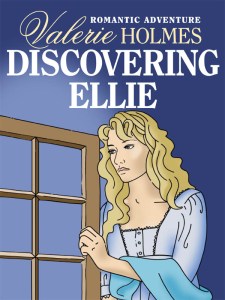
Ellie has recurring nightmares, always waking to a life devoid of love, but still she dreams. Living in the old hall with her Aunt Gertrude and cousins Cybil and Jane, the scandal of her mother’s elopement with a Frenchman cast a long shadow over her life. Until Mr William Cookson arrives to shine new light onto her past opening the way to an exciting future…

An Interview with Freda Lightfoot

Freda L-close up 6My very special guest for Christmas is prolifically successful historical author, Freda Lightfoot, with an insight into her career and sharing with us how she now enjoys the best of two worlds.
You have served a very interesting writing apprenticeship in order to attain the success you now enjoy. Could you share some of the key moments with us?

My first published piece was called An Elizabethan Toothache, published by Today’s Guide in 1972. I followed this small success with pieces on how to pass various badges, how-to’s, crosswords, quizzes and puzzles, then short stories and a serial, all of which sold to Guide and Brownie magazines and annuals. Fiction was what I really wanted to write but amidst all the child rearing and running a book shop, time to write was hard to come by. It wasn’t until I sold the business and moved out into the country that I started writing articles and short stories for adult magazines. My first success with a novel was a historical romance for Mills & Boon called Madeiran Legacy. I went on to write four more before my plot lines were becoming far too complicated and I wanted to write about real women.

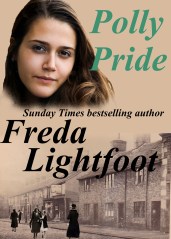
Polly Pride-webYour Lancashire routes have provided a strong background for your Sagas. Have you used some of your own family’s historical experiences within the fiction?
Indeed I have, many times. My grandmother was the spark for Big Flo in Polly Pride. She’d had a hard life but was a real stoic, as Lancashire women were in those days. And the idea for the story came from my Great Aunt Hannah, who did exactly as Polly did and sold or pawned her furniture in order to buy a piece of carpet from a ship in Liverpool. Then she cut it up and sold the squares on the market. But her husband didn’t object as Polly’s did. Family stories may be the inspiration, but the story is fiction.

I often advise new writers that in order to succeed you need to be determined and dedicated. You seem to have these attributes in abundance as you have owned a small holding and a bookshop as well as becoming a successful writer and now live in an olive grove in Spain. Do you have a strong work-ethic, which you apply to your writing routine? 

I dare say that is true, maybe I inherited it from my grandmother, and a long line of Lancashire and Yorkshire weavers. But then I love my work so it is no hardship to spend hours each day at the job. I put my heart and soul into my stories, which is absolutely essential. You must lose your inhibitions and be entirely sincere, but yes, it does take hard work and dedication. I’d say it demands the three p’s, which stand for practise, persistence, and passion for your craft.

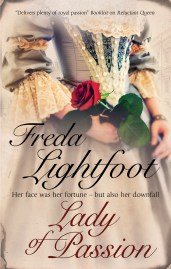
Lady of PassionYour fictionalised biographies must need meticulous research, even more so than historical sagas. How long do you spend researching a new project? Roughly how long do you take to write a completed first draft? 

When I reach a certain stage with my work in progress, I start a little preliminary research on the next book, which gradually builds, taking several months altogether. All my books demand a good deal of research, for which I have a substantial library, plus interviews for my sagas. I’ve met some marvellous old folk who share their working lives and memories with me. The biographical historicals do take longer though, as you can’t make it up, and I like to be as accurate as possible. It’s rather like detective work trying to build the character and life of a real person. Fascinating.

Breaking into the eBook market was another bold move, which has certainly worked. Could you share any tips on how you made this a success? 

I entered the digital market back in 2010, which were pioneering days for ebooks but I taught myself how to do the necessary formatting and put them up by way of experiment to see what would happen. Nothing much did at first but when the UK came on board in December 2011 and Santa Claus delivered a load of Kindles, they really took off. The more books you publish, the more you sell. But they must be good, page-turning stories, well-written and not rushed, error-free and properly edited with good commercial covers.

You now live in Spain. How did this move come about? 

It all began back in 1997 when we bought a holiday home here, a little village house high in the mountains 20 kilometres from the coast. We fell in love with the village and found we were spending more and more time here, so finally bought a piece of land with an olive grove on it and built ourselves a house for our so-called retirement. Of course, writers don’t retire, but we love spending our winters here, and summers in the UK.

Will Spain feature more in your future novels?

I do have one or two ideas, so watch this space. It could happen.

You have the best of both worlds – Would you share a couple of things that you love most about your home country and your new one?

We do have the best of both worlds as here in Spain we can avoid the British winter. Almeria is the last designated desert in mainland Europe so in the daytime we can enjoy some sunshine and gardening, and as the nights grow cold we can light a fire and be cosy. The Spanish people are very friendly and we have a good life here with many friends of all nationalities. In the UK I love taking part in writer’s events, talks and conferences, visiting stately homes, and enjoying all things British.

Could you give a seasonal insight as to how Christmas in Spain varies to our traditional one in England?

l-ayuntamiento_valencia_navidad-reidrac-14_12_08-cc20.jpg

One of the joys of living in Spain is that there isn’t the same commercial fuss made. Feliz Navidad will be up there in twinkling lights, and pontsettias everywhere, the Nativity scene ‘Nacimiento’ can be seen in plazas as well as many Spanish homes and shop windows, but Christmas itself is fairly low key.

Christmas Eve, Nochebuena, is when the main Christmas meal is taken, often roast lamb or suckling pig, a feast that takes place quite late, as do all Spanish fiestas, starting around 10 p.m. and going on until the small hours. Some families will sing carols around the nativity scene which remains without the baby until the stroke of midnight. Others go to midnight Mass ‘La misa del Gallo’, Rooster Mass, named after the bird who announced the birth of Christ. Many people, of course, like the rest of us, just watch the Christmas programme’s on TV while enjoying the traditional Turrón (nougat), or mantecas (a range of butter-based biscuits) with cava.

The big celebration for the Spanish is Fiesta de Los Reyes, Three Kings Day on January 6th. What we would call Epiphany. Traditionally, this is when Spanish children get their presents, not on Christmas Day from Papa Noel, although these days some enjoy gifts on both days. By then we’re packing our Christmas decorations away, but the Spanish are still partying.

What is next for Freda?

I’m currently working on another saga, which I never talk about until it is done. After that I plan to write a sequel for Polly Pride, and also another biographical historical in my royal mistresses series about Sarah Lennox, who had the chance to marry George III, but blew it. I do like to have lots to look forward to.

More by Freda: