Exploring Character Journeys: Upcoming Releases & Updates

Welcome to my new monthly news update. I have had a lapse in posting, but not in writing, and am very excited to announce that Silent Revenge will soon be available for pre-order. This book is close to my heart as it is dedicated to a lifelong friend and supporter, Sue, who sadly died far too soon, and never managed to enjoy Lord Farrington’s last adventure.

Since 2003 I have enjoyed working as a Creative Writing Tutor allowing me to connect with many fellow writers, both published and unpublished, across the globe. Each student unique in their life experiences, yet all share that inner desire to create stories for others to enjoy. This I will continue to do independently, through this website.

Continue reading “Exploring Character Journeys: Upcoming Releases & Updates”

Smuggling, treason and espionage.

Smuggling in Regency times was rife in the rugged and isolated ‘bay towns’ of what was the North Riding of Yorkshire. Although the skill and daring of those involved in the trade can be admired, there was a dark and far-reaching side to their activities.

20181026_145817

In my books there is a recurring element of smuggling showing how it could have affected the lives of those within the region and, inadvertently, helped Napoleon in his war against our own nation.

Being an island, smuggling had been prevalent for many years within the coastal communities nationwide. With a much smaller population than today, most of the inhabitants of these places would be either involved, or at least aware, of contraband being stored or moved through their communities.

This extract from Rudyard Kipling’s’ poem A Smuggler’s Song captured it beautifully:

If you wake at midnight, and hear a horse’s feet,
Don’t go drawing back the blind, or looking in the street,
Them that ask no questions isn’t told a lie.
Watch the wall my darling while the Gentlemen go by.

The reasons the trade existed were complex but huge import taxes applied to certain consumables made brandy, tobacco, tea, silk and many other desired goods far too expensive for most people, instantly creating opportunity to fill a demand illegally.

Napoleon Bonaparte had no wish to lose the income France received from this illicit trade. So, he ordered the French Channel ports be kept open for business. This also created wealth for the organiser of the smuggling gangs’ pockets, some of which were part of the British landed gentry. Their subordinates lower down the chain of command were often unaware of the identity of the ‘top man’ who could only be known by a select few.

This trade was open to being used for further nefarious purposes, as free traders earned even more money by selling government secrets. This shared intelligence could cover troop deployments/movements/logistics, coastal patrols and the names and responsibilities of important people. This information had its value in coin, which Napoleon desperately needed to fuel his war effort. It was aiding treason.

phoebes-challenge

Government agents tried to uncover such traitors. In Phoebe’s Challenge Rev. Matthew Fenton provides information to uncover the local gangs. In The Friends and Foes series, Lord Farrington is a semi-retired Intelligence Officer who has been given the task of unearthing a traitor in Betrayal, but his role is concerned with insurgence and threats to the government at home too. This is a time of hardship and much perceived threats, externally from France and her allies and internally from those deeply affected by the loss of livelihood and the industrialisation, which was bringing huge wealth to a new ‘middle-class’ and displaced communities from the countryside to town and mills.

Revolution on our shores was a fear.

dscn0347Lord Farrington discusses the situation with  Dr. Samuel Speers,  in Betrayal

“I already know they are involved in the business of financing the trade in contraband. But what else? Lord Bagby has influential friends who he meets in his clubs – does he pass on information to our enemies as well as coin? Is he a traitor through and through? These facts I must seek out.”

Samuel looked up, quite shocked. “You think they are traitors. Many people locally dabble in smuggling to eke out their meagre livings…” 

Farrington leaned forward. “Stop my friend if you wish to remain so. Smugglers give coin to Napoleon’s war effort – they help our enemy and our men die. I do not debate the taxes set, but the way they fund our enemies for selfish gain. Do not be so naïve. I shall bring down the Bagby’s and this man Jed Webb who eludes our Riding Officers.”

 Villagers could earn some coin to supplement their meagre incomes by hiding contraband in amazingly inventive places or help to convey goods on arrival from larger vessels at sea in their own fishing boats to hide them on land. Tubmen were men paid to convey the goods from delivery to their next destination. They needed to be strong, often landsmen, who knew the area and walked the trods and snickets that linked the bay towns and crossed the open moors.

IMG-20181103-WA0006

The northeast coast leant itself perfectly to this. Many of these coastal villages have long, flat beaches of fine sand, where the local ‘cobles’, the shallow draught fishing boats could be easily drawn up and the villagers knew how to avoid the scars, the vicious fingers of rocks that extended from the shore. Fishing was the main source of employment on the coast. Whitby and Robin Hood’s Bay are well known for their smuggling links but the coast between Saltburn and Redcar was almost as notorious towards the end of the eighteenth century. The bay towns in my books of Ebton and Allunby are fictitious villages based on the sweeping bay of Saltburn to Coatham, where I grew up and hold a strong affection for.

Three organisations were created to try and stop this trade. The Revenue Cruisers, the Riding Officers and the Preventive Water Guard.

Revenue Cruisers patrolled offshore in ships that with full sail could often overtake smaller vessels once located. The problem they faced was locating ships amongst the many who sailed along the German Ocean, and also the honesty of the crews who were on occasion known to work with some of the smugglers in exchange for a cut of the goods, made discerning their whereabouts even harder.

Riding Officers were based around the coast, living near the suspected communities and riding the coast to try and prevent the collusion between land and sea. A nearly impossible task.

The Preventive Waterguard was established in 1809. They had houses around the coast – Watch Houses, and smaller boat crews which would patrol their stretch of coastland.

Between all three branches the tide was slowly turning in the governments favour. In 1822 they were incorporated into one force, The Coast Guard, charged with stopping the import of these highly taxed goods. They employed ex sailors, strong, tough and knowledgeable who needed employment after the end of the Napoleonic Wars.

This led to a gradual decline of demand and consequently causing the amount of smuggling that was committed throughout the first half of the nineteenth century to dwindle.

Before this happened though the battles fought to catch the smugglers and traitors lay the seed of many a good tale, some yet to be told.

Thank you for taking the time to visit my page. If you like the article please hit the like button and share where you are visiting from in the comments below.

Best wishes

Valerie

The Yorkshire Saga standalone series published by Sapere Books


series insty (1)

Phoebe’s Challenge now £1.99!

Phoebe and her brother, Thomas, have to flee the evil regime of Benjamin Bladderwell when an accident results in them being labelled machine breakers. Hunted with nowhere to run, the mysterious Matthew saves their lives.He is a man of many guises who Phoebe instinctively trusts, but Thomas does not. Their future depends upon this stranger, unaware that he is also tied to their past.

Why not follow Pheobe and Love the Adventure!

Available from Smashwords  Nook iBooks and Amazon

Check out my article about the world of a working mill in the early nineteenth century and you’ll see why Phoebe and Tom had to run.

Escape into Val’s World!

When life changes, a strong woman will survive…

Available from Amazon

For only £1.99 in December meet  Felicity Moon!

Felicity’s temper is sparked when she needs to defend her honour against the owner of the Hall where she is serving as a maid. She is hastily found a new position by her friend, the housekeeper. Mr Lucas Packham, a surgeon, is opening a home for the sick at nearby Marram Hall and he agrees to meet and take her with him.

Felicity is surprised that he already knows details about her past, including the fact that her father, Squire Josiah Moon, is imprisoned in Gorebeck gaol. Together, they visit him, but Felicity is to be shocked, yet again, when she discovers that her father is alarmed at her change in fortune and also with the information she shares with him about where she is to live with Packman.

Upon arrival at Marram Hall, Felicity is charmed by the house on the cliff, and equally by their first client. She is drawn to her new employer as he shares his plans and dreams for this new venture and helping the poor. She also thrives on the responsibility he entrusts to her.

However, Felicity becomes aware that she is regarded with suspicion by some of the staff that were already in residence. Unusual events occur around the Hall, particularly in the old cellars, that she cannot ignore. She begins to mistrust the people around her including Mr Lucas Packman.

Her father shares his daughter’s fears, unbeknownst to her, and takes drastic action because of his concerns for her safety.

Will the dubious actions of her father’s past mar Felicity’s future? Can she act upon the growing tenderness she feels for Mr Lucas Packham? Or is he another man who will let her down again? Felicity determinedly seeks the truth – whatever the cost.

Set in North Yorkshire, England early C19

Love the adventure!

Kirkleatham Village, North Yorkshire: A little gem worth exploring

Kirkleatham Village, North Yorkshire, England is definitely a little gem worth exploring.

Three miles from the coastal resort of Redcar, North Yorkshire, lies the beautiful small village of Kirkleatham. Originally known by its Norse name ‘Westlide’. Through time and links to the original ‘Kirk’ (church) lands it evolved from a small village to a prosperous estate with famous links to London.

I often explore such locations when researching the background to my stories, which are set within the region. This beautiful area was once owned by Guisborough Priory, before King William I granted it to The Count of Mortain and Robert de Brus in 1086, down through the centuries, it came into the hands of the Turner family.

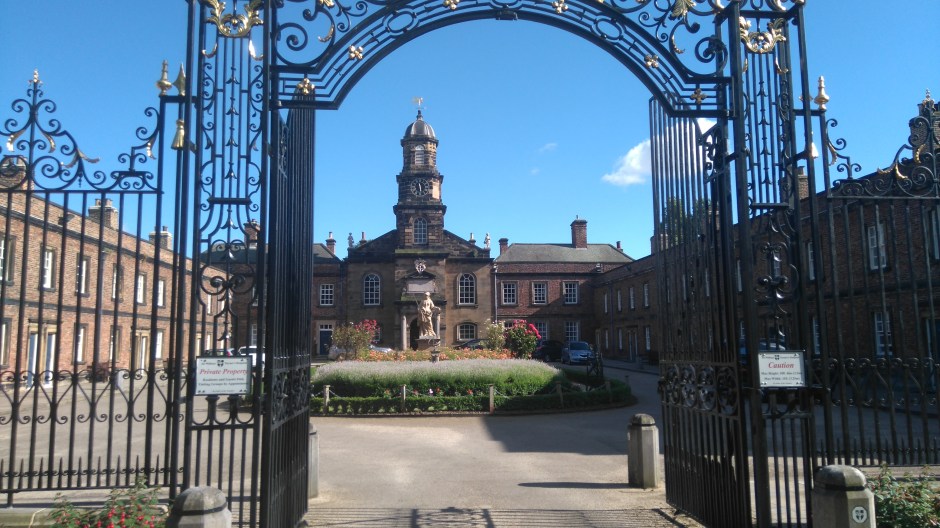
Today the main buildings’ features of the almshouses, the church, mausoleum, and the museum in the Queen Anne building where the old school was housed, they all stand as testament to the legacy left by the Turner family. Sir William Turner (1615-1692) became Lord Mayor of London in 1669. His loyalty to King Charles II and his active involvement in rebuilding the city after the Great Fire were greatly rewarded. However, he was a man who seemingly also showed compassion for the less fortunate. He was President for the Bridewell and Bethlehem Hospitals as well as founding the Sir William Turner Hospital in Kirkleatham (now the almshouse building).

The Hospital was built around a quadrangle, with a chapel opposite the ornate gates separating the quarters of the 10 women and 10 men. There was also accommodation for 10 girls and 10 boys. These children were either orphans or from one-parent families. They were taken in, given a basic education and then would leave to serve an apprenticeship or enter service.

The ancient church was added to in 1740 to commemorate Marwood William Turner who died on his Grand Tour in Lyons in 1739. Charles Turner, who was the first Baronet in 1782, improved the roads in the area. He also built the Turner’s Arms in nearby Yearby to replace the alehouses, ‘wretched hovels’, which had harboured smugglers. Charles encouraged tenants to experiment with new crops and techniques. His son, also a Charles (1773-1810), was the last Turner to own the estates. The estates then passed through marriage to the Newcomen family. Schools and buildings in the local towns have carried the names of these families for years.

Eventually the estate was sold in 1948. The contents of Kirkleatham Hall, the Hospital Library and Museum were sold at auction. The once magnificent Hall was then left to decay and in 1956 was demolished.

Kirkleatham today houses the local history museum which, amongst other exhibits, houses the Saxon Princess Exhibition. The local maritime and industrial historical exhibits cover three floors. Access is good as the site is level; ramps and a lift means that it is accessible to all.

The 15 acre grounds cover a woodland, play area and willow walk. It extends past the old stables to open fields. A café serves hot and cold foods and facilities are good throughout.

Admission to the museum is free but touring exhibitions and events held at the site may be charged for.

More information is available from: http://www.redcar-cleveland.gov.uk/kirkleathammuseum

Laura’s Legacy – New from Endeavour Press!

Laura's Legacy

Laura’s story begins fifteen years after the fire that nearly destroyed Ebton in To Love Honour and Obey.
1820 Ebton, England.

Laura Pennington’s parents think it is time for her to marry, but they are concerned. She likes to take long walks by herself, and doesn’t quite fit in. Laura’s father, Obadiah, thinks local mill owner Daniel Tranton is the perfect husband for Laura, so he suggests marriage to Daniel while working on a business deal.

Daniel is not keen, but does not want to lose Pennington’s business. He is not sure what to do, as he has his hands full with disgruntled mill workers. Daniel has always treated his workers well, but that is the exception, not the rule.

A new problem arises, when Jeb, a young boy who works for Daniel’s cousin Roderick, runs away from the mill where he works. Daniel, not wanting to see him captured and beaten by the local louts who enforce the law, tries to track him down. He finds Laura hiding Jeb, who she stumbled upon while out on one of her walks.

Roderick has his henchman Mr Bullman hunting for Jeb as Laura hides him at her father’s boat house.
Checking on him one morning, Laura sees the boat is gone, but it’s seeing her father stepping out from the hotel he owns that shocks her the most.

For all his efforts to make Laura a lady, it seems Mr. Pennington is not a gentleman.
With the hint of revolution in the air, will Daniel and Laura find a love worth fighting for?
Laura’s Legacy is a historical tale of romance and family strife in a past world.

Laura’s Legacy is availble on Amazon Kindle

New book launch!

To Love, Honour and Obey

Buy on Amazon!
Australia | Brazil | Canada | France | Germany | India | Italy | Japan | Mexico | Netherlands | Spain | United States of America | United Kingdom

To Love Honour And Obey

1805

Six years ago, Willoughby Rossington’s father was murdered while searching for the kingpin of a smuggling and spy ring. Taken under the wing of his uncle, who is running a counter-intelligence operation against Napoleon’s spies, Willoughby is assigned to take up his father’s last mission—and, hopefully, in the process find who killed his father and bring them to justice.

He encounters a young woman, Beth, who works at the local inn. Her spark and resilience against her master’s attempts to break her will strike a chord in him and he, albeit reluctantly, takes her with him when he leaves town.

As they begin to talk, he finds out that her master is more involved in the ring that could have been thought. She overheard things and knows things about the seedy side of villages that could be helpful to him and his mission.

Though Beth hasn’t had the opportunity for education, she’s smart and quite cunning while still maintaining a child-like wonder. Even as Willoughby makes plans to set her up with a family in order to protect her from the perils of his mission, he finds himself a bit melancholy at the thought of losing her company.

Beth is having none of it. She knows she can be of help to Willoughby and isn’t going to be left behind now that she’s found someone nice. Part on purpose, partly because of fate, their two lives become intertwined as they race against the villains that plot to destroy them both.

Will they uncover the truth behind the smuggling ring and find who is responsible for Willoughby’s father’s death?


Spring Offers!

Spring time has arrived at last and with it the chance to read a selection of my titles at only £0.99/$1.50 each! The selection of titles includes warm love stories set against mixed with adventure, mystery (or  a mixture of both!) set in the beautiful North Yorkshire countryside of the early nineteenth century.


Chloe's FriendChloe’s Friend: Miss Chloe Branton has been found a position as a laundry maid in a wealthy country house. The work is hard and she is slight, but she stays knowing the arrangement is to keep her away from her father’s enemies. Mr Thaddeus Poole, is an unlikely person to offer her help, but Chloe does not know if he will betray her or be a true friend.


The Baker’s Apprentice: Molly Mason dreams of escaping from the control of Mrs Cresswell, her step-mother, by becoming an apprentice to her friend who owns the local bakery. This ill thought-out plan is stopped when Juniper Cresswell’s fiancé, war hero Lt. Cherry, returns accompanied with a soldier who had been presumed dead. The soldier brings with him suspicions of murder, mystery and the key to Molly’s heart.


Truth, Love & LiesTruth, Love & Lies: Major Luke Stainbridge returns to his beloved estate in England after being held prisoner by Napoleon, to discover he has been replaced by an impostor. Meanwhile, Miss Florence Swan, naively, ventures out into the world alone to avoid the drudge of life in a cotton mill.  Two lives are in chaos. Two destinies combine: will the love of truth be enough to destroy a sinister network of lies?


Felicity Moon: Miss Felicity Moon jeopardises her position, her life and her future when she strikes the Lord of the manor in self-defence and is forced to leave his household. Squire Moon, her father, is in gaol charged with bank-rolling smugglers and the storing of contraband. She has one last chance to save herself from ruin in the form of a reference written for a Mr Lucas Packman, a man her father dislikes intensely. She has a stark choice to make: trust Packman or her obey her incarcerated father.


Dead to Sin (A Penn Mystery – Book 1): Nicholas Penn is summoned to Gorebeck Gaol to visit a man accused of the rape and murder of five wenches. Having been found holding the body of the last victim in his arms his plight seems sealed. Nicholas is torn between a sense of duty and his feelings of hurt and disgust when being in the presence of the accused. The tables turn abruptly, and Nicholas becomes the incarcerated, duped and incensed he is sworn to find the man, Wilson, before another victim dies.


Betrayal of Innocence: Lydia works desperately hard at Bagby Hall in order to keep her ailing father from the poorhouse. She is a loyal person, but is racked with guilt as she knows her friend, Miss Georgette, is being cruelly used by Lord and Lady Bagby. It is only when she fears Miss Georgette’s life may be in danger that she acts  – but how?

Abigail Moor – The Cruck Inn

Abigail Moor KEC_1Abigail has to flee her home to escape from a forced marriage. This love story wrapped around an adventure takes the heroine away from the comfortable country manor house which has always been her home, onto the wilds of the North Yorkshire moors, to the beauty of the ancient city of York. From here she must seek refuge in the busy seaport of Whitby to discover who she really is.

She embraces her destiny and, accompanied by her maid, makes for The Cruck Inn, a coaching inn, on the moor road where her quest begins. Here, Abigail has her first experience of what the real world is like beyond her sheltered life Beckton Manor. The Cruck Inn was named after the design of the North Yorkshire cruck-built buildings. Spout House is an excellent example of an early inn which still exists in Bilsdale. I visited it when researching the area and was amazed at how well it was preserved. It is literally like taking a step back in time. Abigail Moor: The Darkest Dawn is available at Amazon and Smashwords.

Here are some photos I took of the amazing time capsule that is Spout House.


Flat bottoms and Yorkshire Cobles

One of my fondest memories of growing up in the coastal town of Redcar was walking along the promenade with my father and seeing the flat-bottomed fishing boats being pulled up onto the beach after they crashed through the breakers on the shore-line.

People went down to meet them on the fine sand of the beach to see what they had to sell of their catch. I would eagerly peer inside. Fresh fish meant just that: mackerel, cod or crab to name but a few, depending on the season.

Sadly, this scene is no longer common. The boats that once lined the promenade are few. All along the bay towns of the northeast coast, the fishing industry has diminished.

In Phoebe’s Challenge, she instantly looks upon the distant boats and the sweeping bay as a scene of beauty when she sees the bay open up before her for the very first time. This story is based on a village I call Ebton, which has striking resemblances to Saltburn.

In my previous blog post on Cobles and Contraband, I talked about the versatility of the cobles (often called cobbles locally) and their use in smuggling at the turn of the nineteenth century. When the sea wall was being built at the end of the eighteenth century many men were housed in the small towns of Coatham and Redcar. They supplemented their income, like the local people, by working in gangs to bring contraband ashore from the colliers and luggers that would hover illegally off the coast. They would then distribute it before the beleaguered customs service could catch them. They would have been vastly outnumbered anyway.

One historic boat, which does still have pride of place in its own museum, is the Zetland Lifeboat.

In October 1802 this oldest surviving lifeboat in the world arrived at the small coastal town of Redcar in North Yorkshire. In its time it has been used to save over 500 lives and the service that began with it has continued to work in the exceptionally dangerous conditions of rescues in the North Sea. Grace Darling was an exceptionally brave lady who risked her own life to save others. The RNLI continues to save lives. These days their boats do not need pulling down to the edge of the water, but they face the same dangerous, treacherous seas as their forefathers.