A Stolen Heart – Download it for Free!

A special promotion for my readers!

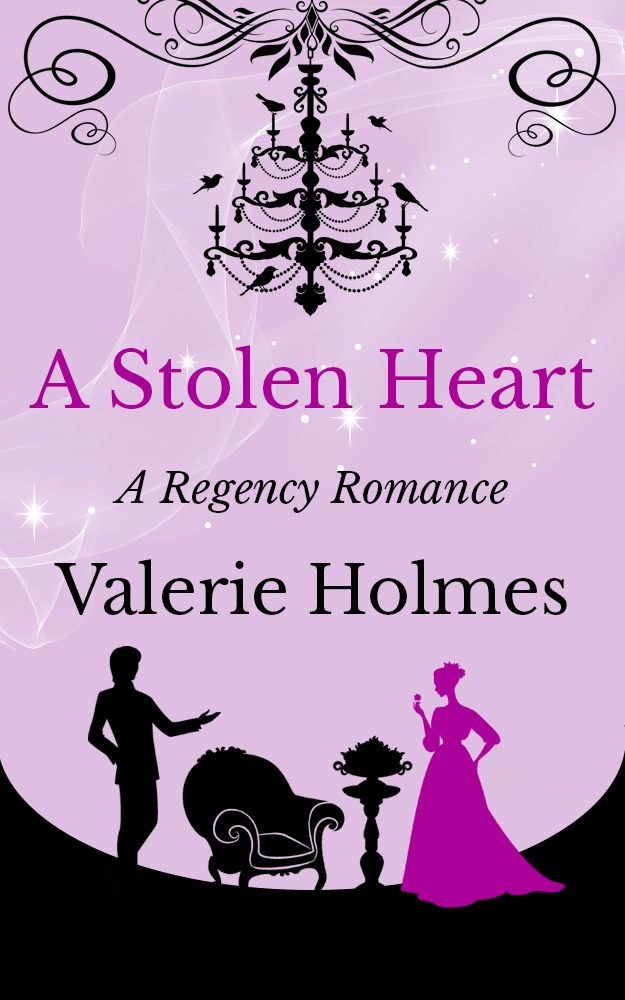
If you love the adventure with mystery combined then download A Stolen Heart from Amazon today.

stolen_heart
Miss Ruth Grainger’s coach jolts to an abrupt halt when it is stopped by a highwayman.

Fearing for her life she is surprised when this highwayman seeks only to retrieve papers carried by a fellow traveller, her guardian, Mr Robert Grentham’s business associate, Mr Archibald Upton.

Ruth abhors thievery, but she is even more disgusted by the cowardice of the man, Upton, as he uses her as a shield.

Released unharmed, she is haunted by the dark blue eyes of the stranger.

What is his connection to Upton? And what is in the papers he was so intent on stealing?

Ruth returns to Grentham’s home, and along with his silly, young wife Eliza, prepares for an upcoming ball.

Little does she know that Grentham is orchestrating events so that the despicable Upton will become her husband.

As Ruth starts to suspect the truth, another stranger steps into her life, and once more she is bewitched by a pair of blue eyes …

Headstrong and independent Ruth is determined to marry for love, and on her own terms.

But everyone around her has other ideas …

Will Ruth be forced into a match she doesn’t desire?

Or will she end up with the man who has stolen her heart …?

A Stolen Heart is a charming regency romance about mistaken identities, and following your heart’s true path.

Promotion ends Sunday!

More titles

This slideshow requires JavaScript.

The Baker’s Apprentice

Buy and read now!

US Readers: iTunes / Nook / Kobo

UK Readers: iTunes / Nook / Kobo

Molly Mason dreams of escaping from the control of Mrs Cresswell, her step-mother, by becoming an apprentice to her friend who owns the local bakery. This ill thought-out plan is stopped when Juniper Cresswell’s fiancé, war hero Lt. Cherry, returns accompanied with a soldier who had been presumed dead. The soldier brings with him suspicions of murder, mystery and the key to Molly’s heart.

Crime and Punishment 3: Man-traps

Before moving on from Ripon I would like to mention one exhibit in the Prison & Police Museum that brought home to me the cruelty of the era that my historical stories are set. I found a man-trap displayed on the wall. I have mentioned them in my work, but it is only when you see the ugly things close up that you realise how being caught in such a sprung trap could maim and kill, in what was a slow and excruciatingly painful way.

They were hidden in undergrowth to catch or deter poachers or trespassers. They had a spring mechanism that meant the metal jaws (many had teeth – serrated edges to really lame the culprit). However, the sentences for poachers were also severe and included hanging or transportation. Although they were a fact of life in the early nineteenth century, and had been for some time, fortunately they were banned from England C.1830. Nonetheless some must have stumbled upon them by chance and others by necessity of crossing private land…

Extract from Phoebe’s Challenge

Phoebe's Challenge KEC Thomas closed his eyes fleetingly. “Yes, we will,” he spoke the words after a few moments of silence.

“We’ll what, Didy?”

“Find Levi; he didn’t disclose us – we should help him too.”

His hand, still holding the bottle, dropped down, but his senses awoke as the clang of an iron mantrap snapped viciously shut next to him. His face paled as he looked down horrified at the sight of meshed metal teeth that greeted him. Phoebe had screamed as the great jagged jaws of the mantrap had snapped shut as Thomas lowered his arm, triggering the edge of mechanism, but fortunately his limb had not fallen within its evil grip; instead the bottle was smashed.

Extract from Hannah of Harpham Hall

HannahShe was gamely running along a path ignoring Betsy’s pleas for her to come back to her, when an arm reached out and grabbed her by the shoulder, pulling her backwards. She landed in a pool of mud and foliage.

“How dare you…you great bully!” Hannah shouted out in indignation at the figure who stood openly laughing at her dishevelled state, whilst boldly standing in front of her. Her ribbon had come loose and her hair started to fall down onto her shoulders. Her anger rose and she was about to vent her opinion at the lad, who must have only been a few years her senior, but he spoke to her first.

“You stupid little spoilt brat! Look what you nearly ran into!” He threw a stick at the ground in front of where she had been heading and, instantly, the metal jaws of a man-trap snapped shut, tearing it in two.

Hannah’s mouth dropped open. She wanted to cry out, but was too scared and confused. Betsy ran up behind her, panting heavily. She slapped the girl hard on her shoulder. Hannah fought hard to hold back her tears. This was not the kind of adventure she had envisaged. The lad looked nervously around him as her father’s voice bellowed to them through the woods, “What is the meaning of this?”

Featured image / RN

Pheobe’s Challenge and Hannah of Harpham Hall are also available to buy on Smashwords!

Crime and Punishment – Dead to Sin

The early nineteenth century in England was a harsh time of poverty for many. When soldiers and sailors were no longer needed to fight the wars that had dogged England from the end of the previous century, many men returned victorious having fought for their King (or Prince Regent) and country only to face unemployment. With little or no social support they often turned to crime to feed themselves and their families. With the increase in crimes, came new laws and harsher sentences.
Ripon Museum
I recently stopped by one of North Yorkshire’s finest museums in the little city of Ripon. Ripon is an unspoilt cathedral city that has maintained its characteristics of a delightful market town with plenty of historical places of interest to visit. It is also an excellent base for venturing into the Yorkshire Dales or the North Yorkshire Moors!

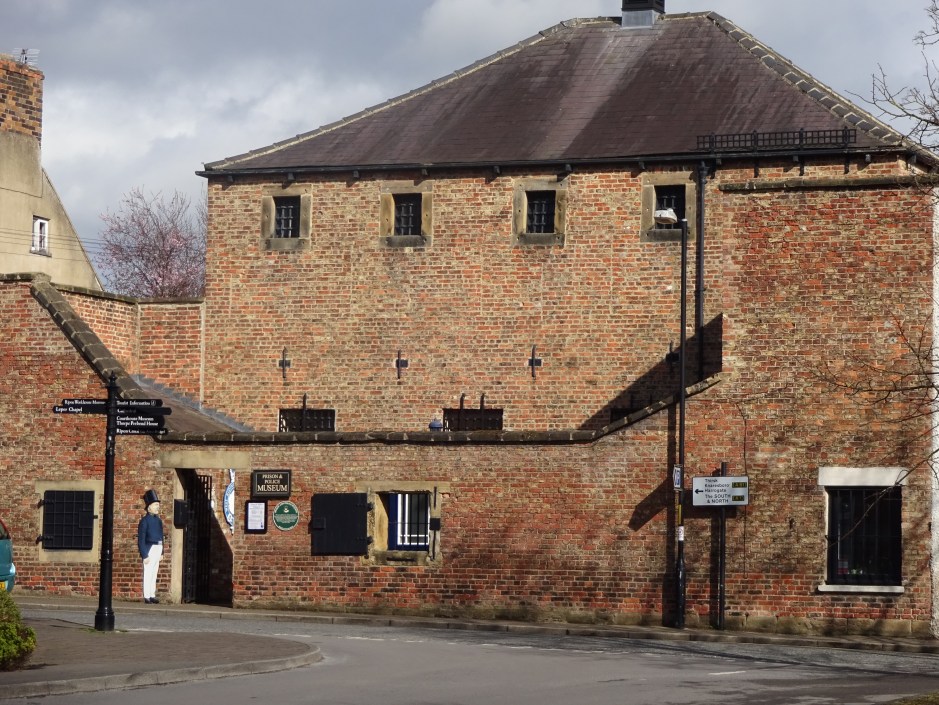
Ripon Museum comprises of three museums, all to do with the city’s historic law and order buildings that have been lovingly maintained. The photos below were taken in the Prison & Police Museum in St Marygate. It was a prison from 1686-1879 and a police station from 1880-1959.

When I first visited the prison I was writing Dead to Sin. Although the existing building was Victorian, the cells hold exhibits which relate to its earlier history and the development of crime and punishment, cruel and harsh as it was. Nowadays, the museum is clean, whitewashed and immaculately presented. Obviously in the time of Nicholas Penn it would be far from this.

The first chapter of Dead to Sin begins with Nicholas Penn bracing himself as he enters this dark, fettered world.


Nicholas Penn took one last deep breath of fresh air outside the high stone walls of the Gorebeck lock up. He glanced back at the cobbled square of the market town; wagons rattled, farmers haggled, women bartered, children’s laughter melted into the animals’ pitiful cries, the noise of which was in turn drowned out by the banter of the bidders. All was chaotic, all stank, yet there was colour and life here amongst the continuous whirl of people trading their wares.

             A heavy lock was turned in the barrier in front of him. Nicholas breathed deeply, his broad chest glad of what fresh air there was as his mind dreaded the prospect of seeing what he would find within the cold walls – and who. The reinforced wooden door creaked and groaned as the warder pulled it open, grating the edge against the stone.

             He pulled the high collar of his coat close, covering the ends of his shoulder length locks. ‘Trapped sunshine’ his mother had poetically described his wayward curls when he was a cosseted child. Now straighter, they had matured and grown like Nicholas himself. No sunshine would filter through behind this door. The rain started to pour down. Nicholas was silently led inside along a narrow stone corridor; he was taken further into the building’s bowels, down a spiral metal staircase to an airless chasm where six bolted black doors lined the dimly lit passage. Disembodied coughs could be heard even through the iron-wood barriers, which incarcerated their prey. Nicholas intuitively pulled out his kerchief and held it over his mouth. Gaol fever was to be avoided by the wise man who had the option to, but the inmates of this place had little chance to do that. The warder turned another key in the door lock at the end of the narrow corridor.

             “Ten minutes!” he growled back at Nicholas. The man had a curvature of the spine and did not look up at Nicholas’s straight frame. Instead, he shuffled back.

             Nicholas grunted what could have been his agreement or a simple acknowledgement. The turnkey gestured for Nicholas to enter.

             With some reluctance, Nicholas stepped into the small dank cell, ducking slightly so that his round hat did not contact the top of the door’s stone frame. What light and fresh air there was from the open grate that served as a window, was lost to the rain water, which now poured in, bringing with it the filth washed down from the market street above. The cell’s air stank of damp and excrement. Nicholas stood equidistant from the slime covered walls, not wanting his new riding coat to touch anything in the place.

             The cell was putrid. Under his highly polished boots was a stone-flagged floor strewn with soiled hay. Nicholas fought back memories, bleak, barefooted memories, as he glared at the figure in front of him. Like the cell, the man locked within it was unwashed, unshaven and unkempt. His appearance was in stark contrast to the man’s usually immaculate presence. The figure was seated on a small stool, wrapped in a flea-infested woollen blanket, leaning against the edge of the moist wall. Even in such discomfiture he seemed to be calm in manner, resigned perhaps to his fate. Nicholas wondered if this was true. To most people in his circumstance it would have been the case, or a near breakdown of spirits, but not Wilson. Nicholas knew the man too well. He was as hard as the stone walls which held him, to the depth of the heart that beat strong within his chest.

             Ebony eyes looked up at him as the door lock was slammed shut behind Nicholas who was trying hard not to show his inner fear, or his loathing of small airless spaces as much as his abhorrence for the pathetic looking creature in front of him.

             “You came, Nick!” the voice announced, louder than Nicholas had expected it to. That tone was almost as if he was annoyed at his late appearance. This was not the whispered breathy word of a dispirited soul. The confidence, the strength and the defiance were still there in his comments even if he looked to be in a physically weakened state.

For the love of baking!

The Baker’s Apprentice is now available to download in eBook format for all eBook readers at a special price of $1.50 from Smashwords!

I love baking because it sparks memories of time spent in a warm kitchen with my mother and aunty, chatting and laughing as we enjoyed eating some of the results of our labour. From a young age I would bake the basics for the house: cakes, scones, puddings and pies. The smell of freshly made bread or scones return me to part of my childhood that will forever bring a burst of nostalgic warmth on a cold winter’s day.

A friend commented that among my titles, which focus on my North Yorkshire villages in the early nineteenth century, I had not based one around a bakery. Not everyone had their own oven, so the village bakery traditionally played an important part of village life. One comment sparked an idea and Molly Mason sprang to mind; an impetuous heroine who does not lack the courage to leave the home she dislikes, but has not the foresight to realise the hard work behind the ‘cosy’ surroundings she imagines sharing when helping her friend who runs the village bakery.

Often in life we see our own problems and look at the greener grass growing elsewhere without considering the effort that is needed to sustain the lawn.

TBA KECThe Baker’s Apprentice is set in a fictitious North Yorkshire market town that pops up in many of my titles called Gorebeck. In this story it is in a state of transition as newer Georgian terrace houses line a road replacing the older timber and cottage buildings. Some people will always welcome change seeing it as an opportunity, or others as a threat – they crave the familiar and as the old saying goes ‘If it ain’t broke don’t fix it’. It is at a crossroads for routes north to Newcastle, south to York, east to Whitby and west to Harrogate.

I will talk more about Gorebeck in future as I look at asylums, churches, market towns, inns, new and old money, mills and coaching routes in future posts.

In this story, Molly Mason carries hatred in her heart, convinced her father was murdered or driven to an early grave and seeks to escape from his wife and discover the truth. Sometimes though the truth is not what we want to hear.

The Captain’s Creek – Pressing Times

Maggie Chase discovers an injured stranger hiding between two rocks as he flees for his life on the beach. Rapidly, she is forced to make a choice: reveal his whereabouts to the fast approaching press gang, or hide him from their sight.

The Impress Service was set up to make sure that the Royal Navy had the needed number of sailors to man its ships. It was harsh and unfair as the press gangs were notorious for their raids, often ignoring the set age-limits of between 18-55, in an era when it was difficult to prove your age when plucked off the street.

The coastal towns were rife with smuggling. Robin Hood’s Bay, for example, had a network of tunnels and passages linking the houses built on its steep banks. Although these were designed to move and hide contraband, they also proved useful when the press gang arrived. The womenfolk fought off the gang with anything they had to hand whilst their menfolk hid. They were a tough and hardy people, which is why the service wanted good seafaring men at a time when paid volunteers were not enough in number to fight Napoleon’s threat. Criminals who had chosen to serve a different type of sentence in the Royal Navy were often weakened by illness because of their previous incarceration. Therefore, the press gang swooped on the unsuspecting and gained a ruthless reputation as a result.

The eBook of The Captain’s Creek is available from Smashwords and Amazon directly or from most eBook sellers.

Abigail Moor – Biddy’s Bakery

Abigail was rescued as a baby by Lord Edmund Hammond – or so she believed.

Raised as a lady, calling him father, she enjoyed a sheltered life as she grew up and loved her step-brother, Frederick. Life dramatically changes because she has to flee from a forced marriage when Lord Hammond falls ill. With her lifelong maid she travels to the port of Whitby via the beautiful ancient city of York.

To Abigail’s naive eyes Whitby would have been a noisy, bustling place with a myriad of smells from the various industries surrounding the whaling, fishing and boat making industries. Even Abigail’s name, like her situation, has a double irony. Abigail literally means ‘my father’s joy’, yet she does not know who he is. The name is also used commonly to refer to a lady’s maid.

When I explored Whitby I came across a narrow snicket in which was a love old ram-shackled set of buildings I borrowed this setting for ‘Biddy’s Bakery’, placing it next to an old inn like the amazingly well restored White Horse and Griffin and took the extra liberty of placing a laundry opposite. Whitby was so wealthy through the whaling industry that in 1790 there were two street lamps in Church Street outside this original coaching inn.

I had the pleasure of staying in the same room that it is said Charles Dickens once used. It was a lovely friendly place in a fascinating location, and serves excellent food.

The eBook of Abigail Moor: The Darkest Dawn is available from Smashwords and Amazon directly for $2.99/£1.88 from most eBook sellers.

An Interview with Eileen Ramsay

Eileen RamsayThank you, Eileen, for taking the time out of your busy schedule to be my guest this month.

You have had a fantastic breadth of life experiences from teaching the children of international politicians and celebrities in the USA to working in Migrant Education. What lasting impressions did this contrast leave you with?
One fact that has remained with me through all my years of teaching is that, no matter the social position of the parents, the wealth or lack of it, education or lack of it, ALL good parents want the best for their children. Another is that poor parents – and I’m not talking finance here – come from every strata of society. I have had extremely wealthy parents leave seriously ill children in hospital while they jetted off to join some celebrity at a ski resort and I have had really poor Mexican parents turn up at my door begging for “Trabajo ahora?” whenever there was a school outing that cost a little money. They didn’t want a hand-out, they wanted to work to earn the money.

What is it about Mexico that appealed to you so much?

I visited Mexico often and studied Spanish language and Mexican music there. I love its fascinating and sometimes sad history. It is incredibly beautiful. The people are proud and they are generous and full of humour and you have just given me ideas for articles!

Would you agree with the observation that despite having lived with the lifestyle of the very privileged, you always seem to have kept your focus on what is important in life – family and reality?

You’re right, I did enjoy some incredible experiences and my upbringing was certainly not among the privileged but one wonderful woman in Washington DC reinforced all my early lessons. I had just met the man who was to become my husband and I wanted to impress him – shallow person that I am – with my ‘new’ family. I was taking him to lunch – to be introduced – and we walked into the house to see the lady of the house on her hands and knees washing a floor.  It turned out that the resident ‘cleaning lady’ wasn’t feeling well and had been sent to bed.

‘But why are you washing the floor?’ I asked.

She looked up at me and laughed. ‘Dirt,’ she said, ‘is no respecter of persons.’

My husband, of course, fell in love with her on the spot.
Churchills AngelsWhen did you break away from teaching to develop a career in writing?

Teaching and writing marched together for years. I wrote stories for Sunday School magazines and I wrote reading materials for primary schools. I was able to use knowledge of Native Americans I had gained while living in the US to write something a little different – Bud and the Hunkpapas was a favourite. For a few years I wrote from 4am to 6am but resigned when our younger son went to university.

Are you a very disciplined writer in the way you organise your day?
Organise?  I can already hear the laughter of those who know me.
I am disciplined. If possible I write every day; some days I write all day and well into the evening – that’s research time too. I use a laptop that has no internet because I can’t resist an email pinging in. My husband is learning to cook – our sons and lovely daughters-in-law sent him on a course – and he does one meal a day and he helps with housework – does all the heavy things and brings me a cup of coffee in bed first thing – and so I have 30 mins of ‘fun’ reading.

How and when did your first breakthrough as a published writer occur?
I went to a writing conference at USC where the great Michael Shaara, Clive Cussler, and the editor Charles Block were speakers. A friend typed up part of a Scottish Regency novel I’d been writing – I had even fewer technical skills then – and Charles Block read it. He was waiting outside a lecture room for me on the last day, handed me the script and said, “I think this will go but have chapters one and two change places.”

I had introduced the heroine in chapter two and he advised that the heroine should always be right there in chapter one. We returned to live in Britain that summer; I managed to get an agent – long story and sent her the finished, rewritten manuscript. A few days later she called and said she’d attended a party the evening before and an American editor had asked her about the availability of Scottish Regencies.  She showed her the typescript and it was bought! I looked at it a few years ago and it was rather dire – wouldn’t be published today. I rewrote it, correcting errors, and published it on Amazon!

You were established as a saga writer and then made the bold and successful move to writing romances based around the world of opera and music. What inspired this departure?

I had written children’s books, Regencies, Sagas and serials and I wanted to write contemporaries. I went to an artist chum’s exhibition and found myself thinking – What if all these paintings were of one person? The idea stayed and grew like Topsy and I wrote a book about an artist who loved a tenor – my favourite voice!  It was read by several reputable editors and agents but no one wanted it but almost everyone made sensible points. (I occasionally bump into one or two at an RNA party and we chat perfectly happily!)

            At a book launch I found myself standing beside a lovely woman who asked me if I wrote books like those of the superb writer onstage. I said “no” and told her my friend’s publisher had just, that very day, rejected me.

            “I didn’t reject you,’ said the woman and gave me her card. “Send it to me and I’ll have a look.’

            I dithered for days and eventually rang my friend, telling her I felt badly about, even inadvertently, using her launch to contact a very senior editor. She looked at me and said. “Don’t be stupid; if anyone holds out a hand to you in this business, grab it.”

            I grabbed, sent it and received the manuscript back with a “NO” for which she gave her reason. She also told me I really needed a good agent and suggested three. Two had already rejected me but I had not heard of the third and so I had one more go.

            The agent accepted me as a client, and, with her guidance, I rewrote a few scenes. The agent, the brilliant Theresa Chris, sent the manuscript to auction. It went for an amazing amount of money and was then bought by several foreign publishers.
Wave Me GoodbyeLast year, ‘Wave me Goodbye’ was published under the name of Ruby Jackson, which I understand is the first of a series of novels ‘Churchill’s Angels’.  Please tell us something about this new project?
I suppose, like many writers, after five best-selling books, I fell out of favour. Theresa stayed with me, encouraging me, advising me.  A few years ago, she asked if I would like to revisit WW11 and after much thought, I said yes. I did not know, of course, that  an editor at Harper Collins had conceived the idea of publishing a series of books about the courageous women who did everything from catching rats to ferrying Spitfires; the women she calls Churchill’s Angels.  Using the pseudonym, Ruby Jackson, I have now written four books; two have been published so far.  It’s been an enormous privilege. I’ve met land girls, pilots, nurses, etcetera and been awed by every one of them. Their stories need no exaggeration – they were quite simply – superb.

You obviously love historical fiction and research your chosen topic thoroughly. What advice would you give to anyone who was considering writing a historical novel?
Advice would depend on which era and which country but obviously I’d say, find out as much as you possibly can about the person the time and the place. Read everything, especially newspapers of the time, and don’t be afraid to ask questions. Archivists and librarians are great sources and remember there are archivists in famous department stores, in grand hotels and in universities.  They know what you don’t know you don’t know!

What is next for Eileen?

I have no idea; my head is spinning – that way, or that way but I did visit a conductor friend at the Royal Opera House earlier this year. He has been keeping me accurate about conducting and conductors for several years as I have an idea. He asked me about progress.

‘I’m afraid, for the past four years, the poor man has been standing on a rock looking out to sea.’

He shrugged. ‘Well, there are worse places for a conductor to stand.’

Now, wouldn’t you want to discover the worse places?!

More from Eileen

Website: eileenramsay.co.uk
Blog: Eileen’s Blog

Sharing Places – Part 4

Whilst researching social history for my stories I visit some fascinating places. Here are some of the places that have triggered plots, created characters or inspired a mood or a desire to return to the keyboard and write.

4. Whitby, North Yorkshire, England.


Whitby Abbey
Whitby Abbey, an iconic image on the headland.

One of my favourite places to explore on the North Yorkshire coast is the unique, atmospheric town of Whitby. This ancient port situated on the northeast coast of England is famous for many reasons.

St Hilda founded a double monastery (for monks and nuns) here in 657 AD, making it a valued seat of learning. The famous Synod of Whitby was held here in 664 AD.

Whitby became a famous whaling port with such famous seafaring names associated to it as the Scoresby‘s.

Whitby's 99 steps
The famous 99 steps, better going down than up!

The James Cook Museum is housed in the C17 house where he lived as an apprentice. It is an atmospheric place overlooking the River Esk. There is a large car park nearby so exploring this side of the harbour is not a problem if arriving by car. If you walk into the East side of the harbour from here you can wander through the old cobblestoned streets and explore the many yards and snickets.

Passing the old inns and market square you will reach the bottom of the famous 99 steps which lead up to the unique church of St Mary and then to the abbey beyond. The views across the harbour from here are magnificent.

St Mary's Church
The unique St Mary’s church in front of Whitby Abbey has pride of place on the horizon.

To experience staying in one of the original inns, The Whitehorse and Griffin has been lovingly restored and offers excellent food.

Whitby sporadically comes into my stories, either in passing as in Abigail Moor, or as a setting in itself, such as Amelia’s Knight, which is still to be released as an eBook.

Whatever your reason for visiting this fascinating location, being prepared to walk and explore its narrow alleyways, historic places, or the more usual shops and eateries on the west side of the harbour, then there is plenty for everyone to enjoy.

Whitby houses
A glimpse of the red pantile rooves that characterise bay town houses.

For excellent seafood and a great place to eat it, looking back across the harbour to the abbey is The Magpie.

Other places of interest in the area can be found on these helpful websites:


An Interview with Louise Allen

A photo of Louise Allen

When did you first decide to become a writer or discover your love for the written word?

I’ve always had a vivid imagination and loved fiction but I think academic work knocked the urge to actually write it out of me. Then I started for all the wrong reasons – I was a librarian and saw how popular Mills & Boon novels were. I thought it would be easy money – idiotic of me, of course. However, by the time I sorted myself out and took it seriously I was hooked.

What appealed to you about the romance genre?

It is a great genre for exploring relationships, which is always interesting, and when I discovered historical romance, there was no stopping me – two passions in one!

Your research is impeccably thorough. At what point do you take a step back from it and begin to write the book?

Walks Through Regency London Cover LARGE EBOOKThe story and the characters have to come first, always, although some plot lines can be sunk from the start if the historical premise is incorrect – 18thc characters getting an easy divorce, for example or a sub-plot that involves getting from London to York in a day. Generally I know what I don’t know and therefore what to research – politics, for example. I’ve got a huge personal reference library. But once I know I have a plot that will work in a particular historical context then I leave the research until afterwards and go back to it so it doesn’t take over. When I wrote a story set in AD410 during the Sack of Rome (Virgin Slave, Barbarian King) I just left questions in red for bits I needed to check and went back to them to be sure my characters left Rome by the right gate onto the right road and I’d got the layout of a bath house correct and so on.

I also write historical non-fiction – Walking Jane Austen’s London (Shire), Walks Through Regency London (Kindle), Stagecoach Travel (Shire, July) and I’m working on something on the Great North Road at the moment, so I can channel the hard facts somewhere they won’t take over.

You must have visited some fantastic locations and discovered some unusual facts during your research. Could you share some of the most memorable with us?

Finding three of the houses that Jane Austen stayed in when she was in London was a thrill. Only one, in Covent Garden has a Blue Plaque, but I discovered the other two when I found a pamphlet about research that was done after the war which revealed that her brother Henry’s homes in Sloane Street and Hans Place were not demolished by the late Victorians, but simply refaced and had new upper floors added. The originals are still there under the later shell.

Practical research is great too – I took carriage driving lessons, for example and I’m about to go on a practical osteoarchaeology course handling real skeletons. Goodness knows when that will come in useful…

Do you have a strict writing routine?

Yes, or I’d never get anything done! I write every afternoon until I have hit at least the minimum number of words I need to do to make sure I finish a week before the deadline, and hopefully a few more. That way I have some time in the bank for catching flu or unexpected commitments.

How do you balance the need of keeping your work accessible to contemporary readers against your desire for historical accuracy?

I won’t distort history but it is possible to use it to appeal to contemporary readers. For example I tend to write heroines who are older and who have the freedom to act in a more assertive, interesting way. They may be widows, or following one of the career paths open to women at the time. Where there are strong differences in beliefs and norms between the time I am writing about and the present – the fact that many wealthy families in the 18th century owed their fortunes to slavery in the West Indies, for example – I simply avoid putting my characters into those situations. On the other hand, the ‘long Regency’, which is the period I usually write about, saw the beginnings of many of the freedoms we are concerned about now, or at least the fight for them. Education for women, abolition of slavery, prison reform, concern for child welfare can all be woven in to some plots and engage the sympathy of readers.

As the New Writers’ Scheme Organiser for the RNA, what key advice would you give to someone who wanted to break into the romantic fiction market?

Read widely in the genre you are interested in and do so analytically as well as for pleasure. What works, what doesn’t? Why? Then work at developing your own voice – there is no substitute for practice!

Please tell us about your latest release?

UnlacingMy latest book is Unlacing Lady Thea (Harlequin Mills & Boon. April). I got the idea for it when we took a small-ship cruise down the eastern coast of Italy. My heroine is no great beauty, and thoroughly practical with it (and I had some fun with the fact that, unlike many romantic heroines, she doesn’t fool the hero for a moment when she disguises herself as a boy). My hero begins the book seriously the worse for drink and talking to the kitchen cat. He’s so drunk that he agrees it would be a good idea to allow Thea to accompany him on his Grand Tour so she can join her godmother in Venice. By the time he sobers up, it is too late and he is stuck with escorting his childhood friend for whom, of course, he has no amorous feelings… None at all, he tells himself.

What is next for Louise?

Scandal’s Virgin is out in June and Beguiled By Her Betrayer, which is set in Egypt in 1801, is released in August. Stagecoach Travel comes out in July.

Currently I’m working on book three in a trilogy, provisionally called Battlefield Brides. Book one is by Sarah Mallory and book two by Annie Burrows. The three books are set before, during and just after the battle of Waterloo and will be released to coincide with the bicentenary of the battle in 2015.

More from Louise

Website: louiseallenregency.com
Blog: janeaustenslondon.com
Twitter: @LouiseRegency