Meet Jan Jones!

JanJonesI am delighted to welcome Jan Jones as my guest this month. Jan is not only an amazing writer of romantic fiction but the organiser of many successful Romantic Novelists’ Association Conferences.

Hi Jan – thank you for taking the time out of your hectic schedule to complete the interview. This year’s conference at Lancaster University was, amazing, as usual. The speakers were from all sections of the industry. How have you seen the event change and grow since you became the organiser?

Hi Val,

Since 2005 when I took over as organiser, the conference has grown from just over a hundred residential delegates to over two hundred. We’ve also increased the number of choices, added extra Sunday afternoon sessions and offer a Thursday pre-conference arrival.

The Romantic Novelists’ Association is a very supportive organisation. When did you join it and make your first break into print?

I first joined during the 1980s when I was writing magazine stories, took a break, rejoined in 1994, then made the breakthrough from NWS to full in 2005.

Your career began in mathematics and computing, so when did you realise that you were a writer at heart?

Oh, I’ve always known that, but I also knew I wouldn’t be able to live on it. Computer programming was a much more bankable skill.

Do you prefer to write long or short fiction, YA or adult, historical or contemporary?

All of them. I have a dreadfully low boredom threshold. I like the variety and challenge of writing different forms and genres. As to length, I think when you first get the germ of an idea, you know what sort of size the story will be. When writing serials I have to squash the story into a few compact episodes, so it is an immense relief to then expand it to the length it always should have been and self-publish it.

Do you have a strict writing regime and work ethic?

Erm, no. I’d like to, but life keeps getting in the way. I just write whenever I can. Late at night is good, because everything is quiet and I don’t have the sense of having left chores undone. I try to only have one project on the go at one time, but I generally have two or three in various stages. There are very few points during the day when I’m not thinking about whatever the current piece of work is. The worst time for me is during RNA Conference preparations. I can’t keep a book in my head as well as all the conference arrangements, so I have to completely stop writing at the end of April and not pick the book up again until July. The upside is that by then, I’ve forgotten how much I hated it!

That is a long time for preparation. No wonder the conferences are such a success. What was the best piece of advice you were given as a new writer?

That everyone has something useful to teach you and that you never stop learning. What I worked out for myself was to believe in my own voice, to dare to be different, and to never give up.

What inspired The Penny Plain Mysteries?

I came across a strange jigsaw when I was clearing my mother’s bungalow that gave rise to the first Penny Plain story, but as for where the characters came from, I have no idea. I think all writers have people lying dormant in their subconscious, just waiting for the right setting.

What are you working on now?

I have recently got the rights back for the three Regency novels published by Hale, so I am revising them ready to self-publish. I am enjoying it tremendously – it’s just like meeting old friends and falling in love with them all over again.

I love that description. So what is next for Jan?

Keep on keeping on! At the last count I had something like nineteen projects waiting for my attention, ranging from finished novels to be done-something-with to tantalising germs of ideas with half-a-dozen lines of notes to anchor the thoughts in place.

Good luck and I wish you every success with them. Thanks for sharing some of your writing experience and world.

More from Jan

FacebookTwitter Blog RNA


Parthena’s Promise – new Kindle release !

Parthena's Promise (1)
Click the cover to go direct to Amazon!

England, 1815

London barrister and gentleman, Jerome Fender, has just returned to England after five years as a Captain in the killing fields of the Napoleonic Wars.

With the harrowing scenes of battle still haunting his every thought, he sets out to start a new life and to find a wife who will share it with him.

Meanwhile recently orphaned 21-year-old Miss Parthena Munro has also arrived at a North Yorkshire market town.

She has been sent away by her scheming sole relative, cousin Bertram, to be governess to a local family, only to find that the family has already moved away from the area.

Left stranded far from home with no job and no place to stay, Parthena encounters Mr Fender outside an inn, where she takes a chance to steal his money in a witless moment of desperation.

She whispers a promise to return the money one day and makes off across the wild Yorkshire moors.
But it’s not long before Fender catches up with her.

Set during 19th century England, Parthena’s Promise leads the reader on a spirited journey to consider if justice and true love are possible in a society on the turning point of change.

Ellie Promo

Laura’s Legacy – New from Endeavour Press!

Laura's Legacy

Laura’s story begins fifteen years after the fire that nearly destroyed Ebton in To Love Honour and Obey.
1820 Ebton, England.

Laura Pennington’s parents think it is time for her to marry, but they are concerned. She likes to take long walks by herself, and doesn’t quite fit in. Laura’s father, Obadiah, thinks local mill owner Daniel Tranton is the perfect husband for Laura, so he suggests marriage to Daniel while working on a business deal.

Daniel is not keen, but does not want to lose Pennington’s business. He is not sure what to do, as he has his hands full with disgruntled mill workers. Daniel has always treated his workers well, but that is the exception, not the rule.

A new problem arises, when Jeb, a young boy who works for Daniel’s cousin Roderick, runs away from the mill where he works. Daniel, not wanting to see him captured and beaten by the local louts who enforce the law, tries to track him down. He finds Laura hiding Jeb, who she stumbled upon while out on one of her walks.

Roderick has his henchman Mr Bullman hunting for Jeb as Laura hides him at her father’s boat house.
Checking on him one morning, Laura sees the boat is gone, but it’s seeing her father stepping out from the hotel he owns that shocks her the most.

For all his efforts to make Laura a lady, it seems Mr. Pennington is not a gentleman.
With the hint of revolution in the air, will Daniel and Laura find a love worth fighting for?
Laura’s Legacy is a historical tale of romance and family strife in a past world.

Laura’s Legacy is availble on Amazon Kindle

An Interview with Ben Adams

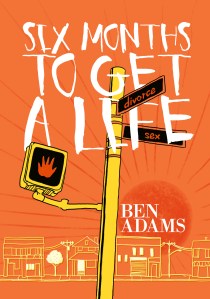
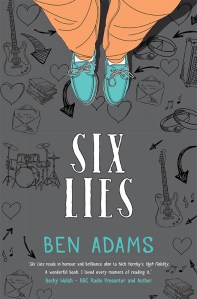
I am delighted to have author Ben Adams as my guest this month. Ben’s critically acclaimed novels Six Months to Get a Life and Six Lies chart two men’s journeys as they strive to make sense of their respective midlife crises.
edited Adam medium q
Welcome, Ben,

Please share with us how and when you discovered the joy of writing fiction!

I can’t remember a time when I didn’t enjoy making up a story. My dad is blind. Instead of reading books to me, he used to captivate me at bedtime, making up stories that would transfix me and keep me awake for hours. I caught the bug and used to invent equally inventive stories involving the most hideous of monsters. As I got older, my fiction expanded to include ingenious excuses for not having done my homework. Roald Dahl expanded my imagination still further as did Douglas Adams and Sue Townsend. But ultimately, I blame my dad.

When and how did you make the break from unpublished to published author?

I always wanted to write a novel. In my 20s I dabbled with crime fiction but too many hours spent staring at blank pages and a lack of life experiences meant that I couldn’t make my stories sing.

In my 30s I mostly wrote boring work-related web content and the occasional acerbic complaint letter to the authorities or to the dog over the road – it defecated on my drive.

And then my 40s came along. Sometimes it takes a life event to set you off on the right track. Six Months to Get a Life, my first novel, was ultimately triggered by my own family upheaval. It’s a story about a man overcoming a divorce and doing his best to build a new life for himself and his children. Having been through the pain myself, I felt able to give my characters some real depth. It was the first time I had felt truly able to write something believable, something memorable.

cover final

And luckily, I found a publisher who believed in the characters as much as I did.

How would you describe Graham Hope, your protagonist in Six Months to Get a Life?

Graham, like a lot of the characters I invent, is a fairly unremarkable fellow. At heart he is a good guy but like most people going through a divorce, he can occasionally be a bit maudlin. And even bitter. He’s someone who generally knows what the right thing to do is, even if he doesn’t always do it. He’s concerned about his relationship with his children. He’s also concerned about his relationships with women. Or rather his lack of relationships with women.

It isn’t easy to take a difficult subject and inject humour and hope into the story successfully. How did you balance the harsh realities of life against the sense of renewal and wit?

The simple truth is that no one would have enjoyed Six Months to Get a Life if Graham hadn’t been able to laugh at himself. If a story about coping with divorce, learning to live separately from your children or arguing over maintenance payments didn’t contain a few comedic release points, the reader would more than likely be contemplating suicide by the end of chapter 3.

The same goes for my second novel, Six Lies. Dave Fazackerley, the protagonist in Six Lies, discovers after she has died that his mother wasn’t his mother after all. And to make matters worse, he was already reeling from his wife’s decision to run off with a librarian. About the only thing Dave actually managed to cling on to was his sense of humour…

six lies cover for pc w endorse

Writing a novel is a major achievement for anyone, but how hard have you found getting to grips with marketing and using social media to build up your author platform – or are you a natural?

I am probably your typical author. Inventing stories is my passion. I love talking to people about mine and their stories too. But trying to understand the difference between a Facebook page and a Facebook profile, uploading content to a website, getting my head around boring twitter protocols and ridiculous book marketing websites is, quite frankly, the bane of my life.

I do understand the need to establish a good author platform though. Twitter indirectly led to me being invited on to the BBC Breakfast sofa. It also led to you and I connecting. These days, few authors will be successful without a bit of investment in their author platform.

What tips would you give to anyone, of any age, who is determined to become a published writer?

Firstly, you need to write exceptionally well. The best way to do that is to write, write and write some more. The more you write, the better you will become. Oh, and read a lot too. Learn from writers within your chosen genre, but don’t copy them.

Secondly, you need to build your emotional resilience. Believe in your own talent. Don’t let a little self-doubt put you off. Imagine if JK Rowling had thought, ‘Oh, this is crap,’ when she was giving Harry his lightening bolt scar and gone off and got a proper job.

Thirdly, see the previous question and take a deep breath…

What is next for Ben?

I have written my third novel in draft form. Provisionally entitled ‘Trouble in the Staffroom’, it is a school-based drama-come-romp. I am really proud of the draft as it currently stands and am loving the feedback I am receiving from beta readers. Hopefully, Trouble in the Staffroom will be published in September to coincide with the start of a new school year.

I am really enjoying reading Six Months to Get a Life and wish you every continued success.

@benadamsauthor

Ben Adams on Facebook

Ben’s Website

Achieving your goals.


picture1

For the Love of Writing: Making your goals realistic


Now you are sitting comfortably and have an idea where you will be working, you will be eager to start writing. If you are a hobby writer, then fitting it in around other commitments is not a problem. However, if you are trying to make a profession from it, then here are some practical tips. Having your own workspace is a luxury but, if it is not possible, then have one where you can ‘hot desk’ for set times. For a change of scene I sometimes use a large coffee shop or a library.

Once you know where you will write and when, set realistic deadlines to train yourself to work in a professional way for the day when those deadlines have to be contractually met. This can be fun as it is like setting a personal challenge.

You might write only 500 or 1500 words a day. That does not matter. Whatever your output is you can easily work out a schedule as a guide for your project to be completed.

For example, if you are setting out to write a 50,000 word manuscript and produce (on average) 1,000 words per day, then you will need 50 days to complete a first draft.

If you work 5 days a week, then you will have your finished first draft in 10 weeks.

Add a couple of weeks for editing and polishing it. So your realistic target would be a 50,000 word novella in 3 months!

These figures are a simple guide to illustrate how easy it is to set a credible target for whatever your project is. Be committed to your work, revising the schedule as you go along. Keep the goals achievable and be determined to succeed, and you will!

A Stolen Heart – Download it for Free!

A special promotion for my readers!

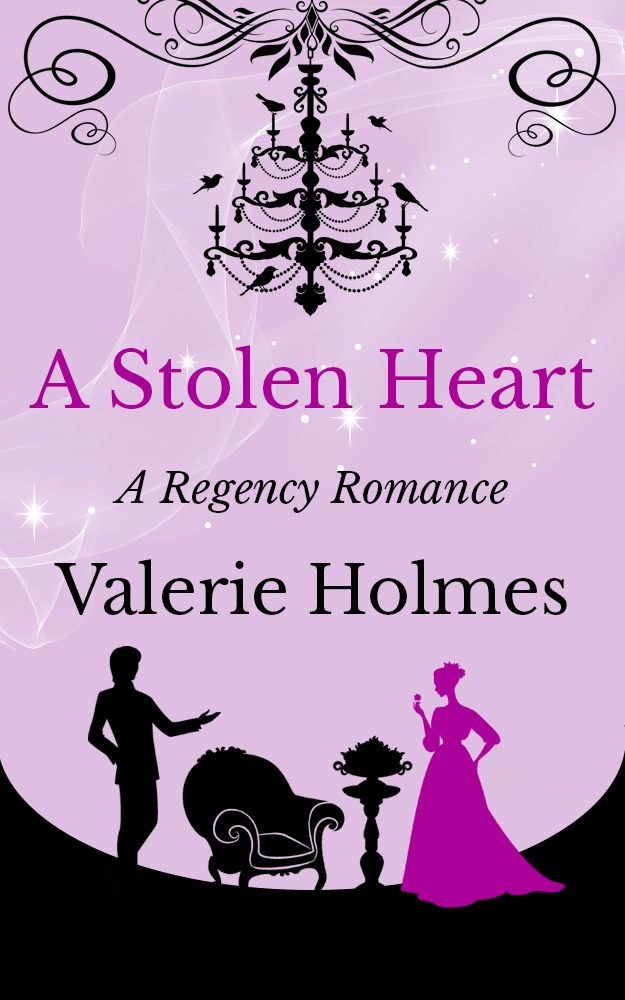
If you love the adventure with mystery combined then download A Stolen Heart from Amazon today.

stolen_heart
Miss Ruth Grainger’s coach jolts to an abrupt halt when it is stopped by a highwayman.

Fearing for her life she is surprised when this highwayman seeks only to retrieve papers carried by a fellow traveller, her guardian, Mr Robert Grentham’s business associate, Mr Archibald Upton.

Ruth abhors thievery, but she is even more disgusted by the cowardice of the man, Upton, as he uses her as a shield.

Released unharmed, she is haunted by the dark blue eyes of the stranger.

What is his connection to Upton? And what is in the papers he was so intent on stealing?

Ruth returns to Grentham’s home, and along with his silly, young wife Eliza, prepares for an upcoming ball.

Little does she know that Grentham is orchestrating events so that the despicable Upton will become her husband.

As Ruth starts to suspect the truth, another stranger steps into her life, and once more she is bewitched by a pair of blue eyes …

Headstrong and independent Ruth is determined to marry for love, and on her own terms.

But everyone around her has other ideas …

Will Ruth be forced into a match she doesn’t desire?

Or will she end up with the man who has stolen her heart …?

A Stolen Heart is a charming regency romance about mistaken identities, and following your heart’s true path.

Promotion ends Sunday!

More titles

This slideshow requires JavaScript.

New book launch!

To Love, Honour and Obey

Buy on Amazon!
Australia | Brazil | Canada | France | Germany | India | Italy | Japan | Mexico | Netherlands | Spain | United States of America | United Kingdom

To Love Honour And Obey

1805

Six years ago, Willoughby Rossington’s father was murdered while searching for the kingpin of a smuggling and spy ring. Taken under the wing of his uncle, who is running a counter-intelligence operation against Napoleon’s spies, Willoughby is assigned to take up his father’s last mission—and, hopefully, in the process find who killed his father and bring them to justice.

He encounters a young woman, Beth, who works at the local inn. Her spark and resilience against her master’s attempts to break her will strike a chord in him and he, albeit reluctantly, takes her with him when he leaves town.

As they begin to talk, he finds out that her master is more involved in the ring that could have been thought. She overheard things and knows things about the seedy side of villages that could be helpful to him and his mission.

Though Beth hasn’t had the opportunity for education, she’s smart and quite cunning while still maintaining a child-like wonder. Even as Willoughby makes plans to set her up with a family in order to protect her from the perils of his mission, he finds himself a bit melancholy at the thought of losing her company.

Beth is having none of it. She knows she can be of help to Willoughby and isn’t going to be left behind now that she’s found someone nice. Part on purpose, partly because of fate, their two lives become intertwined as they race against the villains that plot to destroy them both.

Will they uncover the truth behind the smuggling ring and find who is responsible for Willoughby’s father’s death?


Majestic Moors

The North Yorkshire Moors are beautiful at this time of year. The heather is just coming into flower as a carpet of purple spread across the land. Bird lovers can see or hear red grouse, curlew and golden plover.

Meanwhile hikers and dog walkers can enjoy the open expanses as they follow the old paths trodden by the monks of old. However, as sheep roam freely over these vast areas of rare moorland, they must be kept on their leads so that both can live in harmony and mutual respect of farmer and walker.

I refer to Monks’ Trods in many of my stories such as To Love, Honour and ObeyBetrayal of Innocence. After the Norman Conquest the growth of monasteries meant that pathways across country were created to transport goods freely and to keep the monasteries and abbeys in touch. The region has many well preserved ruins: Rievaulx, Fountains, Whitby Abbeys as well as Guisborough and Mount Grace Priory to name a few. These pathways could also be used to take fish directly inland across moor to the dales, which made them excellent routes to be used by locals for the distribution of contraband in the heyday of smuggling in the late eighteenth and early nineteenth century.

Many have since become overgrown. But these flagstone paths still exist in some places. The Quaker’s Causeway, where my photos were taken, runs from Guisborough (the setting of my fictitious market town of Gorebeck) to Commondale. Part of these medieval trods can still be used in this wild and beautiful landscape.

An Interview with Margaret James and Cathie Hartigan

I am delighted to welcome two successful writers and tutors of creative writing to my blog this month, Margaret James and Cathie Hartigan.

Margaret has been a shining light to me and many unpublished authors as she was the New Writers’ Scheme Organiser for the Romantic Novelists’ Association when I first became published. Cathie is a prolific writer, lecturer and founder of CreativeWritingMatters.

Welcome!

Hello, Valerie –thank you for inviting us to chat with you! It’s lovely to be here.

You are both successful writers so my first question must be where did your own writing journeys begin?

Margaret: I started writing short stories while my children were still babies and eventually I began selling them to women’s magazines.

Cathie: I was a hobby writer until about ten years ago, but after a foundation course with the Open College of Arts, I began having success in short story competitions. Since then I have taken my hobby much more seriously.

CreativeWritingMatters is the inspirational name of the business you founded along with Sophie Duffy. I love the logo. Could you tell us about CreativeWritingMatters and how it came into being?
Cathie: CreativeWritingMatters came into being when I left teaching in mainstream education. The flexibility of being freelance meant we could offer workshops and short courses on all aspects of writing. The competitions came later following the success of a flash competition that we ran for our students.

The name came about because of a conversation I had, during which I became rather too vehement about the importance of creative writing. ‘Creative writing matters,’ I heard myself shriek. Our logo features Sophie’s cat, Henry, the star of her story in our Cat Walks ebook. He’s perky and forward-looking, just like the three of us!

You have jointly written an excellent handbook and a workbook on aspects of creative writing so obviously have a great working relationship, but how do you set about working on a non-fiction joint project as opposed to your independent fiction?

Margaret: I first met Cathie when she joined my local writing group, Exeter Writers. I loved her short stories and she was kind enough to say she liked my own writing, too. We collaborated on producing an anthology of members’ work and found we got on very well. We both teach creative writing (Cathie teaches face-to-face while I teach online) and, after we’d finished editing and producing the anthology, we decided to write a guidebook for our students.

When we wrote The Creative Writing Student’s Handbook, we wrote alternate chapters and then we swapped files and edited these chapters. It all seemed to work well! But when we wrote The Short Story Writer’s Workbook, Cathie wrote the whole of the first draft and then I did a heavy edit, making the second draft twice as long as the first. This approach worked very well, too. We find our non-fiction writing styles are very similar. A few months down the line, we often can’t remember who wrote what.

Will there be more in this series?

We enjoy working together so we intend to produce a handbook for novelists and we have other projects in the pipeline, too. We hope to produce some more anthologies featuring either our own work or that of other people.

You are both very experienced tutors so I would like to ask:-

Margaret, what three tips would you give to an aspiring unpublished novel writer?

  1. Plan your story and know roughly how you want it to end. But don’t be too rigid in your planning. Be prepared for the story to change and grow while you write.
  2. Your reader should want to spend time with your characters. So don’t write about people you don’t actually like or don’t find very interesting yourself. Your characters ought to be your friends.
  3. A novel is a big project. So whenever you get tired or disenchanted – which you almost certainly will – take some time out to reflect and to think about how and where you want this story to go.

Cathie, what three tips would you give to an aspiring unpublished writer of short stories?

  1. Use vivid and specific details that tell a lot, rather than generalisations. If a character puts up an umbrella, we don’t need to be told it’s raining.
  2. How much time you have to set up your story depends on the number of words that have been stipulated by the competition or magazine. Your story needs to develop and reach its resolution without a sudden rush at the end. Once finished, check the balance of set up, development and resolution, then be prepared to cut ruthlessly at the beginning.
  3. Use dialogue and gesture to reveal character rather than word-hungry narrative.

The Exeter Novel Prize is going from strength to strength, what inspired this, and how do you see it evolving?

Margaret: The Exeter Novel Prize came into being because it filled a gap in the world of novel-writing competitions. It’s open to previously published and also self-published novelists. There is more information here: http://www.creativewritingmatters.co.uk/2015-exeter-novel-prize.html

Will there be a CreativeWritingMatters short story competition in 2016? If so, what advice would you give to entrants?

CreativeWritingMatters runs lots of competitions for both short and longer fiction, so here is some general advice.

  • Read the rules.
  • Abide by the rules.
  • Start your story as something interesting happens.
  • Round off your story with a satisfying ending.
Read Making the Grade by Cathie Hartigan
Read Cathie Hartigan’s story, Making the Grade!

What is next for Cathie and Margaret, jointly or independently?

Margaret: I’m about to start the second draft of a novel and to plan a new non-fiction project that has nothing to do with writing.

Cathie: My debut novel, Secret of the Song will be out later this year and there will also be another collection of stories by the three of us at CreativeWritingMatters. Right now, the characters in my next novel are twitching for me to get on with it.

Thank you for taking the time to share your experience and advice with my readers.

Thank you for inviting us! It’s been great to talk to you.

The Baker’s Apprentice

Buy and read now!

US Readers: iTunes / Nook / Kobo

UK Readers: iTunes / Nook / Kobo

Molly Mason dreams of escaping from the control of Mrs Cresswell, her step-mother, by becoming an apprentice to her friend who owns the local bakery. This ill thought-out plan is stopped when Juniper Cresswell’s fiancé, war hero Lt. Cherry, returns accompanied with a soldier who had been presumed dead. The soldier brings with him suspicions of murder, mystery and the key to Molly’s heart.