Discover Captivating Regency Adventures on Audible

Summer may be drawing to a close in the UK, but what a warm one it has been! Whether you enjoyed staying at home or ventured abroad I hope you had a fun time. Personally, I love to balance travel and home. Are you a home bunny or long to see the world? 

Holidays are a way to escape from the normal routine of daily life commitments, to experience new challenges and recharge… Like escaping in a good book. If you enjoy a slow burn romance wrapped around a Regency romantic adventure, then read on…   

My exciting news for Amazon.com readers is that from today three of my Regency novellas are now available to listen to free from Audible.com – Hannah from Harpham Hall, which was shortlisted for The Love Story of the Year Award by the Romantic Novelists’ Association when it was first published by DC Thompson has now joined The Baronet’s Prize and Phoebe’s Challenge.

In the UK and other countries they can be purchased on Kindle or enjoyed free from KindleUnlimited. I hope that in the future they will also be come available in Audible in the UK too. These are my first three novellas to be re-edited and re-launched in digital format, their length is perfect for listening to on a journey or loosing yourself for a few hours in a complete slow burn mantic wrapped around an exciting adventure.

All writers grow and learn as their careers progress. Since 2003, when my first novella was accepted for publication, a further 52 have been published in traditional large print and distributed through the Commonwealth library system.

Libraries have had to compete with the change in readers’ online habits and the availability today of books in various formats through various distribution channels. A library provides a physical presence within a community, but as well as offering its invaluable traditional book-loaning service they now offer so much more to their local community. Which is why they should be used and valued.

More good news is that For Richer For Poorer, published by Sapere Books, will be released in large print by Ulverscroft in early 2026.  

For reader’s who want a longer read with all the elements of romance, mystery and adventure then get ready to fall in love! 

My books offer Regency romances that will warm and captivate your heart. Discover the untold stories, hidden away from societies prying eyes. 

Read now and escape into the adventure! 

“Silent Revenge has the potential to capture not only devoted Regency romance fans, but also readers drawn to intrigue, history, and enduring love.” 

I hope you agree. Please feel free to leave comments and questions below. 

Explore the Timeless Beauty of Gisborough Priory

Gisborough Priory  is cared for by English Heritage and a local charity, Gisborough Priory Project. Its peaceful presence situated on the edge of the busy market town of Guisborough (that is not a typo, the two names are different) offers an escape into a tranquil space.

The priory’s name originates from the Old Norse origin, whereas the town’s name derives from the Domesday book entry – the town of ‘Gighesbore’.

Stepping inside the well-tended grounds is like entering a timeless sanctuary that has been lovingly preserved, providing a place of peace and reflection. I was surprised and delighted that this free-to-enter space is obviously a much used and cared for relic from the past, yet it is accessible to travellers today.

The Augustinian priory of St Mary the Virgin was founded by Robert de Brus in 1119. Its success led to the establishment of Guisborough as a thriving market town. In 1540 the dissolution of the monasteries under Henry VIII’s reign ended the priory’s power and control.

In my novels and novellas I created the fictitious towns of Gorebeck and Beckton, which were strongly influenced by such beautiful Yorkshire market towns as Guisborough. In the period when the Napoleonic Wars (1803-1815) raged overseas taking many menfolk to enlist for the King’s shilling and also to serve in HMS Navy, either by choice or pressgang, the lives of their families and loved ones were deeply affected back home. Trade was disrupted, taxes were high leading to smuggling – which was rife in the area, the costs of farming and grain rose, and of course men were away at war. Unrest, fear and tough times would be the reality for the many, whilst the landed gentry and ‘new money’ were still the relatively few who thrived in the country.

My stories reflect some of the issues of the day and the struggles that a country in the midst of war and social, industrial and religious change faced.

In Silent Revenge, Lord Farrington, a returning officer for Lord Wellington is asked by the Home Office to gather intelligence on local insurgents, lest uprisings happen in England like they did in France.

Goods, legal and contraband were brought to market vis such ancient routes as The Quaker’s Causeway, an ancient trod dating back to monastic times when Gisborough Priory was connected to Commondale.

“Parthena looked at her and decided to tell the truth — almost. “I walked over the old trods from Gorebeck to Beckton. I was at the Abbey School as a child and crossed the moors when the supplies were taken to market. I’d remembered it from back then. The school does not exist now, but the trods have existed for centuries.”

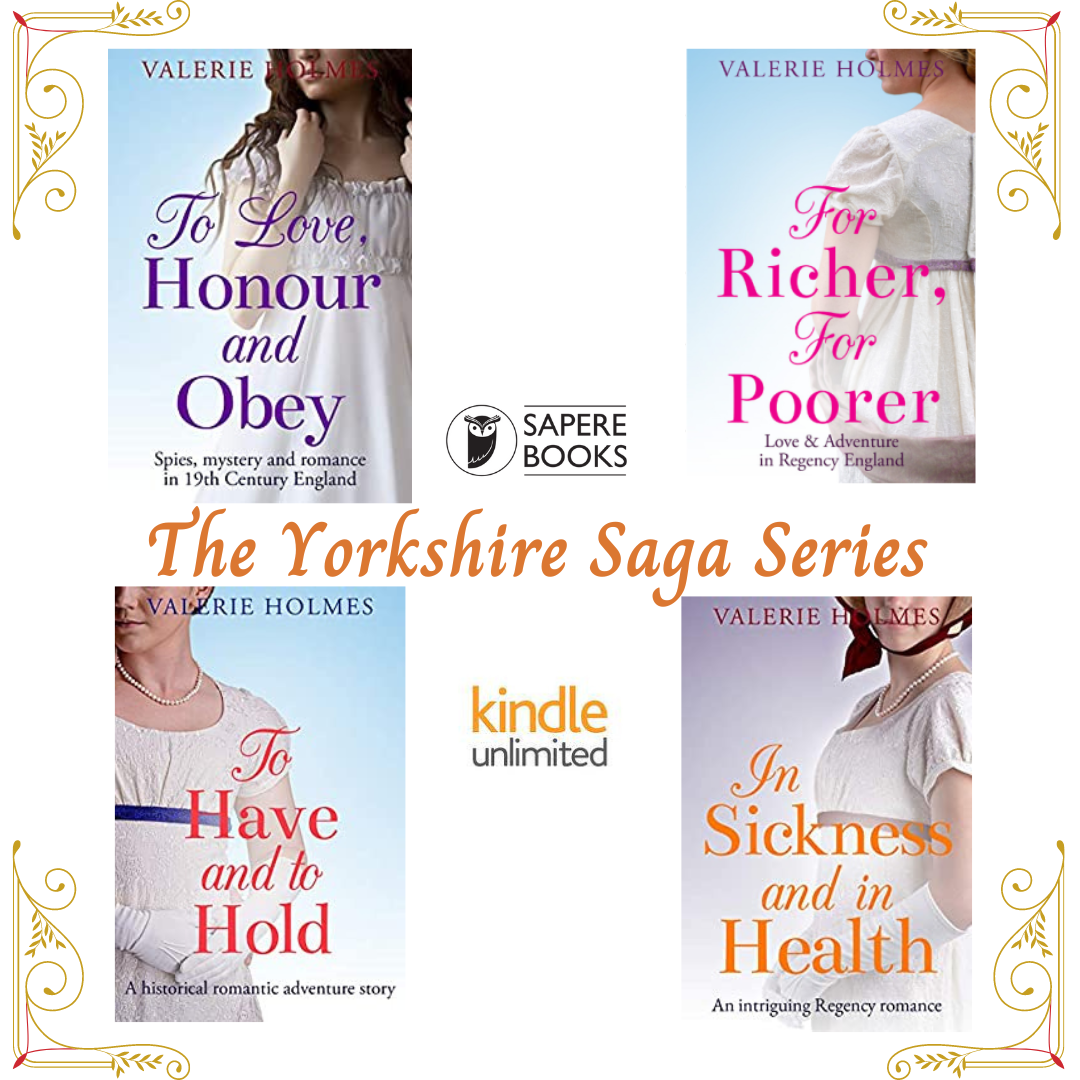
Parthena’s story is told in For Richer, For Poorer, published by @SapereBooks as part of The Yorkshire Saga Series

Book 2 http://getbook.at/ForRicher
Continue reading “Explore the Timeless Beauty of Gisborough Priory”

‘Secrets’ and a Blacksmith: Crafting Tradition and Innovation

I hope you have enjoyed the sunshine and warmth of June, when the UK sampled temperatures nearing those in the tropics! In North Yorkshire the heather is ready to bloom, bringing swathes of lush purple to the vast expanses of moorland. It is a truly beautiful and everchanging landscape.

Another beautiful county that I visited recently in the South West of England was Somerset. When I stopped at a garden centre I came across a working blacksmiths’ forge and felt as though I’d taken a step back in time. Instantly thoughts of Wilfred Underwood, Imogen’s father in Secrets, came to mind. Although we tend to think of smithing as a traditional craft of yesteryear, the charming owner soon corrected that impression.

There is still a demand for the old skills, used now for restoration work, preserving items from the past. This requires the mastery of the trade and knowledge of old methods, material, tools and skillset of the original worker to recreate or mend the item in question. Past imperfections are what makes an old item interesting today.

We live in a time where we have more technical accuracy and, perhaps as a consequence, less individuality. Science has moved on, providing precision tools and improved understanding of the process, yet a modern day blacksmith has to embrace and learn the old ways as well as the new.

Old skills are called upon to mend traditional machines and objects, some still used in other local trades like the local butcher’s grinder, along with reproducing such basic items as the imperfect nails made at a smithy’s before mass production. Each repair has to be done in the style and materials of that bygone age, but today’s Blacksmith also has to build on this historic knowledge by keeping up to date with modern, contemporary designs changes in style, tools, markets and techniques.

There is a long apprenticeship still required, for this labour of love, as science and art combine.

Historically, a chestnut tree was planted near the large forecourt providing shade and was symbolically associated with the trade. Yorkshire wrought iron was and is highly prized for its quality.

In Secrets Imogen’s father, Wilfred Underwood, is the blacksmith for my fictitious village of Dibbledale – a tranquil unspoilt place inspired by such villages as Hutton-le-Hole in the North Yorkshire Moors Park. His trade was central to the local community for the upkeep of agricultural equipment, as a farrier, and the many other jobs concerning the mending of household and trade goods. Wilfred, a gentle giant of a man, also encouraged Imogen’s creative nature providing her with fine tools and wire to make delicate jewellery, deepening the bond between father and daughter.

Secrets and their consequences worm their way between Micah and Imogen. Will they be able to save Dibbledale’s peace and tranquillity? Only when secrets are revealed can devoted friends be distinguished from destructive foes and allow love to find its true home.

From a writing perspective there is a fine balance between keeping historical fiction accurate to the period it is written about, and accessible to a modern reader, who may be unfamiliar with that period of history.

Trades, like everyday language, evolve and adapt through time. The visual importance and need of a central blacksmith may have changed, but in Regency they were essential and central to a thriving village community. They were also excellently placed to see and hear all the comings and goings of the villagers and pick up information from travellers who crossed their paths. Wilfred as a character is able to keep his finger on the pulse of local events.

I would like to greet and thank my new readers in the United States as well as the UK and Australia who have read and enjoyed Betrayal – Book 1 of Friends and Foes Regency romantic adventure series. The

I hope you go on to read the completed trilogy and discover what happens to Lord Farrington, an enigmatic character who features in Book 3 Silent Revenge , which will be published in paperback on 5th July. More about him next time!

July’s bargain book is The Baronet’s Prize, which is now 77p/$1, which also available on KindleUnlimited.

“A delicious Regency! Eleanor is horrified to be made homeless by her brother’s gambling debts and still more disturbed to find herself falling in love with the man who won the estate. Valerie Holmes resolves this dilemma in a spirited tale that keeps you turning the pages until the final “Ah!” of satisfaction.”
GL Robinson, New York USA, Regency romance author.

Reviews left on Amazon (and sites such as Goodreads) are always welcomed and appreciated by authors, especially if the book has been read and enjoyed. They are what keeps the algorithms working in the competitive world of publishing.

I would love to hear from my readers, wherever in the world you are based, and also from visitors to the region.

Have a lovely and safe weekend.

Secrets and Betrayals: A Historical Fiction Trilogy

“A well told tale set in a time when women and ‘ladies’ were expected to obey their master’s and ‘betters’. Here we have a feisty young woman who challenges the rules to her own advantage.”

Val Wood

1814, North Yorkshire, England

The trilogy of #FriendsandFoes begins with ‘Betrayal’ in its simplest and cruel form of the breaking of trust and the abuse of power. The early nineteenth century was a time of war, change and strict social dependencies. The landed gentry held power, and the bulk of the population served, in trade, in houses, or fought for their country overseas against the might of Napoleon’s army.

When a woman of status lost their main male relative, they fell into a void where marriage, or service as a housekeeper or governess prevented them from falling low. In Betrayal Lord and Lady Bagby own a vast estate in the fictitious growing market town of Beckton. Lord Bagby takes advantage of governess, Miss Georgina Davey. This spawns a web of lies and deceit from which Miss Lydia Fletcher tries to rescue her. Lydia’s own situation and silence is controlled and manipulated by the need to keep her ailing father’s tenancy in one of the Bagby estate cottages.

Enter Lord Samuel Speers, a qualified Edinburgh surgeon who is trying to locate his lost cousin, whose last known position was at Bagby Hall. Aided by his friend Lord Farrington, an Intelligence Officer to Lord Wellington, who soon realises that the Bagby’s have taken betrayal to an unimaginable scale.

Whilst finding his cousin, Speers has to accept his future role as head of the family estate following his beloved brother’s death.

The interplay of plot and the threads of deceit that run through the core and sub-plots give the story plenty of room for character development, as the external and inner conflicts arise and clash. We all like to think that in any given situation we would do the ‘right’ thing, but fortunately few of us are tested to the limit. In fiction, characters can be tested – and as authors we can determine who will rise and fall, whilst being true to the personalities that have been created. Hiding their flaws, playing with motivation and loyalties all add depth and credibility to each.

Personally, I love a happy or hopeful ending so my novels inspire and uplift after the adventure has played out. I hope my readers agree. Please leave comments below.

Secrets the second book in the series will be on Kindle countdown Amazon.co.uk from 15th June to 22nd June. In it you meet another friend of Lord Farrington the inspirational Lieutenant Micah Arrow, who has a vision to preserve his home village of Dibbledale, marry for love, and offer hope to returning soldiers – can his dreams be fulfilled? Find out in Secrets.

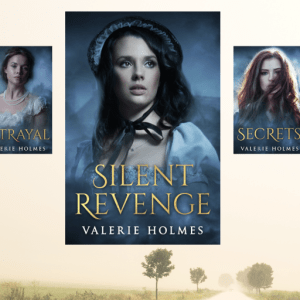
Silent Revenge brings the trilogy to a close with Lord Farrington’s return home, but after years oversees fighting a very visible enemy, he is now seeking a homegrown one, unaware that he and his family are in great danger from an unseen one.

Reviews are especially important in this highly competitive business, so please leave your honest feedback on Amazon and/or Goodreads.

As a special thank you to my readers Phoebe’s Challenge is 77p/$1 throughout June.

Have a lovely June!

Secrets of Dibbledale: A Story of Love and Adventure

May’s welcome sunshine seems to be reflected in the vibrant yellow gorse, brightening the moorland, whilst the aroma of the wild garlic’s delicate white flowers lightens shady woodland banks.

Whether walking through the ancient pathway of Saltburn Gill from the coast or strolling through the grandeur of the grounds of Fountains Abbey and Studley Royal, Mother Nature certainly lifts the spirits and inspires, as it did in Secrets for Lord Farrington’s friend and life-saver Micah Arrow.

The trees were finally showing their new leaves as yellow broom made for a colourful bank in the lane’s hedgerow that dipped towards Dibbledale. Saint Cuthbert’s parish church and the vicarage were on a small hill just outside the village. Micah stopped to admire the newly bloomed clumps of primrose nestling amongst the grass. He breathed deeply – he was home and at peace. Picking his way through the grass, he admired the budding bluebells pushing their way upward. Spring was a time of revival and that is what he planned for Dibbledale.

Dibbledale is a fictitious village, which has elements of real locations, such as, tranquil Hutton-le-Hole and Great Ayton. The latter being where the explorer James Cook went to school. They are villages that have largely remained unspoilt by modernisation and industry, which is what returning soldier Micah Arrow wants to preserve for his family. After witnessing the horrors of war first-hand, peace is what he craves.

Appealing as any setting is, North Yorkshire has dramatic wild beauty throughout the seasons, it acts as a historic backdrop to the characters and their adventures. In writing as in life, you need moments of light and shade to give depth and pace. Here a moment of quiet reflection turns when Micah senses danger…

Micah swung a leg over a fallen tree trunk, but then, as the metal’s edge caught his eye, he mantraps, never had he seen such things around Dibbledale. The woodland had always been open to all. The food it provided was free, the fallen trees taken as needed by the villagers for repairs – so what had changed?…’

Secrets will be on a Kindle Countdown from the 15th to 22nd June on Amazon.co.uk and is freely available on KindleUnlimited now. Micah is an important character to Lord Farrington and reappears in Silent Revenge.

As a thank you to my readers the newly re-edited to extended version of Phoebe’s Challenge is available at 77p till the end of May.

England, North Yorkshire, 1813
Miss Phoebe Elgie and her younger brother, Thomas, flee when an accident results in them being labelled ‘machine breakers’ in the cotton mill where fate had them trapped.
Hunted, with nowhere to run, they are aided by a mysterious stranger called Matthew. They soon discover that he is a man who appears to assume a variety of roles.
Phoebe instinctively trusts Matthew, unlike Thomas who doubts. She is drawn to this stranger; lives and destiny intertwine as their journey crosses the path of smugglers and traitors. This hinders their quest to uncover the truth behind the demise of their family, which left them so vulnerable.
Phoebe’s challenge is three-fold.
She must secure their escape beyond the reach of the overseers of the mill and the crime they have been accused of...

Uncover what happened to their mother.

Cope with the confusion of her developing friendship with the mysterious, Matthew, and determine if there could be a future for them.

Swept along by the swiftness of the serious events that dog their progress to uncover the truth, Phoebe struggles to overcome and resolve these challenges.
Determined, Phoebe has no time to doubt, but how will she succeed…?

If you enjoy any of my books, please leave a review on Amazon or Goodreads – they are much appreciated!

Celebrate Mother’s Day with Silent Revenge: an exciting Regency adventure!

Mother’s Day is rapidly approaching, which also means that my pre-order Regency novel, Silent Revenge, is about to go live on #Kindleunlimted and #Kindle. I am so excited to announce this as it has been a labour of love completing my #FriendandFoes trilogy.

Intelligence Officer, widower, Lord Oscar Farrington, returns to his family estate with mixed emotions. This is unsettling for the powerful, charismatic, and loyal officer who likes to be in control of his own feelings. With his overseas duties finally completed, there is talk of insurgence within the country, so he is still under orders to gather intelligence on his own countrymen, another cause for inner conflict as he has fought alongside his fellow soldiers and has some sympathy for the plight of the returnees.

Sworn never to remarry, he is devoted to his young, adopted daughter, Jessica, who he rescued with her mother in Betrayal. But Lord Farrington of all people should know ‘never to say never’, especially when Miss Jemima Parkes re-enters his life.

Silent Revenge keeps the reader turning the pages and is available for pre-order now!

My other news is that the large print edition of The Baronet’s Prize is available for order directly form the publishers Ulverscroft or via Commonwealth libraries. The original short novel is also available on Kindle.

All my novels are set in the beautiful country of North Yorkshire, England. Littered amongst the actual places of Whitby, York, Harrogate and Northallerton are my fictitious market towns of Gorebeck, Beckton and Dibbledale, which are loosely based on the picturesque Helmsley, Guisborough and Hutton-le-Hole. Please share your favourite places to visit within the region.

Enjoy the coming of Spring and if it triggers the desire to start a new project, write your own adventure, then please check out my manuscript appraisal page. I have over twenty-five years  of experience as a creative writing tutor and love to encourage new writers to explore this fascinating world of possibilities.

Good News!

Now in Large Print in Commonwealth Libraries or direct from FA Thorpe Publishing

Good news! I do like to share good news… In Sickness and In Health, published in eBook and print by SapereBooks is now available as a traditional large print paperback from @Ulvercroft. Copies can be ordered via Commonwealth libraries. Our libraries have had a hard few years, but there are people who find it difficult to manage an eReader so it is lovely to see this market niche is still catered for.

Smuggling, treason and espionage.

Smuggling in Regency times was rife in the rugged and isolated ‘bay towns’ of what was the North Riding of Yorkshire. Although the skill and daring of those involved in the trade can be admired, there was a dark and far-reaching side to their activities.

20181026_145817

In my books there is a recurring element of smuggling showing how it could have affected the lives of those within the region and, inadvertently, helped Napoleon in his war against our own nation.

Being an island, smuggling had been prevalent for many years within the coastal communities nationwide. With a much smaller population than today, most of the inhabitants of these places would be either involved, or at least aware, of contraband being stored or moved through their communities.

This extract from Rudyard Kipling’s’ poem A Smuggler’s Song captured it beautifully:

If you wake at midnight, and hear a horse’s feet,
Don’t go drawing back the blind, or looking in the street,
Them that ask no questions isn’t told a lie.
Watch the wall my darling while the Gentlemen go by.

The reasons the trade existed were complex but huge import taxes applied to certain consumables made brandy, tobacco, tea, silk and many other desired goods far too expensive for most people, instantly creating opportunity to fill a demand illegally.

Napoleon Bonaparte had no wish to lose the income France received from this illicit trade. So, he ordered the French Channel ports be kept open for business. This also created wealth for the organiser of the smuggling gangs’ pockets, some of which were part of the British landed gentry. Their subordinates lower down the chain of command were often unaware of the identity of the ‘top man’ who could only be known by a select few.

This trade was open to being used for further nefarious purposes, as free traders earned even more money by selling government secrets. This shared intelligence could cover troop deployments/movements/logistics, coastal patrols and the names and responsibilities of important people. This information had its value in coin, which Napoleon desperately needed to fuel his war effort. It was aiding treason.

phoebes-challenge

Government agents tried to uncover such traitors. In Phoebe’s Challenge Rev. Matthew Fenton provides information to uncover the local gangs. In The Friends and Foes series, Lord Farrington is a semi-retired Intelligence Officer who has been given the task of unearthing a traitor in Betrayal, but his role is concerned with insurgence and threats to the government at home too. This is a time of hardship and much perceived threats, externally from France and her allies and internally from those deeply affected by the loss of livelihood and the industrialisation, which was bringing huge wealth to a new ‘middle-class’ and displaced communities from the countryside to town and mills.

Revolution on our shores was a fear.

dscn0347Lord Farrington discusses the situation with  Dr. Samuel Speers,  in Betrayal

“I already know they are involved in the business of financing the trade in contraband. But what else? Lord Bagby has influential friends who he meets in his clubs – does he pass on information to our enemies as well as coin? Is he a traitor through and through? These facts I must seek out.”

Samuel looked up, quite shocked. “You think they are traitors. Many people locally dabble in smuggling to eke out their meagre livings…” 

Farrington leaned forward. “Stop my friend if you wish to remain so. Smugglers give coin to Napoleon’s war effort – they help our enemy and our men die. I do not debate the taxes set, but the way they fund our enemies for selfish gain. Do not be so naïve. I shall bring down the Bagby’s and this man Jed Webb who eludes our Riding Officers.”

 Villagers could earn some coin to supplement their meagre incomes by hiding contraband in amazingly inventive places or help to convey goods on arrival from larger vessels at sea in their own fishing boats to hide them on land. Tubmen were men paid to convey the goods from delivery to their next destination. They needed to be strong, often landsmen, who knew the area and walked the trods and snickets that linked the bay towns and crossed the open moors.

IMG-20181103-WA0006

The northeast coast leant itself perfectly to this. Many of these coastal villages have long, flat beaches of fine sand, where the local ‘cobles’, the shallow draught fishing boats could be easily drawn up and the villagers knew how to avoid the scars, the vicious fingers of rocks that extended from the shore. Fishing was the main source of employment on the coast. Whitby and Robin Hood’s Bay are well known for their smuggling links but the coast between Saltburn and Redcar was almost as notorious towards the end of the eighteenth century. The bay towns in my books of Ebton and Allunby are fictitious villages based on the sweeping bay of Saltburn to Coatham, where I grew up and hold a strong affection for.

Three organisations were created to try and stop this trade. The Revenue Cruisers, the Riding Officers and the Preventive Water Guard.

Revenue Cruisers patrolled offshore in ships that with full sail could often overtake smaller vessels once located. The problem they faced was locating ships amongst the many who sailed along the German Ocean, and also the honesty of the crews who were on occasion known to work with some of the smugglers in exchange for a cut of the goods, made discerning their whereabouts even harder.

Riding Officers were based around the coast, living near the suspected communities and riding the coast to try and prevent the collusion between land and sea. A nearly impossible task.

The Preventive Waterguard was established in 1809. They had houses around the coast – Watch Houses, and smaller boat crews which would patrol their stretch of coastland.

Between all three branches the tide was slowly turning in the governments favour. In 1822 they were incorporated into one force, The Coast Guard, charged with stopping the import of these highly taxed goods. They employed ex sailors, strong, tough and knowledgeable who needed employment after the end of the Napoleonic Wars.

This led to a gradual decline of demand and consequently causing the amount of smuggling that was committed throughout the first half of the nineteenth century to dwindle.

Before this happened though the battles fought to catch the smugglers and traitors lay the seed of many a good tale, some yet to be told.

Thank you for taking the time to visit my page. If you like the article please hit the like button and share where you are visiting from in the comments below.

Best wishes

Valerie

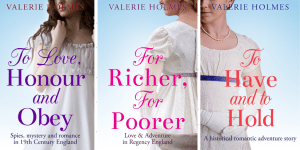
The Yorkshire Saga standalone series published by Sapere Books


series insty (1)

Regency Christmas celebrations

Merry Christmas

Christmastide in Regency times was a prolonged period of celebration, compared to our modern holiday, for those who could enjoy it. Public holidays did not exist so for the working class it was not a given that the day would be given  

It began on December 6th, Saint Nicholas’ Day. This was marked by exchanging small gifts.  

Christmastide ended on January 6th, otherwise known as ‘Twelfth Night’, marking Epiphany.  

For those who could celebrate Saint Nicholas’s Day, it was a period for parties, suppers, and balls to be held. But for all who had them it was a time for family and friends.  

This period did carry the feeling of ‘goodwill’ so it was expected that charity would be given to the poor, particularly on December 21st, Saint Thomas’s Day when the widows of soldiers who had died in the Napoleonic wars would go ‘Thomasing’, calling at the kitchen doors seeking alms or food parcels. 

On Christmas Eve holly and evergreens would be gathered and brought into the house to decorate and bring in the fresh small of nature. Garlands and wreaths would be woven with rosemary, bay, and laurel, and then embellished with apples, oranges, ribbons, and holly berries. 

Untitled design (1)

Mistletoe brought its own added spice to the festivities as kissing balls or boughs were made from it, a tradition that still lingers today. With each exchanged kiss a berry was plucked, once all the berries were gone then the kissing had to stop.  

A candle was lit on Christmas Eve and the Yule log was brought in wrapped in hazel twigs and custom stated that it should be lit with a remnant of last year’s log. The fire would then be kept burning as long as possible and be at the heart of family gatherings; a small piece being saved for the next year.  

istockphoto-184596879-612x612

On Christmas Day people attended church and then the gentry had a celebratory dinner of turkey, venison, or goose for the gentry, followed by plum pudding. Much of the seasonal food could be prepared ahead of time with a favourite being cold, brawn pies. 

The next day, Saint Stephen’s Day, was a day for charity. Richer people gave servants and tenants their ‘Christmas boxes’, usually gifts of money, hence it becomes known as ‘Boxing Day’. 

Finally, on the twelfth night there might be a party held with much dancing and singing. Hot spiced, mulled, wine was offered, and a special cake made to share amongst all the members of the household.  

Games such as ‘bobbing for apples,’ and ‘snapdragon’ – a game where raisins were soaked in a brandy in a large shallow bowl, were enjoyed. A more challenging one involved candles being blown out and the brandy lit, people then had to try and grab a raisin and eat it without burning themselves – health and safety was yet to be implemented!  

Men’s names were put into a hat so that ladies could then pick a name out to be her partner for the night.  

17thc-yew-wood-wassail-bowl-english-c1680---90_10183_main_size3

A C17 yew wood wassail bowl.

A wassail bowl was often carried from house to house, filled with warmed ale, mulled wine, or punch, sometimes accompanied by the singing of carols.  

The feeling of goodwill to all humankind was the message of the season. It depended on where you were on the social scale from impoverished to rich as to how much you could be a part of the tradition, but the feeling and love shared at this time was priceless then, just as it is today. 

Merry Christmas and season’s greetings to all my readers! 

Relax, this Christmas time and share Phoebe’s adventure and romanceon the North East coast in Regency times.

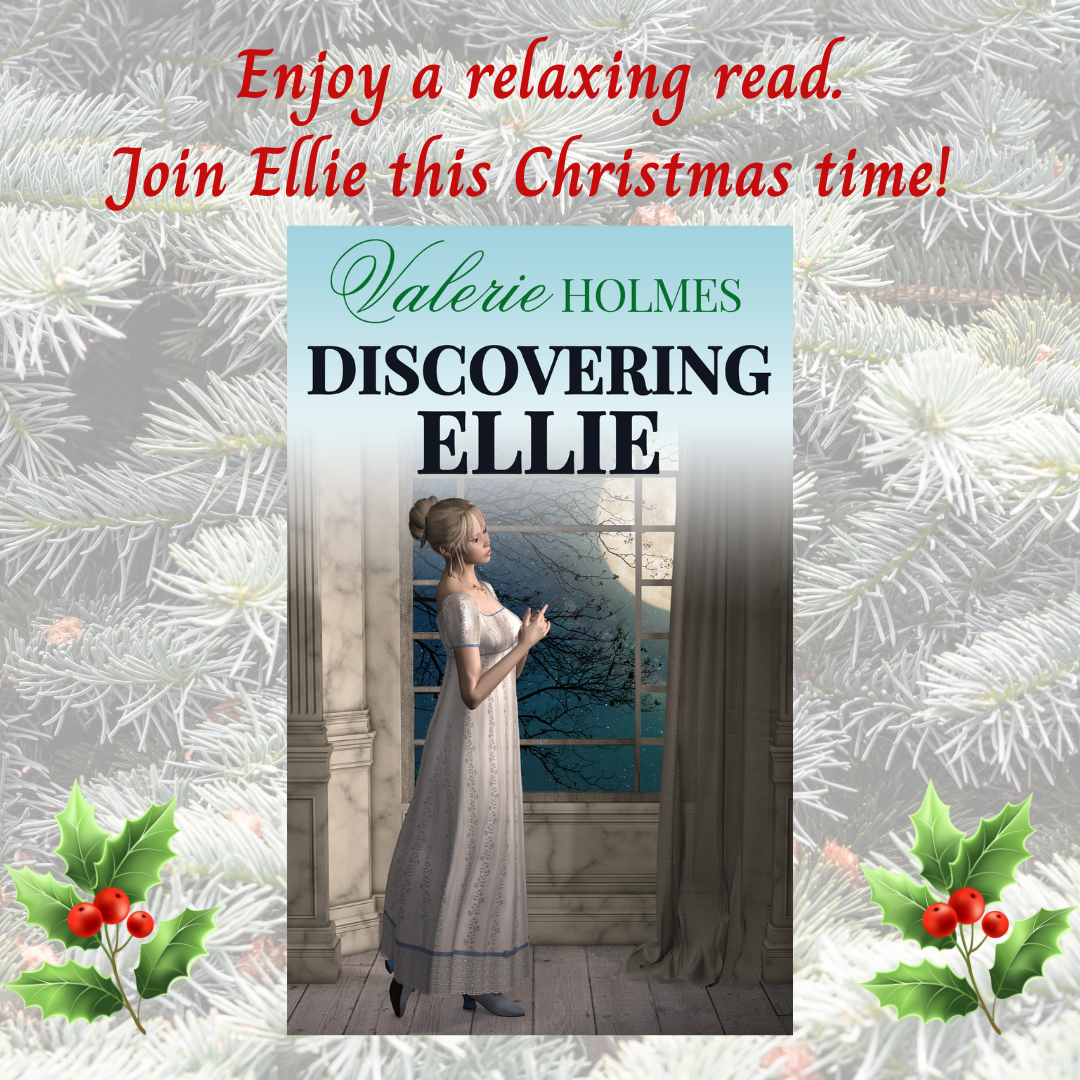
Ellie encounters a handsome stranger, when escaping the claustrophobic presence of her widowed aunt, Mrs Hemming in The Old Hall. She is initially distressed and annoyed, until he introduces himself as Mr. Montgomery Cookson causing Ellie’s dark clouds to instantly lift, for she knows they will formally meet again.
Mrs Hemming homed the deserted Ellie, whilst bringing up her two cousins, Dorcas and Sybil, despite the ruinous reputation of her mother for deserting her husband and child.
Ellie had been shocked and scared, when infirmed she was expected to marry Mrs. Hemming’s own cousin, Mr. MONTGOMERY COOKSON.
But has Ellie met her match in Mr. Cookson?
Will her future be as grim as she envisaged?
When Fate has cast a shadow over her life for so long, can destiny shine a light into Ellie’s world?
Will Ellie finally discover who she really is?

Available on:  iBook    Kindle   Kobo   Smashwords 

“Man traps, beware!”

secrets front

Micah, the charismatic hero of Secrets, encounters a man trap and saves a young lad from a terrible fate as the jaws snap shut.

Mantrap_Y
Godalming Museum

These devices were cruel, vicious deterrents that were set in the ground and when the central plate was pressed the jaws clamped shut, maiming the unsuspecting trespassers. 

Micah swung a leg over a fallen tree trunk, but then, as the metal’s edge caught his eye, he froze. He saw the danger and the notion of his peaceful village suddenly dispersed – man traps, never before had he seen such things around Dibbledale. The woodland had always been open to all.” 

Man traps have been used since the 18th century as the amount of what had been common ground or shared woodland began to be increasingly enclosed by unscrupulous and greedy landowners. 

Private landowners saw no reason to share the game that lived on the land with the ‘common folk.’ The 19th century progressed but so did poverty – rapidly, and many families struggled. Large pieces of what had previously been common land, free for all to graze their flocks and hunt on had been enclosed into private estates.

The Napoleonic Wars with France had incurred huge costs which had been passed on through taxation and by raising the cost of basic foods. Men had left to fight so their homes, wives and children had to cope alone. These were desperate times.

Beamish Museum

Man traps were cheaper than employing additional gamekeepers and were perfectly legal. The only proviso being that signs should be posted about the traps, or anyone injured could claim compensation. However, this aspect was not widely publicised, and it was hardly affective when literacy was rare.

DSC03148

Hunger motivated poaching gangs, breaking the law to feed their own families, and selling excess on. This upscaling of illegal activity meant landowners were more aware of the losses than they would have been with only occasional rabbits or birds disappearing. 

Man traps were an inhumane method of control, which could maimed and sometimes killed their victims. Easily disguised by putting leaves, twigs, or grass over them so that any foot, hoof or paw would spring the trap shut.

DSC02907
Ryedale Museums

They generally had a central plate with toothed jaws that would be held back by a spring until triggered when they would come together with considerable force leading to a bloodthirsty and gruelling result.

They were made illegal in 1827. Following this ‘humane’ man traps were created. A hole was dug, and the trap placed in it. These were then covered with suitable undergrowth. They still had a central plate, but the jaws were no longer toothed. No doubt it was not without pain, but it did not maim as it would previously. These had to be unlocked by the gamekeeper who had the key, but I imagine, extraordinarily little sympathy was given to the poacher who was then caught and sentenced. 

The Friends and Foes series, for lovers of romantic adventures is now available on Amazon and #KindleUnlimited. Just click here to take a peek!