Meet Sarah Quirke!

img_4007
Sarah Quirke, Publishing Manager of F A Thorpe Publishing

I am  delighted to welcome Sarah Quirke, Publishing Manager of FA Thorpe Publishing to my blog to talk about her work and interests.

 Firstly, Sarah, welcome! Could you tell us about FA Thorpe Publishing?

F.A. Thorpe Publishing is the publishing division of Ulverscroft Large Print Books Ltd, which distributes large print and audio books worldwide. It was established by Frederick Thorpe in 1964, with the intention of reproducing popular books in larger type for those who struggled to read standard print. Initially, there was scepticism on the part of publishers about this unknown format. However, a chance encounter with Agatha Christie allowed Dr. Thorpe to discuss this project with her, which resulted in her wholehearted support – she expressed a desire to see all of her titles produced in large print. This was a key factor in gaining the support of other publishers and authors. A Pocket Full of Rye was one of the first titles to be published in large print format, and we have, over the years, published all of Agatha Christie’s title in large print – along with a fair few others…

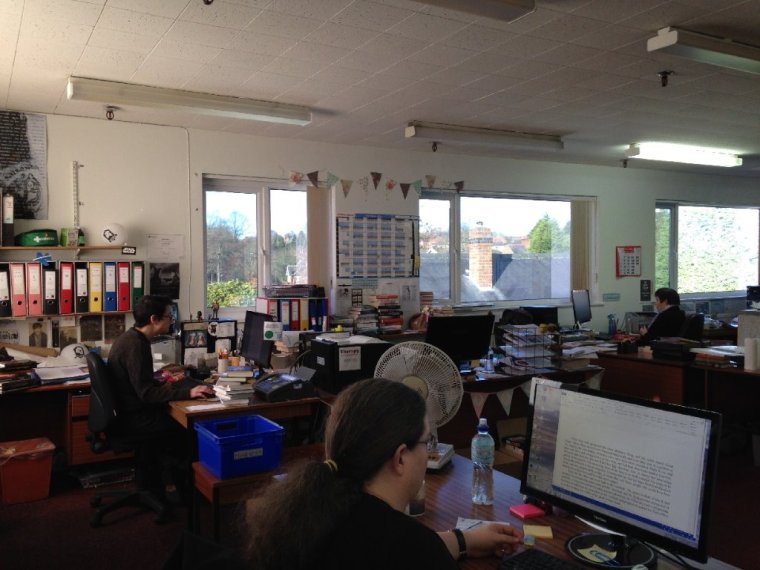
vals-blog-office-pic
The team working hard at F A Thorpe

Did you always want to have a career in publishing?

Although I had no doubts about what I wanted to study at university – English literature – I hadn’t a clue what I wanted to do once I finished my studies. I feel extremely fortunate to have landed my job. I’ve been with the company for nearly 14 years, so I feel rather fortunate about that, too!

Have you always been an avid reader?

Always! I vividly remember reading aloud to my dad when I was about six, and him telling me to read the words ‘as though you’re speaking’, and it suddenly clicked. And then there was no stopping me…

Which authors have, or do, inspire you?

I found A Land More Kind Than Home by Wiley Cash thoroughly inspirational in terms of the writing, which was exceptional; it just poured off the page and felt beautifully effortless. In terms of story-telling, and the moral dilemma presented, The Light Between Oceans by M.L. Stedman was utterly compelling.

What is your favourite genre for your own leisure reading?

I do enjoy a well-written, ‘unreliable narrator’/twisty-turn-y tale. I think Paula Daly is fantastic, and I also like Tamar Cohen. I’m afraid I’ve yet to read The Girl on the Train, but I definitely want to do so before seeing the film.

Could you describe the imprints you represent and the word limitations on each?

Our Charnwood and Isis imprints contain mass market popular fiction and non-fiction titles, and our big name authors. The upper limit here is very much dependant on how well we can expect a particular author to sell. Our Ulverscroft imprint tends to house much shorter titles, and the upper limit here is currently around 60-65,000 words. For our Linford Romance imprint, we’d ideally want titles to be somewhere between 30-50,000 words, although we have taken shorter and longer titles than this; the same is true of our Linford Mystery and Linford Western imprints, give or take a few thousand either way.

What do you look for in a new submission?

For most titles, the first consideration is always a practical one – if it’s too long or too short, I won’t be able to consider it. The next consideration is whether or not it will be a good fit for our lists.

What should writers avoid sending you?

If you’re aiming for one of the Linford imprints, then try to make sure it’s a clear fit within the genre – so, a romance rather than a general fiction title, for example. We tend not to do sci-fi or fantasy titles, or self-published non-fiction.

You must see a vast number of submissions, so is there any advice you could give to a writer who is considering submitting a manuscript to you?

Please read and re-read what you’re submitting with as clear an eye as possible. The fewer mistakes, the easier it is for us to see the story you’re trying to tell.

What is the most satisfying aspect of your work?

It’s great when I win an auction for a title I desperately want in our lists, and it’s also very satisfying putting a list together and seeing what I know are some absolutely cracking reads in there. Being surrounded by books all day is also a definite bonus!

Would you consider writing a novella/novel yourself?

I would love to. I note down ideas a lot, although that’s about as far as I’ve ever got.

When not involved in the world of books what do you love doing to relax?

Yoga and singing – I do both with great enthusiasm and questionable results.

My thanks for your continued support for my work (39 titles to date) and for the insight into your world and that of F A Thorpe Publishing.

Escape into Val’s World!

When life changes, a strong woman will survive…

Available from Amazon

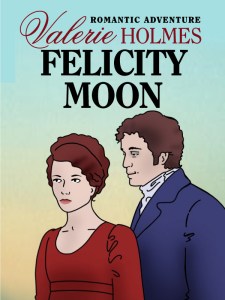
For only £1.99 in December meet  Felicity Moon!

Felicity’s temper is sparked when she needs to defend her honour against the owner of the Hall where she is serving as a maid. She is hastily found a new position by her friend, the housekeeper. Mr Lucas Packham, a surgeon, is opening a home for the sick at nearby Marram Hall and he agrees to meet and take her with him.

Felicity is surprised that he already knows details about her past, including the fact that her father, Squire Josiah Moon, is imprisoned in Gorebeck gaol. Together, they visit him, but Felicity is to be shocked, yet again, when she discovers that her father is alarmed at her change in fortune and also with the information she shares with him about where she is to live with Packman.

Upon arrival at Marram Hall, Felicity is charmed by the house on the cliff, and equally by their first client. She is drawn to her new employer as he shares his plans and dreams for this new venture and helping the poor. She also thrives on the responsibility he entrusts to her.

However, Felicity becomes aware that she is regarded with suspicion by some of the staff that were already in residence. Unusual events occur around the Hall, particularly in the old cellars, that she cannot ignore. She begins to mistrust the people around her including Mr Lucas Packman.

Her father shares his daughter’s fears, unbeknownst to her, and takes drastic action because of his concerns for her safety.

Will the dubious actions of her father’s past mar Felicity’s future? Can she act upon the growing tenderness she feels for Mr Lucas Packham? Or is he another man who will let her down again? Felicity determinedly seeks the truth – whatever the cost.

Set in North Yorkshire, England early C19

Love the adventure!

Welcome Roger Sanderson

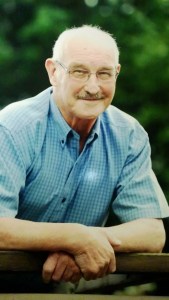
Roger gate
It is my pleasure to introduce Roger Sanderson as my guest author this month. Roger is a prolific romance author and assistant organiser of the fantastic RNA Conferences along with Jan Jones.

Welcome, Roger, and thank you for giving up your time to do this interview.

When and why did you break into the world of romantic fiction?

For many years I lectured in English at a Further Education College, and as everyone knows, all English teachers really want to write novels – so when I retired, I decided to give it a go. I was already writing Commando comic scripts. While waiting at the publishers one day, I picked up their matching romance line STAR, so started with that. I went on to write for Hale, then M&B and am now with Accent (as Gill Sanderson) and Desert Breeze (as Roger Sanderson).

The RNA is a very supportive organisation. When did you first discover and join it?

I was a member of a local writing circle run by the late Sheila Walsh. She was on the committee of the RNA at the time and suggested I join. I am very glad she did!

Did your previous experience of writing scripts for Commando Comics influence the way you plot and write your novels?

They both demand a tight plot and extra care dealing with characterisation because there isn’t the room to over-develop the storyline. You have to focus. Possibly the experience of writing Commando scrpits has left me with a liking for a ‘big finish’. Of course, in a Commando, the hero shoots the enemy. In a romance novel the hero kisses the heroine. An important difference.

You are a prolific writer. How many titles have you had printed by Mills & Boon?

I think I wrote 44 or 45, all of which have now been re-edited and republished by Accent Press. It’s great to know these new digital editions are reaching a second audience.

You must have researched so many medical books and procedures over the years for your medical romances that I wondered if part of you had a leaning towards actually being a doctor or physician. Or do you prefer to stay away from the actual blood?

The latter, definitely! However three of my children are in the medical profession (Mark is a consultant oncologist, Adam is a dispensing nurse and Helen was a midwife for many years) so I have a wealth of research at the end of the phone.

I know many people ask you about writing as ‘Gill Sanderson’, but as many women writers create male protagonists I find this natural and refreshing. Did you choose to adopt a female pseudonym or was it advised?

It was very strongly suggested to me that I write under a female name. At the time the perceived wisdom was that when reading romance, women preferred a female name on the cover.

You have a love of the outdoors and hiking. Do you use this time to switch off from writing or to ponder and plot?

Originally I mountineered at the weekends to counteract the pressures of the staff room. The habit of outdoor exercise never leaves you, even if these days it’s more of a long daily walk by the sea. I rarely switch off from writing. I use walking time to think about the current book and also mull over ideas for future ones.

What is the best piece of advice you could offer to an as yet unpublished writer?

One: read as much as you can. Two: aim to write at least 500 words a week. Some weeks, this might be all you manage, some weeks it might be 5000 words. The important thing is to write something.

What do you like to read to relax?

Anything! I have very wide reading tastes.

What are you working on now?

I’m currently writing a sequel to my light-hearted romance LIVERPOOL TO LAS VEGAS (Desert Breeze Publishing), which features an ex-PE teacher and a documentary film maker and is one of my US-published novels under my own name.

What is next for Roger?

I had a major heart operation last year which is taking me a lot longer than I hoped to recover from. My goal at the moment is to get back to full health and keep on writing!

Free Promotion! Parthena’s Promise

Available on Amazon
Parthena's Promise (1)

England, 1815

London barrister and gentleman, Jerome Fender, has just returned to England after five years as a Captain in the killing fields of the Napoleonic Wars.

With the harrowing scenes of battle still haunting his every thought, he sets out to start a new life and to find a wife who will share it with him.

Meanwhile recently orphaned 21-year-old Miss Parthena Munro has also arrived at a North Yorkshire market town.

She has been sent away by her scheming sole relative, cousin Bertram, to be governess to a local family, only to find that the family has already moved away from the area.

Left stranded far from home with no job and no place to stay, Parthena encounters Mr Fender outside an inn, where she takes a chance to steal his money in a witless moment of desperation.

She whispers a promise to return the money one day and makes off across the wild Yorkshire moors.
But it’s not long before Fender catches up with her.

However, on learning of her plight they set out on a plan to seek justice against the wrongs plotted by Bertram.

With Jerome’s help, Parthena returns to her home to the great surprise of Bertram, who, thinking that Parthena, the rightful heir to the estate, was now out of the way, was about to clear his debts by selling the family estate.

Jerome endeavours to hatch a new plan to thwart Bertram, but Parthena’s rightful inheritance can only fall to her if she marries within the month.

Parthena and Jerome discover the flame of love has been kindled between them, but is it already too late?

Meet Jan Jones!

JanJonesI am delighted to welcome Jan Jones as my guest this month. Jan is not only an amazing writer of romantic fiction but the organiser of many successful Romantic Novelists’ Association Conferences.

Hi Jan – thank you for taking the time out of your hectic schedule to complete the interview. This year’s conference at Lancaster University was, amazing, as usual. The speakers were from all sections of the industry. How have you seen the event change and grow since you became the organiser?

Hi Val,

Since 2005 when I took over as organiser, the conference has grown from just over a hundred residential delegates to over two hundred. We’ve also increased the number of choices, added extra Sunday afternoon sessions and offer a Thursday pre-conference arrival.

The Romantic Novelists’ Association is a very supportive organisation. When did you join it and make your first break into print?

I first joined during the 1980s when I was writing magazine stories, took a break, rejoined in 1994, then made the breakthrough from NWS to full in 2005.

Your career began in mathematics and computing, so when did you realise that you were a writer at heart?

Oh, I’ve always known that, but I also knew I wouldn’t be able to live on it. Computer programming was a much more bankable skill.

Do you prefer to write long or short fiction, YA or adult, historical or contemporary?

All of them. I have a dreadfully low boredom threshold. I like the variety and challenge of writing different forms and genres. As to length, I think when you first get the germ of an idea, you know what sort of size the story will be. When writing serials I have to squash the story into a few compact episodes, so it is an immense relief to then expand it to the length it always should have been and self-publish it.

Do you have a strict writing regime and work ethic?

Erm, no. I’d like to, but life keeps getting in the way. I just write whenever I can. Late at night is good, because everything is quiet and I don’t have the sense of having left chores undone. I try to only have one project on the go at one time, but I generally have two or three in various stages. There are very few points during the day when I’m not thinking about whatever the current piece of work is. The worst time for me is during RNA Conference preparations. I can’t keep a book in my head as well as all the conference arrangements, so I have to completely stop writing at the end of April and not pick the book up again until July. The upside is that by then, I’ve forgotten how much I hated it!

That is a long time for preparation. No wonder the conferences are such a success. What was the best piece of advice you were given as a new writer?

That everyone has something useful to teach you and that you never stop learning. What I worked out for myself was to believe in my own voice, to dare to be different, and to never give up.

What inspired The Penny Plain Mysteries?

I came across a strange jigsaw when I was clearing my mother’s bungalow that gave rise to the first Penny Plain story, but as for where the characters came from, I have no idea. I think all writers have people lying dormant in their subconscious, just waiting for the right setting.

What are you working on now?

I have recently got the rights back for the three Regency novels published by Hale, so I am revising them ready to self-publish. I am enjoying it tremendously – it’s just like meeting old friends and falling in love with them all over again.

I love that description. So what is next for Jan?

Keep on keeping on! At the last count I had something like nineteen projects waiting for my attention, ranging from finished novels to be done-something-with to tantalising germs of ideas with half-a-dozen lines of notes to anchor the thoughts in place.

Good luck and I wish you every success with them. Thanks for sharing some of your writing experience and world.

More from Jan

FacebookTwitter Blog RNA


Laura’s Legacy – New from Endeavour Press!

Laura's Legacy

Laura’s story begins fifteen years after the fire that nearly destroyed Ebton in To Love Honour and Obey.
1820 Ebton, England.

Laura Pennington’s parents think it is time for her to marry, but they are concerned. She likes to take long walks by herself, and doesn’t quite fit in. Laura’s father, Obadiah, thinks local mill owner Daniel Tranton is the perfect husband for Laura, so he suggests marriage to Daniel while working on a business deal.

Daniel is not keen, but does not want to lose Pennington’s business. He is not sure what to do, as he has his hands full with disgruntled mill workers. Daniel has always treated his workers well, but that is the exception, not the rule.

A new problem arises, when Jeb, a young boy who works for Daniel’s cousin Roderick, runs away from the mill where he works. Daniel, not wanting to see him captured and beaten by the local louts who enforce the law, tries to track him down. He finds Laura hiding Jeb, who she stumbled upon while out on one of her walks.

Roderick has his henchman Mr Bullman hunting for Jeb as Laura hides him at her father’s boat house.
Checking on him one morning, Laura sees the boat is gone, but it’s seeing her father stepping out from the hotel he owns that shocks her the most.

For all his efforts to make Laura a lady, it seems Mr. Pennington is not a gentleman.
With the hint of revolution in the air, will Daniel and Laura find a love worth fighting for?
Laura’s Legacy is a historical tale of romance and family strife in a past world.

Laura’s Legacy is availble on Amazon Kindle

An Interview with Amy Durant

Amy Durant
Amy Durant, Publishing Director of Endeavour Press

Where did your love of books originate?

My dad is a children’s book author, and he worked at Walker Books when I was little, so I grew up surrounded by books, and I fell in love with reading from an early age.
Do you have a favourite genre?
My favourite genres are historical fiction and literary fiction, although I read everything from sci-fi to military history.
Have you any desire to write a novel?
Yes, I have a few ideas and I hope to write something myself eventually.
What was your route into the publishing industry?
I was quite lucky – the first internship I undertook landed me a job! After completing my MA in contemporary literature, I applied to a few internships and a was taken on for a month with Endeavour Press. Straight after that I began working with them full-time as a publishing assistant, and now I act as Publishing Director.
How has Endeavour Press evolved in the time since it first took up the challenge of becoming the UK’s leading independent publisher?
Endeavour Press has evolved enormously since I first started work with them in January 2013. Back then we were publishing around 15 books month, and we only had about fifty authors on our books. Now we have five new imprints (Endeavour Press Germany, Venture Press, Pioneering Press, Albion Press and Endeavour Press Creative) and in total we publish 30 books a week, and we have a list of over 500 authors.
Could you tell us about the History Festival and what has been planned?
The virtual history festival we have set up will run from the 18-22 April. We have 50 authors signed up, some from Endeavour Press, and some from other publishing houses, and we will be running various online events, mainly on Twitter and Goodreads. They will include competitions, author interviews, reader Q&As, cover reveals and exclusive extracts from upcoming novels.
What is next for Amy and Endeavour Press?
The great thing about Endeavour Press is you never know what is around the corner! We are in talks about launching more imprints this year, and we are always scouting for new authors to work with. I have also just started a part-time PhD on English women’s writing in the seventeenth century, so hopefully I will be able to find some interesting forgotten texts to add to our classic books imprint.
Endeavour Press logo

An Interview with Margaret James and Cathie Hartigan

I am delighted to welcome two successful writers and tutors of creative writing to my blog this month, Margaret James and Cathie Hartigan.

Margaret has been a shining light to me and many unpublished authors as she was the New Writers’ Scheme Organiser for the Romantic Novelists’ Association when I first became published. Cathie is a prolific writer, lecturer and founder of CreativeWritingMatters.

Welcome!

Hello, Valerie –thank you for inviting us to chat with you! It’s lovely to be here.

You are both successful writers so my first question must be where did your own writing journeys begin?

Margaret: I started writing short stories while my children were still babies and eventually I began selling them to women’s magazines.

Cathie: I was a hobby writer until about ten years ago, but after a foundation course with the Open College of Arts, I began having success in short story competitions. Since then I have taken my hobby much more seriously.

CreativeWritingMatters is the inspirational name of the business you founded along with Sophie Duffy. I love the logo. Could you tell us about CreativeWritingMatters and how it came into being?
Cathie: CreativeWritingMatters came into being when I left teaching in mainstream education. The flexibility of being freelance meant we could offer workshops and short courses on all aspects of writing. The competitions came later following the success of a flash competition that we ran for our students.

The name came about because of a conversation I had, during which I became rather too vehement about the importance of creative writing. ‘Creative writing matters,’ I heard myself shriek. Our logo features Sophie’s cat, Henry, the star of her story in our Cat Walks ebook. He’s perky and forward-looking, just like the three of us!

You have jointly written an excellent handbook and a workbook on aspects of creative writing so obviously have a great working relationship, but how do you set about working on a non-fiction joint project as opposed to your independent fiction?

Margaret: I first met Cathie when she joined my local writing group, Exeter Writers. I loved her short stories and she was kind enough to say she liked my own writing, too. We collaborated on producing an anthology of members’ work and found we got on very well. We both teach creative writing (Cathie teaches face-to-face while I teach online) and, after we’d finished editing and producing the anthology, we decided to write a guidebook for our students.

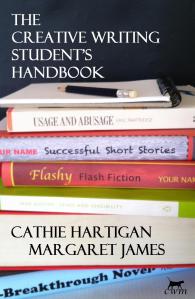
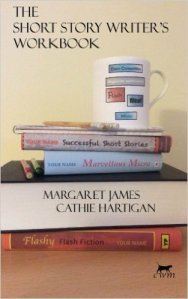
When we wrote The Creative Writing Student’s Handbook, we wrote alternate chapters and then we swapped files and edited these chapters. It all seemed to work well! But when we wrote The Short Story Writer’s Workbook, Cathie wrote the whole of the first draft and then I did a heavy edit, making the second draft twice as long as the first. This approach worked very well, too. We find our non-fiction writing styles are very similar. A few months down the line, we often can’t remember who wrote what.

Will there be more in this series?

We enjoy working together so we intend to produce a handbook for novelists and we have other projects in the pipeline, too. We hope to produce some more anthologies featuring either our own work or that of other people.

You are both very experienced tutors so I would like to ask:-

Margaret, what three tips would you give to an aspiring unpublished novel writer?

  1. Plan your story and know roughly how you want it to end. But don’t be too rigid in your planning. Be prepared for the story to change and grow while you write.
  2. Your reader should want to spend time with your characters. So don’t write about people you don’t actually like or don’t find very interesting yourself. Your characters ought to be your friends.
  3. A novel is a big project. So whenever you get tired or disenchanted – which you almost certainly will – take some time out to reflect and to think about how and where you want this story to go.

Cathie, what three tips would you give to an aspiring unpublished writer of short stories?

  1. Use vivid and specific details that tell a lot, rather than generalisations. If a character puts up an umbrella, we don’t need to be told it’s raining.
  2. How much time you have to set up your story depends on the number of words that have been stipulated by the competition or magazine. Your story needs to develop and reach its resolution without a sudden rush at the end. Once finished, check the balance of set up, development and resolution, then be prepared to cut ruthlessly at the beginning.
  3. Use dialogue and gesture to reveal character rather than word-hungry narrative.

The Exeter Novel Prize is going from strength to strength, what inspired this, and how do you see it evolving?

Margaret: The Exeter Novel Prize came into being because it filled a gap in the world of novel-writing competitions. It’s open to previously published and also self-published novelists. There is more information here: http://www.creativewritingmatters.co.uk/2015-exeter-novel-prize.html

Will there be a CreativeWritingMatters short story competition in 2016? If so, what advice would you give to entrants?

CreativeWritingMatters runs lots of competitions for both short and longer fiction, so here is some general advice.

  • Read the rules.
  • Abide by the rules.
  • Start your story as something interesting happens.
  • Round off your story with a satisfying ending.
Read Making the Grade by Cathie Hartigan
Read Cathie Hartigan’s story, Making the Grade!

What is next for Cathie and Margaret, jointly or independently?

Margaret: I’m about to start the second draft of a novel and to plan a new non-fiction project that has nothing to do with writing.

Cathie: My debut novel, Secret of the Song will be out later this year and there will also be another collection of stories by the three of us at CreativeWritingMatters. Right now, the characters in my next novel are twitching for me to get on with it.

Thank you for taking the time to share your experience and advice with my readers.

Thank you for inviting us! It’s been great to talk to you.

An Interview with Rosemary Kind

I am delighted to welcome author Rosemary Kind, who is the founder of Alfie Dog, a publisher of short fiction based in the beautiful county of North Yorkshire.

Welcome, Rosemary.

What was the deciding factor that motivated you to switch from a successful business career to becoming a full time author?

My husband had the opportunity to move to work in Belgium and I said ‘Why not?’ Because we were going back and forth every fortnight to see my stepchildren an ordinary career wasn’t going to work, so as I’d proved everything to myself that I needed to in a traditional working environment it was the perfect time to follow my heart. I’ve always written, but in my spare time. I knew I’d regret it if I never found out if I could do more.

Please tell us about your published work and what inspires you?

I write in a number of genres. Inspiration can come from the strangest places. My first published book (leaving aside ‘Negotiation Skills for Lawyers’ which was commissioned), was a humorous guide to travelling on the London Underground ‘Lovers Take Up Less Space’. I wrote most of the ideas as therapy when I was working in London. ‘Alfie’s Diary’ started as a daily blog in January 2006 when our first dog moved in. I’d been in Belgium for a couple of months and was writing mainly non-fiction, business articles, company newsletters etc. I wanted to write fiction, but it felt like a big step. Writing Alfie’s view of the world was a way to make myself write something every day. I originally intended to write it for a year of two, but nine years on it’s still growing and has spun off into several other projects, not least because he set up his own political party The Pet Dogs Democratic Party.

Inspiration for my novels is more interesting. ‘The Appearance of Truth’ came out of a writing group project to write 300 words on ‘verisimilitude’. Once I’d looked it up in the dictionary I started mulling it over. I was researching my own family tree and had ordered a birth certificate. It occurred to me that it would be quite possible to pass a birth certificate off as belonging to someone that it really didn’t relate to and it all went from there. Lisa was given the birth certificate of a baby who died at 4 months old and the story is her search for who she really is and why it happened. ‘Alfie’s Woods’ came from our woodland walks. We’d just rescued a hedgehog, who was stuck in a fence, when a helicopter passed overhead. The rest of the walk was spent thinking ‘What if they were looking for the hedgehog? What if he had escaped from the woodland prison?’ ‘The Lifetracer’ was inspired by seeing an electronic countdown clock in a catalogue and finding myself thinking ‘What if it could be programmed with Time to Death and used to send a death threat?’ I have more ideas than I have time to write them.

What appeals to you most about Entelbucher Mountain Dogs and Alfie in particular?

I fell in love with the breed long before there were any in the UK. They are incredibly loyal affectionate dogs who are great with children and like nothing more than to be close to you. I also adored the way they look, not only their colouring but the fact they are such happy smiley dogs. Alfie is my pride and joy. He is a gentle giant who is everything I had ever dreamed of in a dog. We are incredibly close.

When did the inspiration for an online digital site for short fiction first occur to you?

Not only do I write short fiction as well as books, but I have many friends who are widely published in that field. The more I talked to other writers the more frustrated I felt that there were so few outlets for short stories and for earning an income from secondary rights. It was January 2012 when I wrote the business plan. I launched to authors in February and to readers in May. I was overwhelmed by the response and we had more than 100 stories by the launch and have rapidly built a library of 1700 stories. I also wanted to set up a site that gave as much back to authors as possible. The culture is very much to give support to the writing community where we can. I was amazed by how word of mouth spread the message across the globe and we very soon had writers from more than 25 countries, all writing in English.

stp version smallWhat can a reader expect to find on www.alfiedog.com?

We carry good quality stories in a wide range of genres. All submissions are reviewed and where necessary edited and only the best are accepted for publication. We want our readers to come away having had a really good read and be looking forward to coming back for more. We carry work by over 400 authors, so there really is something to suit everyone’s taste. Many of our authors are widely published, but we enjoy introducing high quality work from new writers too. Unlike most sites, we carry the stories in a range of formats to suit all types of ereader or to print. We also publish a range of books in both electronic and paper formats. They are mainly short story collections, but we do carry some novels as well.

Of course for writers, our International Short Story Competition may also be of interest. The closing date is the end of September so there is plenty of time to take part. First prize is £200 and book publication.


How do you see www.alfiedog.com developing in future?
PDDP cover final small

The site is already one of the biggest short story publishers in the world, but hopefully it will be the site on everyone’s list when they talk about short stories. I want it to be ‘THE’ place that people go to when they are looking for quality short fiction.

What is next for Rosemary?

I’m writing another novel at the moment. This one was inspired by a chance comment in a meeting. Someone made reference to the ‘Orphan Train’ movement in America in the late 1800s and I had to go and find out more. As soon as I did, I was hooked on a story idea and the lives of three Irish immigrant orphans, fighting for survival, was born. It is my first full historical fiction writing and the research has been fascinating. It even made me get on a plane for the first time in over seven years, but that’s another story!

More from Rosemary

An Interview with Della Galton

Della Galton


I was intrigued to read that your first published story was achieved when you were six. You obviously have not looked back since. Could you share with us how this early success came about?

I have to confess, Valerie, that this comment on my home page is actually a bit tongue in cheek and an effort to pretend I am younger than I am. I wasn’t really six. Although I think my very first publication credit, which was a poem in Pony Magazine was actually published when I was about eight 🙂

Would you agree that you are a person who has a natural empathy with people, their problems and situations and that this is part of the appeal of your many successful character driven stories?

I do hope so. I do like people very much. And I think that all writers need empathy and sensitivity in order to step into the shoes of a character who may be quite different than themselves.

How would you describe your work ethic?

Workaholic. Definitely.

To achieve all that you do I can only imagine you are a fantastic organiser of your time. Roughly what percentage of time would you spend researching, writing and promoting a novel on social media?

I spend a little less time on social media that I did once – as it’s not easy to justify spending too much time there. I have a tendency to use it as a procrastination activity to avoid writing. But I would still say, writing a novel 60 per cent, researching 20 per cent, promotion 20 per cent.

Ice And A Slice Book 1

I remember driving my son back from college and hearing you on Steve Wright in the Afternoon discussing one of your non-fiction books ‘Eat Loads and Stay Slim’. Then I saw a new title of yours called ‘Ten Weeks to Target’ and I wondered if the research and work on one project creates a ‘spin off’ of ideas for new stories as an ongoing process?

I am thrilled that you heard the Steve Wright Interview – my one claim to fame, that!
Actually, the two books were entirely separate. Ten Weeks to Target came first – it was originally published as a serial in Woman’s Weekly. However, there’s definitely a spin off process that goes on constantly. Both of these titles came from my own experiences of trying to stay slim – and eat loads!

Could you tell us about some of the lovely pets that share your life?

I adore dogs. Currently there is Maggie May, my ten year old white German Shepherd. And Seamus who is a wolfhound, fourteen stone, and five years old.

You are not only a lecturer, public speaker and a creative writing tutor, but you also still attend writing events yourself. How important is this two way interaction?

Writing is my passion as well as my work. So I guess it’s just how things pan out. I think I must be quite boring. So recently I’ve taken up singing lessons and am learning to play the guitar, in an attempt to be more balanced.

Could you give a short piece of advice to as yet unpublished writers who are trying to break into the limited short fiction market, especially in the UK?

Don’t assume that rejections mean you aren’t any good. I still get my fair share of rejections. Not every story is saleable at the time you send it out. That doesn’t mean it won’t be later.

Ice And A Slice Book 2

Of all the things that you have achieved within your career what have been the top three most memorable highlights that you hold fondly?

This is tricky. There have been many. I will try and narrow it down.

I quite liked going on the Steve Wright Show.
Selling my first short story was awesome, as was selling my first novel.
And the third one, was when the editor of My Weekly phoned me and asked me if I fancied going on an all expenses paid trip to Malawi – I’m a journalist as well as a fiction writer. That experience and the going bit – I went twice – was fabulous.

The more I researched this interview the more convinced I was that your love of the world of writing is a driving force which means there are many more delights for us to look forward to. Could you share with us what is next for Della Galton?

At the moment I am writing a series for People’s Friend – I can’t tell you too much about this as they haven’t started publishing it yet. Watch this space. But I’m also keen to write a third novel in my Ice and a Slice series. The first novel is called Ice and a Slice. The second is The Morning After The Life Before. I don’t know what the title of the third one will be yet. If any of your readers have any suggestions I’d love to hear them though.

Many thanks for having me as a guest.

More from Della