Ripon Cathedral and the Saxon Crypt

I could not leave Ripon without visiting its ancient cathedral. The ancient building has a fascinating history, the oldest part of which still exists. The ancient Saxon crypt of the original church founded by St Wilfred (AD 634-709) not only still exists, but is open to the public for exploration. Accessed via a narrow staircase and a short narrow tunnel, the small rooms are amazingly peaceful.

(By the way, I’m an author, not a professional photographer!)

St Wilfred influenced the decision of the christian church to move away from the Celtic Church and follow the Roman church. The decisive move been made in 664AD at The Synod of Whitby when the calculation of Easter was decided by following the Roman method. He had a fascinating life and survived many life threatening events.

The main building is a delightful mix of Norman and Gothic styles, reflecting the many periods of history it has survived through. Far from feeling like a museum, which provides cold facts for the casual visitor this is a living house of God. When I visited there were Bible readings in progress, yet we were made welcome giving the palace a warm, homely feel. Other activities were in progress at the same time. There is no set fee to pay, but donations are requested and voluntary.

My visit was quite short as I was en-route to a conference but Ripon is certainly a place I would happily revisit as I am sure that I did not explore all its treasures.

Further sources of information:


[Featured image / The Association of English Cathedrals]

Crime and Punishment – Part 2

In my exploration around Ripon’s three amazingly well preserved law and order museums I was touched at the ease at which a person’s life, regardless of their age or sex, or the seriousness of the crime, could be devastated by incarceration, transportation or death.

The Police and Prison museum was mentioned in an earlier post.

The Courtroom, however, is based upon a Victorian courtroom and has been well preserved. It presents some shocking facts about how crime was dealt with from before this period too. The ‘Quarter Sessions’ were held at: Epiphany, Easter, Midsummer and Michaelmas and trial was by jury. Sentences passed here could send people to be punished in the market square or for more serious crimes to the County Assizes to hang.

From the seventeenth century the court could also sentence a ‘criminal’ to transportation to the colonies for up to 14 years. This could be instead of a death penalty. It was thought that criminal behaviour could spread so by removing it the problem it would literally go away by sending them to…

“His Majesties Colonies over the seas… preventing the communication of the cantagion.”

This was an extremely cruel system as many failed to return. Forgery was a capital offence, but this could be reduced to transportation. We usually link this to sending prisoners to New South Wales, Australia (1788-1868) as dramatised in the TV series Banished, but before this convicts were sent to the Americas from as early as 1610 to 1770’s.

Special gaols (jails) were built to house debtors. These were self-funding as inmates had to pay, if able, which made it difficult for them to clear the actual debts they were imprisoned for.

Suicide was judged as a crime and the bodies of such poor souls would be buried at crossroads rather than in consecrated ground.

Lesser sentences included whipping (for both sexes) pilloried or placed in stocks, was done publicly to humiliate and shame. Fines could be levied, but if the person was poor there was little point to this. When the standard of living improved then fines became more popular and they raised money to build more prisons, which were expensive to build and run.

A person could be bound over to keep the peace. It seemed normal for the harsher sentences to be levied against offenders who had already been before the court.

The last case of a man to be held in the stocks was in 1857. It was interesting to learn hat it was the Methodist and Evangelical Christians, who had previously been behind the banishment of slavery, who helped change public opinion and the law against such public cruelty as a punishment.

Vagrants and the poor had a different fate. If they stayed within the law and did not steal in order to feed their family they could end up in the harsh regime that was the workhouse. Ripon’s Workhouse certainly provides plenty of information about the long days and the harsh life of the individuals and families that were made to work there. Families were split, even mother’s from their children.

From being stripped and bathed at the entrance, to the early rise and long hours picking oakham (the threads were literally unpicked by hand (the phrase ‘money for old rope’ was born) to harder labour of breaking rocks. They did nothing to encourage people to stay willingly, but to make them work in the absence of any social welfare, they were places to avoid if possible.

Sophie's Dream Sophie’s Dream is to find an exciting life away from her strict education in a workhouse. She applies, with references, through an agency for a position as Governess in New South Wales. Along with other young women, she is chaperoned to their new life, beyond the social barriers in England. Abandoned on the quayside of Sydney, Sophie discovers the agency is a sham. Her instincts lead her to Mr Matthias Wells and a very different world opens up to her.

Sophie’s Dream is also available to buy on Smashwords!

More about crime and justice within the era:

Spring Offers!

Spring time has arrived at last and with it the chance to read a selection of my titles at only £0.99/$1.50 each! The selection of titles includes warm love stories set against mixed with adventure, mystery (or  a mixture of both!) set in the beautiful North Yorkshire countryside of the early nineteenth century.


Chloe's FriendChloe’s Friend: Miss Chloe Branton has been found a position as a laundry maid in a wealthy country house. The work is hard and she is slight, but she stays knowing the arrangement is to keep her away from her father’s enemies. Mr Thaddeus Poole, is an unlikely person to offer her help, but Chloe does not know if he will betray her or be a true friend.


The Baker’s Apprentice: Molly Mason dreams of escaping from the control of Mrs Cresswell, her step-mother, by becoming an apprentice to her friend who owns the local bakery. This ill thought-out plan is stopped when Juniper Cresswell’s fiancé, war hero Lt. Cherry, returns accompanied with a soldier who had been presumed dead. The soldier brings with him suspicions of murder, mystery and the key to Molly’s heart.


Truth, Love & LiesTruth, Love & Lies: Major Luke Stainbridge returns to his beloved estate in England after being held prisoner by Napoleon, to discover he has been replaced by an impostor. Meanwhile, Miss Florence Swan, naively, ventures out into the world alone to avoid the drudge of life in a cotton mill.  Two lives are in chaos. Two destinies combine: will the love of truth be enough to destroy a sinister network of lies?


Felicity Moon: Miss Felicity Moon jeopardises her position, her life and her future when she strikes the Lord of the manor in self-defence and is forced to leave his household. Squire Moon, her father, is in gaol charged with bank-rolling smugglers and the storing of contraband. She has one last chance to save herself from ruin in the form of a reference written for a Mr Lucas Packman, a man her father dislikes intensely. She has a stark choice to make: trust Packman or her obey her incarcerated father.


Dead to Sin (A Penn Mystery – Book 1): Nicholas Penn is summoned to Gorebeck Gaol to visit a man accused of the rape and murder of five wenches. Having been found holding the body of the last victim in his arms his plight seems sealed. Nicholas is torn between a sense of duty and his feelings of hurt and disgust when being in the presence of the accused. The tables turn abruptly, and Nicholas becomes the incarcerated, duped and incensed he is sworn to find the man, Wilson, before another victim dies.


Betrayal of Innocence: Lydia works desperately hard at Bagby Hall in order to keep her ailing father from the poorhouse. She is a loyal person, but is racked with guilt as she knows her friend, Miss Georgette, is being cruelly used by Lord and Lady Bagby. It is only when she fears Miss Georgette’s life may be in danger that she acts  – but how?

Crime and Punishment – Dead to Sin

The early nineteenth century in England was a harsh time of poverty for many. When soldiers and sailors were no longer needed to fight the wars that had dogged England from the end of the previous century, many men returned victorious having fought for their King (or Prince Regent) and country only to face unemployment. With little or no social support they often turned to crime to feed themselves and their families. With the increase in crimes, came new laws and harsher sentences.
Ripon Museum
I recently stopped by one of North Yorkshire’s finest museums in the little city of Ripon. Ripon is an unspoilt cathedral city that has maintained its characteristics of a delightful market town with plenty of historical places of interest to visit. It is also an excellent base for venturing into the Yorkshire Dales or the North Yorkshire Moors!

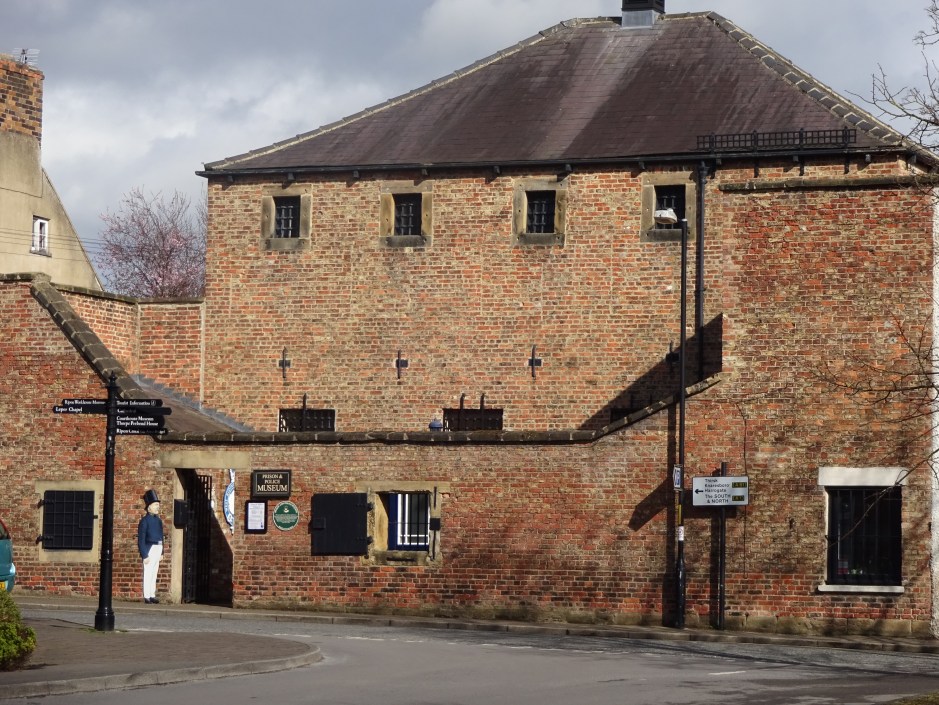
Ripon Museum comprises of three museums, all to do with the city’s historic law and order buildings that have been lovingly maintained. The photos below were taken in the Prison & Police Museum in St Marygate. It was a prison from 1686-1879 and a police station from 1880-1959.

When I first visited the prison I was writing Dead to Sin. Although the existing building was Victorian, the cells hold exhibits which relate to its earlier history and the development of crime and punishment, cruel and harsh as it was. Nowadays, the museum is clean, whitewashed and immaculately presented. Obviously in the time of Nicholas Penn it would be far from this.

The first chapter of Dead to Sin begins with Nicholas Penn bracing himself as he enters this dark, fettered world.


Nicholas Penn took one last deep breath of fresh air outside the high stone walls of the Gorebeck lock up. He glanced back at the cobbled square of the market town; wagons rattled, farmers haggled, women bartered, children’s laughter melted into the animals’ pitiful cries, the noise of which was in turn drowned out by the banter of the bidders. All was chaotic, all stank, yet there was colour and life here amongst the continuous whirl of people trading their wares.

             A heavy lock was turned in the barrier in front of him. Nicholas breathed deeply, his broad chest glad of what fresh air there was as his mind dreaded the prospect of seeing what he would find within the cold walls – and who. The reinforced wooden door creaked and groaned as the warder pulled it open, grating the edge against the stone.

             He pulled the high collar of his coat close, covering the ends of his shoulder length locks. ‘Trapped sunshine’ his mother had poetically described his wayward curls when he was a cosseted child. Now straighter, they had matured and grown like Nicholas himself. No sunshine would filter through behind this door. The rain started to pour down. Nicholas was silently led inside along a narrow stone corridor; he was taken further into the building’s bowels, down a spiral metal staircase to an airless chasm where six bolted black doors lined the dimly lit passage. Disembodied coughs could be heard even through the iron-wood barriers, which incarcerated their prey. Nicholas intuitively pulled out his kerchief and held it over his mouth. Gaol fever was to be avoided by the wise man who had the option to, but the inmates of this place had little chance to do that. The warder turned another key in the door lock at the end of the narrow corridor.

             “Ten minutes!” he growled back at Nicholas. The man had a curvature of the spine and did not look up at Nicholas’s straight frame. Instead, he shuffled back.

             Nicholas grunted what could have been his agreement or a simple acknowledgement. The turnkey gestured for Nicholas to enter.

             With some reluctance, Nicholas stepped into the small dank cell, ducking slightly so that his round hat did not contact the top of the door’s stone frame. What light and fresh air there was from the open grate that served as a window, was lost to the rain water, which now poured in, bringing with it the filth washed down from the market street above. The cell’s air stank of damp and excrement. Nicholas stood equidistant from the slime covered walls, not wanting his new riding coat to touch anything in the place.

             The cell was putrid. Under his highly polished boots was a stone-flagged floor strewn with soiled hay. Nicholas fought back memories, bleak, barefooted memories, as he glared at the figure in front of him. Like the cell, the man locked within it was unwashed, unshaven and unkempt. His appearance was in stark contrast to the man’s usually immaculate presence. The figure was seated on a small stool, wrapped in a flea-infested woollen blanket, leaning against the edge of the moist wall. Even in such discomfiture he seemed to be calm in manner, resigned perhaps to his fate. Nicholas wondered if this was true. To most people in his circumstance it would have been the case, or a near breakdown of spirits, but not Wilson. Nicholas knew the man too well. He was as hard as the stone walls which held him, to the depth of the heart that beat strong within his chest.

             Ebony eyes looked up at him as the door lock was slammed shut behind Nicholas who was trying hard not to show his inner fear, or his loathing of small airless spaces as much as his abhorrence for the pathetic looking creature in front of him.

             “You came, Nick!” the voice announced, louder than Nicholas had expected it to. That tone was almost as if he was annoyed at his late appearance. This was not the whispered breathy word of a dispirited soul. The confidence, the strength and the defiance were still there in his comments even if he looked to be in a physically weakened state.

An Interview with Alison Joseph

Alison Joseph portrait

Photo by:  Hugo Glendinning

I am delighted to welcome Crime Writers’ Association Chair, Alison Joseph, as my guest this month. 

Alison is a prolific author of crime novels as well as a radio dramatist skilfully adapting such works as Georges Simenons’ Maigret for the listening audience.

Welcome, Alison.

Have you had a love of books and story-telling from a young age?

Absolutely. I began to write stories almost as soon as I knew what writing was. And I was an obsessive reader too.  I was quite a sensitive child, and sometimes real life was somehow too big, or too chaotic, perhaps,  so finding I could take refuge in fiction was a huge relief. Not that I had an unhappy childhood, though – it was more my own response to it.

Your career began in local radio before making documentaries for Channel 4. When did you decide to branch out and become an author?

I loved being a radio presenter, in Leeds. And then, back in London, I got into making films. Documentaries is only another kind of story-telling, really. I made a series about women and religion for Channel 4, presented by Helen Mirren, and at that time my first child was about a year old, and I’d just tuck him under my arm and bring him on the shoot with me – in fact I have a lovely photo of him and Helen gazing rather adoringly at each other. But as he got older and then I had two more children, the logistics of freelance directing and childcare just got too much for me. As I said, I’d always written, and it just seemed to be the right time to start to take it seriously as a career.

What appealed to you about the crime genre?

I rather tumbled into it. I was lucky, that my first few short stories got published – they were mostly romances for women’s magazines. But I started hatching a plot to write a detective nun, and my then agent was extremely encouraging about it, so I wrote the first Sister Agnes story chapter by chapter, sending it to her. And it got snapped up straight away, and I started on the second. But even then I had no idea how much I would love being a crime writer, and how a properly structured, page-turning story was the thing I really aspired to do.

The Sister Agnes Mystery series has an independent, compassionate and frequently challenged protagonist at its core. Did you set out to explore issues of faith, science and life as the character develops through the cases she solves?

Again, those themes grew with time. The idea of a detective nun to start with was a kind of literary device – I wanted a female detective who was single and who would stay that way, but I didn’t want anyone hard-edged, and I didn’t at that time want to write a policewoman. Sister Agnes is white, half-French but very English, a contemporary nun, working in an open order, and as I wrote more of her I realised how she can quite realistically be in a position to know more than the police, for example, she works in a hostel for homeless people in South London. It’s difficult to write a believable amateur detective in these times of expert policing, so an amateur detective has to have access to places that the police can’t necessarily uncover with any ease.aj-act
And then, of course, there’s the dilemma of having a character who believes in a benign God constantly being brought face to face with the worst that one human being can do to another. Again, this has become a rich seam in the novels, her religious doubt in the face of suffering, and the way her own faith is tested by the criminality she encounters.

The novels have a very different setting, giving each book a fresh appeal. Did you plan out the whole series beforehand or do you move Agnes on one book at a time?

I don’t plan anything. Although, I have got a bit more orderly in my plot structuring as I’ve got better at it. My early plot structures were completely chaotic and often re-written madly as a result. But I have certain obsessions which I constantly circle in my work, and having a continuous character has been a great gift in exploring them. So, for example, The Dying Light is about family secrets emerging. It’s set against the background of the building of the Jubilee Line extension – I got to go down into the tunnels while they were being built, which was fantastic. And the Night Watch is about gambling and chance and the mathematics of probability. And A Violent Act is all about creationism and Darwinism.

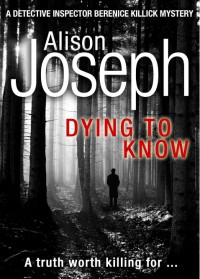
Last year Dying to Know was released. What appealed to you about Detective Inspector Berenice Killick?

Berenice is a policewoman, a mixed-race Yorkshirewoman. I had got to the point where I wanted to write more realistically. If you’re a copper then you really are dealing with murder, whereas if you’re a nun, even on the mean streets of Bermondsey, it’s not going to be that normal to have to solve a crime.  Dying to Know  is a police procedural about particle physics. I invented a physics lab in Kent, on the marshlands of the south coast there, and the story starts when it looks as if there is a serial killer targeting the lab. I got to visit the Large Hadron Collider at CERN for it, which was one of the most compellingly interesting days of my life.dtk200
What is the most challenging aspect of adapting someone else’s work for radio?

The thing about writing a radio play is that it’s all about speech. But in a way, so is crime writing. It’s about what people say – whether they tell the truth, whether they’re telling lies, whether they choose to say nothing at all. So my own radio plays, although most of them aren’t crime stories, still have a mystery about them, I hope.  My adaptations have been more to do with crime, for example, the Maigret stories by Simenon which I absolutely loved doing. I love working with actors too – there’s a magic about seeing someone find the potential in a line of dialogue.

You have been chair of the CWA for nearly two years, What major changes have you seen in that time and how exciting do you see the future of crime writing?

It’s been a great privilege to be Chair. It’s a role I give up this April. The single most important thing I’ve witnessed in my time as Chair has been the centrality of the crime and thriller story to our culture. It’s quite wonderful, really, how readers and viewers take the detective story to their hearts. It’s not surprising, though – a well-told story that is about important issues of criminality and morality is always going to have a huge following.

The other important issues I’ve seen are to do with publishing, and the business of it. Our genre remains buoyant, but of course there are concerns about the market’s greater reliance on bestsellers, and the sustainability of the business model of publishers selling to bookshops and bookshops selling to readers. There are so many fractures in that model, to do with on-line selling in particular. On the other hand, those fractures are opening up new markets, in terms of e-books and self-publishing, that weren’t there before.

What is next for Alison Joseph?

I have just started doing a series of novellas featuring Agatha Christie as a detective. The first one is called Murder Will Out. I was reluctant at first, as she’s real, of course, and I wasn’t sure it would be possible. But it’s been hugely enjoyable, firstly to write in that era (the first one is set in 1923) and secondly to structure a story around the tension between what’s real and what’s made up. And, thirdly, to aspire to Dame Agatha’s mastery of the crime story.mwo200
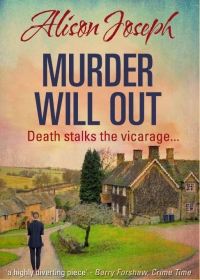
I’m also planning the next Sister Agnes story, and the next D I Berenice Killick story too, and I’ve got another, male, detective, waiting in the wings. I seem to have created these demanding characters who are very keen to get on with the next chapter in their lives. I guess I’m just lucky that I haven’t yet run out of ideas.

Thank you for taking time out of your busy schedule to answer my questions and share your writing experience and your love of the crime genre with us.

More from Alison:

Love a mystery?

If you want to take a few hours out to relax and lose yourself in a mystery, then why not meet Nicholas Penn in Dead to Sin – A Penn Mystery Book 1?


Amazon UKAmazon USSmashwords

Dead to Sin

Nicholas Penn is summoned to Gorebeck Gaol to visit a man accused of murder. Having been found holding the body of the last victim in his arms, his plight seems sealed. Nicholas is torn between a sense of duty and his feelings of hurt and disgust when being in the presence of the accused. The tables turn abruptly, and Nicholas becomes the incarcerated. Duped and incensed, he swears to find the man, Wilson, before another victim dies.

An interview with Cindy Nord!

Cindy Nord - Professional ImageI am delighted to welcome my special guest this month, bestselling Historical Romance author, Cindy Nord.
Thank you so much for taking the time to do this interview and share your experiences with us.

What inspired your love of books, or the desire to be a story-teller/writer yourself?

Coming from a family of educators, I’ve always been encouraged to read.  I devoured books by the dozens.  From classics to childhood favorites, books expanded my world. As I grew older, I also grew to love history, with a specific focus on the Victorian era.  I read my first romance, and fell in love with the genre. I enjoyed the details of history sprinkled throughout the storyline, coupled with an unrestrained romantic entanglement. Because of this combination, I felt moved to put pen to paper and craft my own love story.

NO GREATER GLORY cover

What characteristics do you think are essential in a hero or heroine?

I want my hero to be strong, involved and engaged. A man who transforms compassion into heroic action with a unique leadership ability that separates him from the rest of the pack. Of course, he’s not perfect, he does have his weaknesses, AND, ultimately, it will be the heroine who helps him overcome those internal conflicts and imperfections. Likewise, I want my heroine to have a resourceful and internal focus that becomes challenged when she meets her hero. She must have a resilient sense of purpose with an unfulfilled need that even she doesn’t know she has. And, in turn, the hero, at first overwhelming and unwanted, eventually fills this void inside her heart. Of course, the romance wrapped around these two individuals is the catalyst that spurs them onward to completing their tumultuous journey to happily-ever-after.

Reliable research is essential to historical authors, but when did you first become involved in Civil War re-enactments?

As a Victorian lecturer and historian, I appreciate the details that breathe a character to life upon the pages. Wonderful tidbits that immerse the reader fully into the time period.  And my experience in re-enacting only helped solidify this knowledge. Many years ago, when I began writing my first novel, I read in the newspaper that they were having a Civil War living history weekend at our local university. Holy Toledo! I couldn’t believe that they actually did this sort of thing.  Here was American history brought to life. The acrid aroma of campfires. The thundering gallop of cavalry horses. Women clad in Victorian gowns sashaying across a lawn. All the things that I was writing about at the time. Indeed, I was swept straight back into the nineteenth century, and fell head-over-heels in love with this whole new experience. Immediately, I threw myself into the hobby.  I even ended up meeting my future husband on the battlefield.  Although we no longer re-enact now, I’ll forevermore cherish those years spent living in the time period I love so well.

What can your readers expect from a Cindy Nord novel?

Passion. Emotion. Conflict. Indeed, an accurate, historical immersion. All those things plus an ardent romance filled with sensations that tug at a readers’ heartstrings. Getting my characters to ‘The End’ is a hard won journey, for sure. And the greatest test of success for any writer is when their readers make the trip through their novels and never want the love story to end.

In your fascinating career to date, what memorable moments stand out?

Oh my, such a great question. Let’s see… I’ll begin with being a Romance Writers of America National Golden heart finalist with No Greater Glory which started this whole incredible journey, signing with my fabulous literary agent, Louise Fury of the Jenny Bent Agency in New York City, the day my first box of books arrived from my publisher, being a USA Today Lifeblog ‘Recommended Read’ author, having my Civil War romance novel used as a supplemental read in a well-known university history class, receiving a stellar review by the Library Journal (buying bible for all libraries in the U.S., Canada & the U.K.), my first invitation to be a keynote speaker at an RWA affiliated chapter, and having my very first book signing at Barnes & Noble…these, and so many more, have truly brought me untold joy.

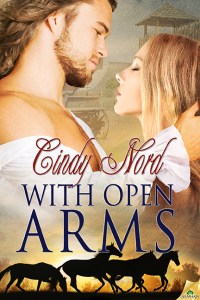
With Open Arms (USE)

Do you have a very organized day, or do you write around ‘life’, but to set targets?

Balancing my time and attention between writing, social media, my family and my friends is always a difficult task. I try to set up a schedule with mornings spent on the internet and my social media sites, with my afternoons devoted to writing. In the evening, my husband listens as I read what I’ve written for the day.  This is a routine that works well for me. I’m what they call a ‘pantser’ (writing without an outline), and must completely finish each chapter before moving on to the next. I wouldn’t advise anyone else to follow this writing style, so say the ‘plot-first’ experts, but it does seem to work for me.

Writing books involves long hours working at a computer. What do you do to keep healthy and active?

I thoroughly love to ‘water walk’ at the gym, plus I walk my two shelties daily around our neighbourhood. I also enjoy working in the garden, as well as bicycling with my husband. We are both passionate followers of an ‘organic’ lifestyle, along with nutraceutical supplementation.

Along with other writers, I understand that you contributed to an anthology for ‘Women in Need’. Could you tell us something about this work and the charity?

I was invited by writer-extraordinaire, Hope Tarr, to be part of her project entitled, “Scribbling Women and the Real-Life Romance Heroes Who Love Them” non-fiction anthology where I joined several New York Times & other romance fiction writers.  Each real-life story in this body of work details how we writers met, wed and love—and are loved and supported by—our spouses and life partners. All proceeds from this literary compilation go directly to Women In Need, a New York City women’s shelter for abused females & their children. I am so honoured to have been asked to participate. Happily Ever After isn’t only the stuff of romance novels and fairy tales.

What single piece of advice would you give to any, as yet, unpublished author?

Never, ever, ever give up on your dream. And since we’re going to dream anyway…DREAM BIG!

What is next for Cindy?

I am putting the finishing touches on AN UNLIKELY HERO, the third book in my four-book The Cutteridge Series. I anticipate this love story debuting Spring, 2016.  I’ve also been invited to host one of the ten coveted ‘opening night’ tables at the 2015 Romantic Times Booklovers Convention in Dallas in May.  I’m also doing several book signings, as well as guest interviews for television stations. Plus, lecturing on Victorian fashions at several locations across the Midwest.

More from Cindy:

Abigail Moor – The Cruck Inn

Abigail Moor KEC_1Abigail has to flee her home to escape from a forced marriage. This love story wrapped around an adventure takes the heroine away from the comfortable country manor house which has always been her home, onto the wilds of the North Yorkshire moors, to the beauty of the ancient city of York. From here she must seek refuge in the busy seaport of Whitby to discover who she really is.

She embraces her destiny and, accompanied by her maid, makes for The Cruck Inn, a coaching inn, on the moor road where her quest begins. Here, Abigail has her first experience of what the real world is like beyond her sheltered life Beckton Manor. The Cruck Inn was named after the design of the North Yorkshire cruck-built buildings. Spout House is an excellent example of an early inn which still exists in Bilsdale. I visited it when researching the area and was amazed at how well it was preserved. It is literally like taking a step back in time. Abigail Moor: The Darkest Dawn is available at Amazon and Smashwords.

Here are some photos I took of the amazing time capsule that is Spout House.


The future of romance with Pia Fenton

I would like to welcome back Pia Fenton to my blog (Christina Courtenay) who has been the RNA Chair for nearly two years.

Hi Pia!

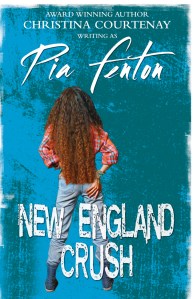
NEC front LatestAs Valentine’s Day approaches can you share with us some of the major changes you have seen in the last couple of years within the world of romance?

I don’t think the world of romance has changed very much, but rather the publishing industry as a whole.  With the advent of ebooks and ereaders (and especially the Kindle which had a massive impact the year it was first launched in the UK), the way people read books has changed enormously in a very short space of time.  Things seem to have settled down a bit now though and paperbacks are holding their own, which is great (I love proper books myself!), but I think ebooks have given both readers and authors more freedom to read/write what they like.

As for the books themselves, the popularity of certain sub-genres come and go, but editors and agents are always saying they’re just looking for really good stories.  I think that if a story is gripping enough, it doesn’t matter what it’s about – good story-telling is key.

Are you excited about the future of romance as a genre?

Yes, I think it’s going from strength to strength.  The RNA commissioned some research into sales and trends recently, and it showed that figures for romantic fiction are going up year by year, which is fantastic.  People will always want love in their lives and I’m sure they will continue to want to read about it too.

You have branched into the Young Adult market. Could you share with us the inspiration for this exciting new venture?

I discovered a while back that I love reading YA fiction – it’s an amazing sub-genre where imagination seems to have no bounds.  Then I went to a high school reunion and it really made me think about my own teenage years, both all the fun I had and the angst that comes with being that age.  I attended an American high school for three years, which was a bit of a culture clash to begin with and it occurred to me that it would be fun to write a series of books with UK heroines and US heroes and so the Northbrooke High series was born.  I have now self-published the second book in the series, New England Crush.

What is next for Pia/Christina?

I have just finished edits for the third book in my Japanese trilogy – sequel to The Scarlet Kimono and The Gilded Fan – which is due out in paperback in August this year.  I’ve also started work on a new time slip novel, which is based on the final few months of the English civil war.  I love that period in history and was inspired to write about it as there are several ruined castles, destroyed during that time, near where I live. (Both these books are for adults, not YA).

More from Pia:

For the love of baking!

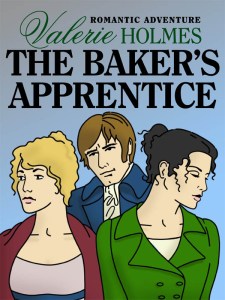
The Baker’s Apprentice is now available to download in eBook format for all eBook readers at a special price of $1.50 from Smashwords!

I love baking because it sparks memories of time spent in a warm kitchen with my mother and aunty, chatting and laughing as we enjoyed eating some of the results of our labour. From a young age I would bake the basics for the house: cakes, scones, puddings and pies. The smell of freshly made bread or scones return me to part of my childhood that will forever bring a burst of nostalgic warmth on a cold winter’s day.

A friend commented that among my titles, which focus on my North Yorkshire villages in the early nineteenth century, I had not based one around a bakery. Not everyone had their own oven, so the village bakery traditionally played an important part of village life. One comment sparked an idea and Molly Mason sprang to mind; an impetuous heroine who does not lack the courage to leave the home she dislikes, but has not the foresight to realise the hard work behind the ‘cosy’ surroundings she imagines sharing when helping her friend who runs the village bakery.

Often in life we see our own problems and look at the greener grass growing elsewhere without considering the effort that is needed to sustain the lawn.

TBA KECThe Baker’s Apprentice is set in a fictitious North Yorkshire market town that pops up in many of my titles called Gorebeck. In this story it is in a state of transition as newer Georgian terrace houses line a road replacing the older timber and cottage buildings. Some people will always welcome change seeing it as an opportunity, or others as a threat – they crave the familiar and as the old saying goes ‘If it ain’t broke don’t fix it’. It is at a crossroads for routes north to Newcastle, south to York, east to Whitby and west to Harrogate.

I will talk more about Gorebeck in future as I look at asylums, churches, market towns, inns, new and old money, mills and coaching routes in future posts.

In this story, Molly Mason carries hatred in her heart, convinced her father was murdered or driven to an early grave and seeks to escape from his wife and discover the truth. Sometimes though the truth is not what we want to hear.