Catching up: Sapere Books 1 year on!

logo-1-circle_filled

Congratulations to Amy, Caoimhe and Richard on there first birthday as Sapere Books.

Amy has taken time out of her busy schedule to share some of the events that have happened in this amazing first year.

Since we last caught up in March 2018, a lot has happened at Sapere Books! We now have over 40 authors who have joined the Sapere family, and we have published lots of fabulous novels in our first year.

The genres we were looking for initially are thriving: crime fiction; historical fiction and romantic fiction are all very popular with our readers, and books in a series do particularly well for us. We are just about to publish in a genre we haven’t tried yet: military ‘action and adventure’ fiction, and we are preparing to launch titles in that genre by this time next year, including a Vietnam combat series and Tudor-era naval fiction.

Us with Catherine 2

The team with the winner of The Sapere Books Popular Romantic Fiction Award, Catherine Isaac

One of the most exciting announcements for us in our first year is our sponsorship of two excellent writing awards. In March we sponsored a new award for 2019 from the Romantic Novelists’ Association: The Sapere Books Popular Romantic Fiction Award. The shortlist was very strong and the winner was Catherine Isaac for her wonderful novel YOU ME EVERYTHING. We are also the new sponsors of the Crime Writers’ Association Historical Dagger Award. The shortlist will be announced at CrimeFest in May and I can’t wait to read them all! We are also currently interviewing for our first full-time staff member, which is very exciting, so we should have a new Editorial Assistant to introduce to our authors soon!

Many of the authors we signed up before our launch are working on new projects with us, as they are thrilled with reader feedback and the wonderful work Caoimhe has been doing marketing our books: we regularly feature on Amazon’s best-seller lists, and have been getting Kindle deals world-wide, from the US to Australia – and even India!

We don’t anticipate growing our list hugely in the next year, as we already have so many amazing books scheduled for release, but we will continue to support our Sapere family and we hope all of our authors will continue working with us for many years to come!

party
Happy Birthday Sapere Books!


Aunty Mary’s Rhubarb Crumble


The humble rhubarb has gone from being known as an ancient cure, to a favourite British dessert, to one that post WWII fell from grace. During the war years the price was controlled so that everyone could afford it and many, like my Aunty Mary learned how to use it in a variety of recipes from tarts to Rhubarb and Ginger Jam.

This article looks at the ever popular Rhubarb Crumble.

So what is it and how did it come to be linked so strongly with Yorkshire?

It is a large leafed herbaceous perennial growing from rhizomes – a vegetable, the stalk of which provides vitamins K and C but lacks sweetness and so is low in calories. However, the leaves are high in oxalic acid which can damage the kidneys.

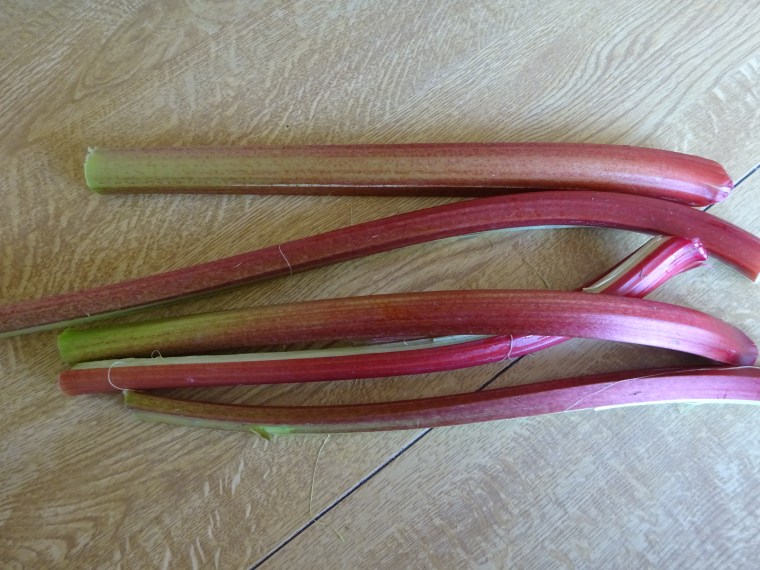
DSC01631

Because it is not sweet sugar is used in recipes and this will affect some of the benefits eating the stalk can bring, when cooked properly. It is thought to have been used as far back as 2700 BC as a medicine. Claims that it could treat gut, lung and liver problems kept it popular. In recent years it has come back into fashion and there is still a Wakefield Rhubarb Festival held in February.

Rhubarb was a native crop in Siberia growing on the banks of the Volga.  Marco Polo is attributed with bringing it to Europe. In the seventeenth century it is claimed to have been more valuable than opium.

The Yorkshire Rhubarb Triangle began around 1877 when the method of forcing rhubarb was brought to West Yorkshire. Forcing had been discovered by accident in the Chelsea Physic Garden, London, in 1817, but the conditions of the sheltered area  between Leeds, Wakefield and Bradford in the shadows of the Pennines provided a perfect growing environment. The rain, cold and the high nitrogen available from ‘Shoddy’ – a by product of the successful woollen mill industry that also thrived in the area – all helped. The Yorkshire coalfields provided an ample supply of fuel to heat the sheds needed to grow the crop in the dark. Then excellent railways in the region linked to London and Covent Garden market as well.

Forced rhubarb was grown in sheds and the first crop early in the year was said to be the best.

The following recipe is for a simple dessert and not a health recommendation for this unique rhubarb crop.

When picking rhubarb go for early and straight, thin colourful stalks. If the stalks are limp they are not fresh. Later in the year you might need to strip off the tougher outer layer before cooking.

Ingredients

6 Stalks of rhubarb
Two teaspoonfuls of ground ginger
1 level tablespoon of Demerara sugar

For the Crumble

7 oz  unsalted butter
7 oz golden caster sugar
14 oz plain flour

Method

Rub butter and the flour together until crumble is fine. You can substitute some flour with oats to make the top crunchier.

Add in the sugar (to taste).

When finely mixed it should clump together when squeezed once and fall apart again a separate time.

Leave in the fridge to chill.

Top and tail the crunchy stalks of rhubarb.

Either soften in a pan with a knob of butter and the ginger and sugar until softer, or bake on a tray in the oven on 170C for ten minutes.

If the pan method is used, drain off some of the fluid. If the oven method is used then transfer to the serving dish once the rhubarb has been tested to make sure it is tender.

I would love to receive any other original recipes for the versatile and unique rhubarb.

Money Matters in Regency England


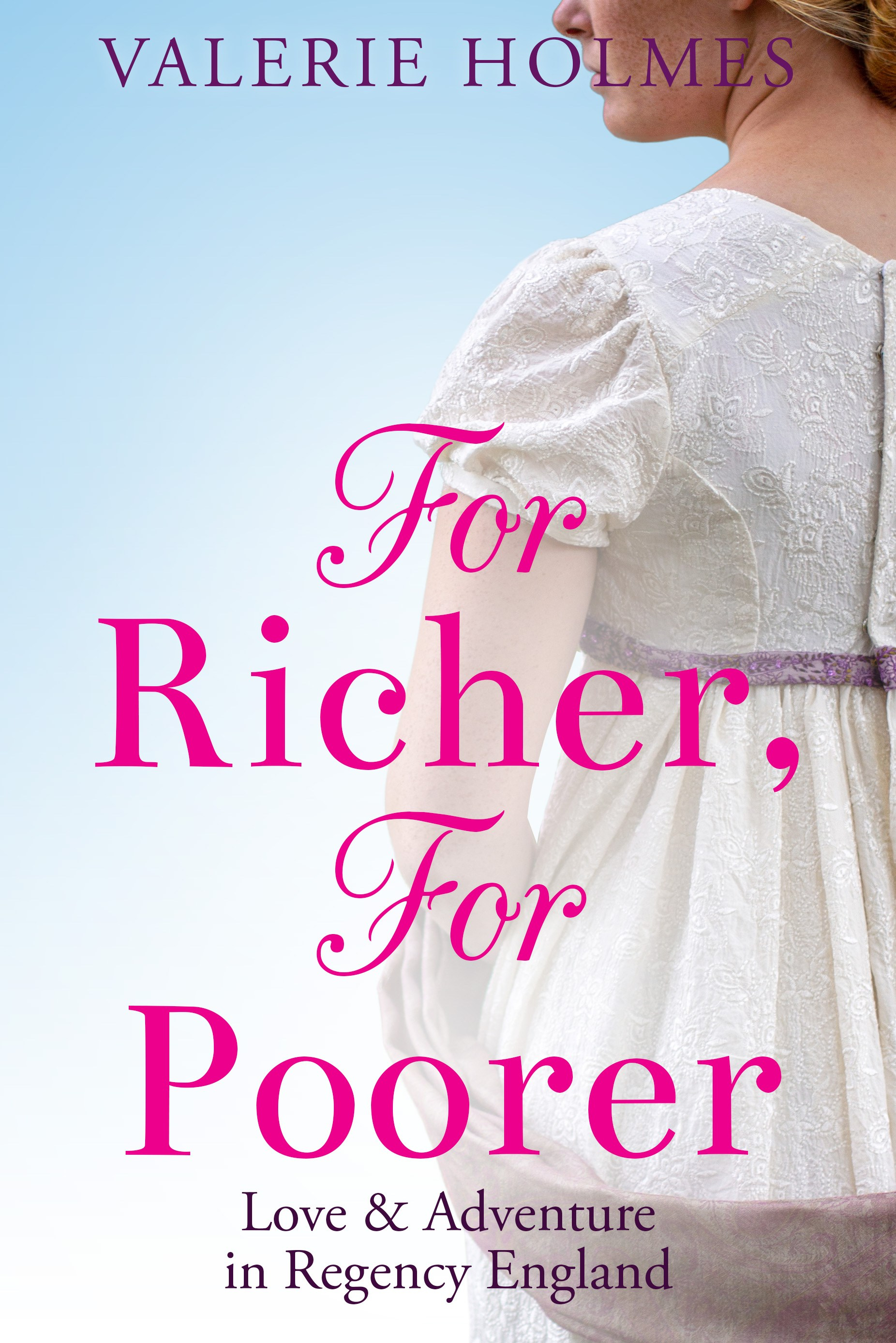
Book 2 http://getbook.at/ForRicher
Join Parthena and Jerome on their exciting adventure!

The first conflict in For Richer, For Poorer occurs when heroine Miss Parthena Munro ‘borrows’ a coin purse from Mr Jerome Fender.

I used the term ‘coin purse’ rather than wallet because, unlike the pre-plastic card society where paper money had been the norm it was not so commonly used in Regency England.

Banknotes outside of London were not guaranteed by the Bank of England until 1826 when its first branch outside the City was opened in Gloucester. Privately owned regional banks in England and Ireland had unique notes that were signed by their own chief cashiers and therefore their continued validity depended on the success of the issuing bank. This meant that banknotes were not as secure as they are today, should a run on such an establishment occur, it could wipe out a person’s assets.

Coins had immediate and standardised values and so, although weighty, were accepted everywhere.

The golden guinea had a value of 1 sovereign and 1 shilling making it the highest denomination.

Next was the sovereign (1 pound) worth 20 shillings.

Then a half sovereign worth 10 shillings

A Crown equalled 5 shillings

1 shilling equalled 12d (old pennies)

1/2 shilling was known as a six pence piece.

A groat was 4d

A farthing was 1/4d

However, not everyone in Regency England was expected to pay their bills immediately. The aristocracy, upper and middle classes lived on credit to a large extent. This seems a strange inequality to us today, but it was the lower classes who were expected to pay coin for their goods and services on demand.

This created a highly unfair society. It also led to a number of Debtors’ prisons such as  York prison, Marshalsea and The Fleet. Charles Dickens’ father was in the former under the Insolvent Debtor’s Act of 1813, when he failed to pay his debts to a trader. It was a hard system to break free from even though there was the chance of day-release to go and work, but debts continued to mount.

This period marks the beginning of change in what had previously been the norm because of the inability of debtors to pay their cumulative debts to their creditors, which could then bring these companies down as they also had creditors too. Therefore, the system had to change and settlement by cash was being favoured, yet the debtors still kept these prisons throughout Dickensian times.

What Parthena did could have cost her liberty, her life or seen her transported to the . It was just as well that it was Jerome she borrowed the coin from!

Book 2

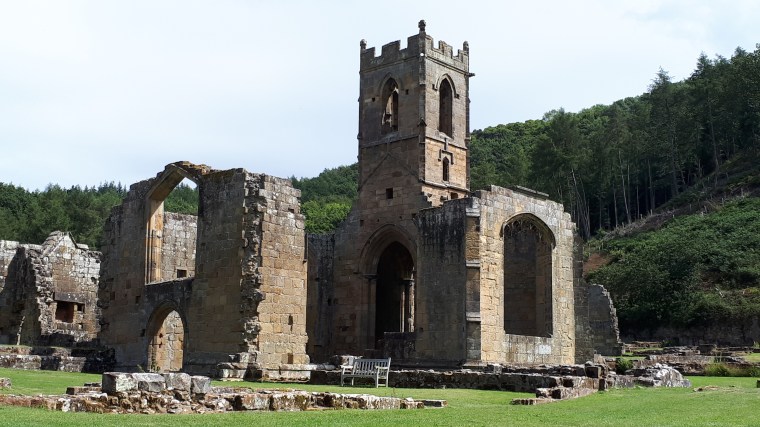
Mount Grace Priory
Now a ruin, but once a thriving community, beautifully set against the forestry with the moorland above.

Aunty Mary’s Yorkshire Parkin

DSC01649 (2)

Nothing felt more homely and welcoming when I was growing up in my home town of Redcar, North Yorkshire, than entering my Aunty Mary’s old terrace house and smelling the delights being created in her kitchen.

Artie, her friendly black spaniel, also shared my enthusiasm for her cheerful personality and her home cooking hospitality.

One such recipe, Parkin, is a traditional cake (not for the health conscious or diabetic) that is basically a ginger cake packed with oats and treacle. It is mentioned in my books, such as: For Richer, For Poorer, as its recipe has been passed down the generations.

It was certainly made during the Industrial Revolution and gained favour as the ideal snack to partake of in November on a cold Bonfire Night on the 5th. The first Sunday of that month is referred to as ‘Parkin Sunday’.

This rich cake, full of flavour, also helped to keep hardworking folk filled and warmed through the cold winter months.

Lancashire also has its own recipes for parkin, but there are differences between the two versions. Yorkshire includes oats and uses more black treacle (molasses) giving a darker distinct flavour. Lancashire Parkin tends to be lighter and sweeter using more golden syrup (not corn syrup, which is different) instead. Opinions on this vary, as much as the recipes because some people leave out the oats all together, but this version hits the mark when you want to feel re-energized on a cold and dreary day.

The recipe I have included here is the one my Aunty Mary used and the one that when I do indulge takes me back to my childhood, a warm and loving home with my aunt and of course dear old Artie.

Ingredients

5 oz      oats
4 oz      SR flour
1/2 tsp baking powder
2 tsp     ground ginger
1 tsp     mixed spice
1/2 tsp  nutmeg
Pinch of salt
5 oz       black treacle
3 oz       golden syrup
4 oz       soft brown sugar
4 oz       butter
2 large   beaten eggs
1 tbsp    milk


Method

  1. Line a 1lb loaf tin with baking paper or a paper loaf case.
  2. Preheat oven to 150C
  3. Assemble dry ingredients in a large bowl
  4. Melt the brown sugar with the treacle, syrup and butter – DO NOT BOIL THEM – remove from heat once the sugar has melted. Allow to cool slightly.
  5. Pour the hot mixture into the dry ingredients and mix.
  6. Add eggs and milk – stir well. You should have a thick liquid batter mix.
  7. Pour into the prepared tin and bake for between 1 to 1 hour and 20 minutes. Or until a skewer comes out clean when tested. The cake should be firm and springy.
  8. Allow to cool in the baking tin.

The resulting cake should be dark, sticky, and spicy and has a flavour that improves if it is left in an airtight tin for 3-5 days after it has been allowed to cool.

Then enjoy a slice with a nice cup of tea – but in moderation!

If you know any other versions of this old favourite or more about the origins of it I would love to see your comments.

https://www.amazon.co.uk/Richer-Poorer-Adventure-Regency-Yorkshire-ebook/dp/B07LCSMG9R/
Availbale now

Jacobean Architecture and Kiplin Hall, Richmond, North Yorkshire.

This slideshow requires JavaScript.

Leaham Hall in For Richer, For Poorer is a Jacobean style of country house that provides employment for its estate workers and the small nearby village of Leaham. In reality the image of Kiplin Hall inspired its fictitious counterpart.

Jacobean architecture gained popularity during the reign of King James I (1566-1625) with its love of symmetry and the mixture of gable or flat roofs; these brick built buildings were houses of the well-to-do landed gentry.

The era’s love of colour, Palladian columns, woodwork and carvings, along with the use of granite made them quite unique. The central staircase would be a focal point that lead the family or visitors up to the first and second  floors.

The Jacobean period was one that was tumultuous and the use of heraldry could reveal the owner’s loyalty. These houses, like many of the time, could also have been used as safe havens for those who had Jacobite sympathies.

Kiplin is a treasure to be discovered, tucked away in the beautiful countryside of North Yorkshire near the village of Scorton. It was built by George Calvert who was the Secretary of State to James 1 and founder of Maryland USA.

I borrowed some aspects of this tranquil setting for my plot in For Richer, For Poorer and placed Leaham Hall under threat.  The early nineteenth century was a time of great social, industrial, political and religious change; so I set Parthena and Jerome Fender loose on a quest to save the Hall, the estate and the village.

Here are some pictures of the moorland trods that Parthena and Jerome have to cross. You can find out more about these ancient pathways in my blog post at Sapere Books

This slideshow requires JavaScript.

A step back in time!

533900_193142140832995_1059893854_n

In my book Abigail Moor The Cruck Inn was named after the design of the North Yorkshire cruck-built buildings. There are many examples in the region but none as well preserved as the old inn Spout House which served Bilsdale until it closed its doors in 1914.

I visited it when researching the area for my book and found it was literally like taking a step back in time. Spout House can be visited from Easter – 31st October. It is just one of  many historic places hidden away in the beautiful North York Moors National Park.

The amazing time capsule that is Spout House was the inspiration behind the starting point of Abigail’s adventure that takes her on to the beautiful city of York with its gothic cathedral, then to the amazing historical whaling port of Whitby and further to discover the rugged bays of the North Yorkshire coast.

This slideshow requires JavaScript.


Historic York.

This slideshow requires JavaScript.

The ancient whaling port of Whitby.

This slideshow requires JavaScript.

You can follow Abigail on her journey here!

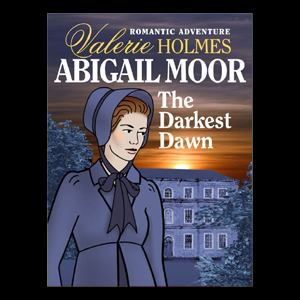
Abigail Moor: The Darkest Dawn is available at Amazon and Smashwords

AbigailMoorTwitter_1

Promotion Time!

Stolen Treasure is now only 99p!

Some secrets are intended to stay buried...

In 1809 Elizabeth Matthews shares many a childhood adventure with her soul-mate, Thomas Lamb, son of the estate’s handyman.
Elizabeth is entrusted with the safe keeping of a tin box by her Mama but instead, leaves the task to Thomas’s father Joseph. However, life in the windswept north-east coastal village of Alunby is left behind when she is promptly sent away to be schooled in the city of York.
Risking her reputation, and a possible marriage match, Elizabeth dreams of the day when the secret inside the tin box will be revealed to her, and goes on a journey of rediscovery to find Thomas and seek out the stolen treasure.
Some secrets were intended to stay buried, however, what Elizabeth discovers is of greater value than she could ever have imagined.

‘Great read, especially for the price!’

Discover Ellie for only 99p!

DiscoveringEllieTwitter (1)
Click on the picture for Kindle Discovering Ellie!

Ellie has recurring nightmares of a child surrounded by early nineteenth century luxury who is kidnapped. When Ellie wakes it is to the normal sparse surroundings of her attic room and a life devoid of love. Yet, haunted by the child’s fear, she still dares to dream that one day she will be happy and find love.

Living in the old hall with her Aunt Gertrude and cousins Cybil and Jane, she feels as if she neither belongs to the family nor the ranks of the few servants. Her aunt frequently reminds Ellie that she is the child of shame – her mother had eloped with a Frenchman. The scandal, apparently, cast a long shadow over Ellie and the family.

However, when Aunt Gertrude announces that a suitor has been found for her Ellie’s initial excitement quickly turns to dread and humiliation.

Mr William Cookson’s unwelcome presence shines a light onto her past, but how can Ellie escape from her aunt’s plan for her future?

Find out here!

King Ludd & trouble at the mills!

This slideshow requires JavaScript.

The term ‘Luddite’ is widely used even today, but its origins are shrouded in both truth and myth.

Two names that are supposed to have been associated with it are Ned Ludd and King Llud. Whatever the truth, the term has stayed in common language. Today it is used to describe someone  who is averse to technical change, but its origins stemmed from men who thought they were fighting to save their livelihoods and their families from being destitute.

Since medieval times the wool trade had been of great importance to the working people of our nation. Traditionally women and their children spun the yarn and the menfolk were skilled loom weavers. Each piece of cloth was then taken to market to be sold in the Piece Halls. In the early nineteenth century new inventions took over this traditional family method of making and selling cloth.

With new cotton and wool mills growing in size and numbers, the workers that left their villages to work in them need not be so skilled. They could be taught a task and become part of the overall process.

The volume of cloth produced could therefore be increased. Uniformity and scale of production would be guaranteed by the use of these wider weaving machines. But the downside was that the employment was no longer a cottage industry, but required a central approach, breaking up communities and leaving men without the means to feed their families. With the price of food, particularly bread increasing, the men felt somehow their concerns needed to be heard.

The actions of a man allegedly called Edward Ludlam also knonw as ‘Ned Ludd’ in 1779 was given the label ‘Luddite’. He was accused of breaking two frames in anger. So when in Nottingham in 1811 groups of weavers gathered and planned attacks on targeted mills to destroy the machines that had taken away their livelihood, the term ‘Luddite’ was used again and stuck.

These attacks spread to Yorkshire and other counties and continued for a number of years. Groups banded in numbers of up to three figures, but surprisingly few were actually caught or hanged.  Some were transported, perhaps unjustly, as those who were accused of being part of a gathering or an attack would have little defence heard to save them. King Llud was used on letters of demand to add weight to their threats and demands.

In 1812 The Frame Breaking Act made the breaking of stocking-frames a capital felony, hence allowing the death penalty to be given to those caught. Rewards were offered, but the local people were the very families of the men who were trying to stop a revolution of machine replacing manual labour, soit was unlikely that many would provide information. It is also likely they would be in danger if they were discovered by the gang members. It was a battle they could never win,

The government and the mill owners did not listen to their pleas. Workers, including young children, were paid low, had no say over their conditions and were often exploited.This was exactly the situation Phoebe and Thomas escaped from in Phoebe’s Challenge. As mills developed not all owners were as harsh (they were by comparison to today’s working practices) but some introduced education, shorter hours for children and healthier diet and living conditions. This is where the idea for Laura’s Legacy came from.

Just click on the link to see how Phoebe rises to the challenge or how Laura’s Legacy survives!

Laura's Legacy


FOR THE LOVE OF WRITING: INSPIRATION AND MOTIVATION

picture1In previous blog posts I have looked at how to keep yourself fit for the task of writing thousands of words and then how to set realistic goals to achieve them. Before moving on to looking at the actual writing of the fiction, two factors play an important part in beginning and completing the process: inspiration and motivation.

Where do you get your inspiration from?
What motivates you to write fiction?
These two questions are asked to many authors and the answers may be as varied as the individuals who the questions are posed to.

I am constantly inspired by anything from a name, a newly learned and intriguing little known fact, a place that sparks an idea or a simple overheard statement. Inspiration is all around us, we just have to be open to it and use our imaginations to ask that simple question: “What if?”

Once inspired to write, then motivation kicks in to drive our effort so that the idea turns into a real manuscript. We can be both inspired and motivated at the same time by reading our favourite author’s work.

Here are a just a few common motivators:

  • To escape from reality into a world of our making that we may or may not share with others.
  • To earn money (realistically, this is not an easy industry to break into or make a liveble wage from.)

Whatever your inspiration, you need the motivation to keep going, learning and growing as a writer; going beyond rejection to reach that place of acceptance and becoming a published author.If you choose to write for your own enternment that is fine. Once published there are always those who will look upon your work negatively and leave reviews to say so. This should not stop you writing what you want to, but the choice and opportunity to become published does mean that you have to accept the positive and negative reviews alike. Ultimately we have to believe in what we do.

Learn from those who have done it and also from any of their early mistakes, so that you can avoid some of the common errors yourself. Accept that it is all part of undertsanding the business and put rejection and destructive criticism aside, which is why I share author interviews, whilst taking on board the constructive advice.

Once you are keen to begin your project, then set your realistic goals and be determined!

You can network at conferences, online and in local writing groups. Or invest in a reputable course, join in schemes such as The New Writers’ Scheme run by the Romantic Novelists’ Association and seek professional feedback.

Writing is a lonely business. I am often asked how can you teach a person to write a novel or short fiction. My answer is simple: imagination can be encouraged not taught. It has to spark from within the writer. However, there are common errors new writers make as they learn their craft that can be corrected. Every person, every student that I have had the pleasure of teaching over many years has been unique. Therefore, my feedback is always tailored to the individual. If you have a manuscript that you are working on at the moment, or have finished, and would like constructive, professional feedback on, then please contact me on vholmesauthor@gmail.com for a quote.

What inspires or motivate you to write?