Kirkleatham Village, North Yorkshire: A little gem worth exploring

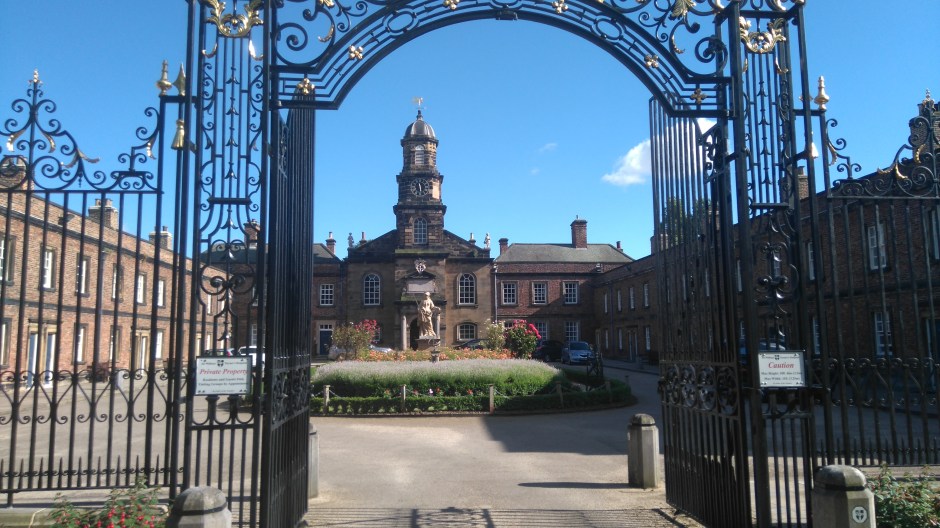
Kirkleatham Village, North Yorkshire, England is definitely a little gem worth exploring.

Three miles from the coastal resort of Redcar, North Yorkshire, lies the beautiful small village of Kirkleatham. Originally known by its Norse name ‘Westlide’. Through time and links to the original ‘Kirk’ (church) lands it evolved from a small village to a prosperous estate with famous links to London.

I often explore such locations when researching the background to my stories, which are set within the region. This beautiful area was once owned by Guisborough Priory, before King William I granted it to The Count of Mortain and Robert de Brus in 1086, down through the centuries, it came into the hands of the Turner family.

Today the main buildings’ features of the almshouses, the church, mausoleum, and the museum in the Queen Anne building where the old school was housed, they all stand as testament to the legacy left by the Turner family. Sir William Turner (1615-1692) became Lord Mayor of London in 1669. His loyalty to King Charles II and his active involvement in rebuilding the city after the Great Fire were greatly rewarded. However, he was a man who seemingly also showed compassion for the less fortunate. He was President for the Bridewell and Bethlehem Hospitals as well as founding the Sir William Turner Hospital in Kirkleatham (now the almshouse building).

The Hospital was built around a quadrangle, with a chapel opposite the ornate gates separating the quarters of the 10 women and 10 men. There was also accommodation for 10 girls and 10 boys. These children were either orphans or from one-parent families. They were taken in, given a basic education and then would leave to serve an apprenticeship or enter service.

The ancient church was added to in 1740 to commemorate Marwood William Turner who died on his Grand Tour in Lyons in 1739. Charles Turner, who was the first Baronet in 1782, improved the roads in the area. He also built the Turner’s Arms in nearby Yearby to replace the alehouses, ‘wretched hovels’, which had harboured smugglers. Charles encouraged tenants to experiment with new crops and techniques. His son, also a Charles (1773-1810), was the last Turner to own the estates. The estates then passed through marriage to the Newcomen family. Schools and buildings in the local towns have carried the names of these families for years.

Eventually the estate was sold in 1948. The contents of Kirkleatham Hall, the Hospital Library and Museum were sold at auction. The once magnificent Hall was then left to decay and in 1956 was demolished.

Kirkleatham today houses the local history museum which, amongst other exhibits, houses the Saxon Princess Exhibition. The local maritime and industrial historical exhibits cover three floors. Access is good as the site is level; ramps and a lift means that it is accessible to all.

The 15 acre grounds cover a woodland, play area and willow walk. It extends past the old stables to open fields. A café serves hot and cold foods and facilities are good throughout.

Admission to the museum is free but touring exhibitions and events held at the site may be charged for.

More information is available from: http://www.redcar-cleveland.gov.uk/kirkleathammuseum

Parthena’s Promise – new Kindle release !

Parthena's Promise (1)
Click the cover to go direct to Amazon!

England, 1815

London barrister and gentleman, Jerome Fender, has just returned to England after five years as a Captain in the killing fields of the Napoleonic Wars.

With the harrowing scenes of battle still haunting his every thought, he sets out to start a new life and to find a wife who will share it with him.

Meanwhile recently orphaned 21-year-old Miss Parthena Munro has also arrived at a North Yorkshire market town.

She has been sent away by her scheming sole relative, cousin Bertram, to be governess to a local family, only to find that the family has already moved away from the area.

Left stranded far from home with no job and no place to stay, Parthena encounters Mr Fender outside an inn, where she takes a chance to steal his money in a witless moment of desperation.

She whispers a promise to return the money one day and makes off across the wild Yorkshire moors.
But it’s not long before Fender catches up with her.

Set during 19th century England, Parthena’s Promise leads the reader on a spirited journey to consider if justice and true love are possible in a society on the turning point of change.

Ellie Promo

Laura’s Legacy – New from Endeavour Press!

Laura's Legacy

Laura’s story begins fifteen years after the fire that nearly destroyed Ebton in To Love Honour and Obey.
1820 Ebton, England.

Laura Pennington’s parents think it is time for her to marry, but they are concerned. She likes to take long walks by herself, and doesn’t quite fit in. Laura’s father, Obadiah, thinks local mill owner Daniel Tranton is the perfect husband for Laura, so he suggests marriage to Daniel while working on a business deal.

Daniel is not keen, but does not want to lose Pennington’s business. He is not sure what to do, as he has his hands full with disgruntled mill workers. Daniel has always treated his workers well, but that is the exception, not the rule.

A new problem arises, when Jeb, a young boy who works for Daniel’s cousin Roderick, runs away from the mill where he works. Daniel, not wanting to see him captured and beaten by the local louts who enforce the law, tries to track him down. He finds Laura hiding Jeb, who she stumbled upon while out on one of her walks.

Roderick has his henchman Mr Bullman hunting for Jeb as Laura hides him at her father’s boat house.
Checking on him one morning, Laura sees the boat is gone, but it’s seeing her father stepping out from the hotel he owns that shocks her the most.

For all his efforts to make Laura a lady, it seems Mr. Pennington is not a gentleman.
With the hint of revolution in the air, will Daniel and Laura find a love worth fighting for?
Laura’s Legacy is a historical tale of romance and family strife in a past world.

Laura’s Legacy is availble on Amazon Kindle

New book launch!

To Love, Honour and Obey

Buy on Amazon!
Australia | Brazil | Canada | France | Germany | India | Italy | Japan | Mexico | Netherlands | Spain | United States of America | United Kingdom

To Love Honour And Obey

1805

Six years ago, Willoughby Rossington’s father was murdered while searching for the kingpin of a smuggling and spy ring. Taken under the wing of his uncle, who is running a counter-intelligence operation against Napoleon’s spies, Willoughby is assigned to take up his father’s last mission—and, hopefully, in the process find who killed his father and bring them to justice.

He encounters a young woman, Beth, who works at the local inn. Her spark and resilience against her master’s attempts to break her will strike a chord in him and he, albeit reluctantly, takes her with him when he leaves town.

As they begin to talk, he finds out that her master is more involved in the ring that could have been thought. She overheard things and knows things about the seedy side of villages that could be helpful to him and his mission.

Though Beth hasn’t had the opportunity for education, she’s smart and quite cunning while still maintaining a child-like wonder. Even as Willoughby makes plans to set her up with a family in order to protect her from the perils of his mission, he finds himself a bit melancholy at the thought of losing her company.

Beth is having none of it. She knows she can be of help to Willoughby and isn’t going to be left behind now that she’s found someone nice. Part on purpose, partly because of fate, their two lives become intertwined as they race against the villains that plot to destroy them both.

Will they uncover the truth behind the smuggling ring and find who is responsible for Willoughby’s father’s death?


The Baker’s Apprentice

Buy and read now!

US Readers: iTunes / Nook / Kobo

UK Readers: iTunes / Nook / Kobo

Molly Mason dreams of escaping from the control of Mrs Cresswell, her step-mother, by becoming an apprentice to her friend who owns the local bakery. This ill thought-out plan is stopped when Juniper Cresswell’s fiancé, war hero Lt. Cherry, returns accompanied with a soldier who had been presumed dead. The soldier brings with him suspicions of murder, mystery and the key to Molly’s heart.

An Interview with Rosemary Kind

I am delighted to welcome author Rosemary Kind, who is the founder of Alfie Dog, a publisher of short fiction based in the beautiful county of North Yorkshire.

Welcome, Rosemary.

What was the deciding factor that motivated you to switch from a successful business career to becoming a full time author?

My husband had the opportunity to move to work in Belgium and I said ‘Why not?’ Because we were going back and forth every fortnight to see my stepchildren an ordinary career wasn’t going to work, so as I’d proved everything to myself that I needed to in a traditional working environment it was the perfect time to follow my heart. I’ve always written, but in my spare time. I knew I’d regret it if I never found out if I could do more.

Please tell us about your published work and what inspires you?

I write in a number of genres. Inspiration can come from the strangest places. My first published book (leaving aside ‘Negotiation Skills for Lawyers’ which was commissioned), was a humorous guide to travelling on the London Underground ‘Lovers Take Up Less Space’. I wrote most of the ideas as therapy when I was working in London. ‘Alfie’s Diary’ started as a daily blog in January 2006 when our first dog moved in. I’d been in Belgium for a couple of months and was writing mainly non-fiction, business articles, company newsletters etc. I wanted to write fiction, but it felt like a big step. Writing Alfie’s view of the world was a way to make myself write something every day. I originally intended to write it for a year of two, but nine years on it’s still growing and has spun off into several other projects, not least because he set up his own political party The Pet Dogs Democratic Party.

Inspiration for my novels is more interesting. ‘The Appearance of Truth’ came out of a writing group project to write 300 words on ‘verisimilitude’. Once I’d looked it up in the dictionary I started mulling it over. I was researching my own family tree and had ordered a birth certificate. It occurred to me that it would be quite possible to pass a birth certificate off as belonging to someone that it really didn’t relate to and it all went from there. Lisa was given the birth certificate of a baby who died at 4 months old and the story is her search for who she really is and why it happened. ‘Alfie’s Woods’ came from our woodland walks. We’d just rescued a hedgehog, who was stuck in a fence, when a helicopter passed overhead. The rest of the walk was spent thinking ‘What if they were looking for the hedgehog? What if he had escaped from the woodland prison?’ ‘The Lifetracer’ was inspired by seeing an electronic countdown clock in a catalogue and finding myself thinking ‘What if it could be programmed with Time to Death and used to send a death threat?’ I have more ideas than I have time to write them.

What appeals to you most about Entelbucher Mountain Dogs and Alfie in particular?

I fell in love with the breed long before there were any in the UK. They are incredibly loyal affectionate dogs who are great with children and like nothing more than to be close to you. I also adored the way they look, not only their colouring but the fact they are such happy smiley dogs. Alfie is my pride and joy. He is a gentle giant who is everything I had ever dreamed of in a dog. We are incredibly close.

When did the inspiration for an online digital site for short fiction first occur to you?

Not only do I write short fiction as well as books, but I have many friends who are widely published in that field. The more I talked to other writers the more frustrated I felt that there were so few outlets for short stories and for earning an income from secondary rights. It was January 2012 when I wrote the business plan. I launched to authors in February and to readers in May. I was overwhelmed by the response and we had more than 100 stories by the launch and have rapidly built a library of 1700 stories. I also wanted to set up a site that gave as much back to authors as possible. The culture is very much to give support to the writing community where we can. I was amazed by how word of mouth spread the message across the globe and we very soon had writers from more than 25 countries, all writing in English.

stp version smallWhat can a reader expect to find on www.alfiedog.com?

We carry good quality stories in a wide range of genres. All submissions are reviewed and where necessary edited and only the best are accepted for publication. We want our readers to come away having had a really good read and be looking forward to coming back for more. We carry work by over 400 authors, so there really is something to suit everyone’s taste. Many of our authors are widely published, but we enjoy introducing high quality work from new writers too. Unlike most sites, we carry the stories in a range of formats to suit all types of ereader or to print. We also publish a range of books in both electronic and paper formats. They are mainly short story collections, but we do carry some novels as well.

Of course for writers, our International Short Story Competition may also be of interest. The closing date is the end of September so there is plenty of time to take part. First prize is £200 and book publication.


How do you see www.alfiedog.com developing in future?
PDDP cover final small

The site is already one of the biggest short story publishers in the world, but hopefully it will be the site on everyone’s list when they talk about short stories. I want it to be ‘THE’ place that people go to when they are looking for quality short fiction.

What is next for Rosemary?

I’m writing another novel at the moment. This one was inspired by a chance comment in a meeting. Someone made reference to the ‘Orphan Train’ movement in America in the late 1800s and I had to go and find out more. As soon as I did, I was hooked on a story idea and the lives of three Irish immigrant orphans, fighting for survival, was born. It is my first full historical fiction writing and the research has been fascinating. It even made me get on a plane for the first time in over seven years, but that’s another story!

More from Rosemary

Crime and Punishment 3: Man-traps

Before moving on from Ripon I would like to mention one exhibit in the Prison & Police Museum that brought home to me the cruelty of the era that my historical stories are set. I found a man-trap displayed on the wall. I have mentioned them in my work, but it is only when you see the ugly things close up that you realise how being caught in such a sprung trap could maim and kill, in what was a slow and excruciatingly painful way.

They were hidden in undergrowth to catch or deter poachers or trespassers. They had a spring mechanism that meant the metal jaws (many had teeth – serrated edges to really lame the culprit). However, the sentences for poachers were also severe and included hanging or transportation. Although they were a fact of life in the early nineteenth century, and had been for some time, fortunately they were banned from England C.1830. Nonetheless some must have stumbled upon them by chance and others by necessity of crossing private land…

Extract from Phoebe’s Challenge

Phoebe's Challenge KEC Thomas closed his eyes fleetingly. “Yes, we will,” he spoke the words after a few moments of silence.

“We’ll what, Didy?”

“Find Levi; he didn’t disclose us – we should help him too.”

His hand, still holding the bottle, dropped down, but his senses awoke as the clang of an iron mantrap snapped viciously shut next to him. His face paled as he looked down horrified at the sight of meshed metal teeth that greeted him. Phoebe had screamed as the great jagged jaws of the mantrap had snapped shut as Thomas lowered his arm, triggering the edge of mechanism, but fortunately his limb had not fallen within its evil grip; instead the bottle was smashed.

Extract from Hannah of Harpham Hall

HannahShe was gamely running along a path ignoring Betsy’s pleas for her to come back to her, when an arm reached out and grabbed her by the shoulder, pulling her backwards. She landed in a pool of mud and foliage.

“How dare you…you great bully!” Hannah shouted out in indignation at the figure who stood openly laughing at her dishevelled state, whilst boldly standing in front of her. Her ribbon had come loose and her hair started to fall down onto her shoulders. Her anger rose and she was about to vent her opinion at the lad, who must have only been a few years her senior, but he spoke to her first.

“You stupid little spoilt brat! Look what you nearly ran into!” He threw a stick at the ground in front of where she had been heading and, instantly, the metal jaws of a man-trap snapped shut, tearing it in two.

Hannah’s mouth dropped open. She wanted to cry out, but was too scared and confused. Betsy ran up behind her, panting heavily. She slapped the girl hard on her shoulder. Hannah fought hard to hold back her tears. This was not the kind of adventure she had envisaged. The lad looked nervously around him as her father’s voice bellowed to them through the woods, “What is the meaning of this?”

Featured image / RN

Pheobe’s Challenge and Hannah of Harpham Hall are also available to buy on Smashwords!

Ripon Cathedral and the Saxon Crypt

I could not leave Ripon without visiting its ancient cathedral. The ancient building has a fascinating history, the oldest part of which still exists. The ancient Saxon crypt of the original church founded by St Wilfred (AD 634-709) not only still exists, but is open to the public for exploration. Accessed via a narrow staircase and a short narrow tunnel, the small rooms are amazingly peaceful.

(By the way, I’m an author, not a professional photographer!)

St Wilfred influenced the decision of the christian church to move away from the Celtic Church and follow the Roman church. The decisive move been made in 664AD at The Synod of Whitby when the calculation of Easter was decided by following the Roman method. He had a fascinating life and survived many life threatening events.

The main building is a delightful mix of Norman and Gothic styles, reflecting the many periods of history it has survived through. Far from feeling like a museum, which provides cold facts for the casual visitor this is a living house of God. When I visited there were Bible readings in progress, yet we were made welcome giving the palace a warm, homely feel. Other activities were in progress at the same time. There is no set fee to pay, but donations are requested and voluntary.

My visit was quite short as I was en-route to a conference but Ripon is certainly a place I would happily revisit as I am sure that I did not explore all its treasures.

Further sources of information:


[Featured image / The Association of English Cathedrals]

Crime and Punishment – Part 2

In my exploration around Ripon’s three amazingly well preserved law and order museums I was touched at the ease at which a person’s life, regardless of their age or sex, or the seriousness of the crime, could be devastated by incarceration, transportation or death.

The Police and Prison museum was mentioned in an earlier post.

The Courtroom, however, is based upon a Victorian courtroom and has been well preserved. It presents some shocking facts about how crime was dealt with from before this period too. The ‘Quarter Sessions’ were held at: Epiphany, Easter, Midsummer and Michaelmas and trial was by jury. Sentences passed here could send people to be punished in the market square or for more serious crimes to the County Assizes to hang.

From the seventeenth century the court could also sentence a ‘criminal’ to transportation to the colonies for up to 14 years. This could be instead of a death penalty. It was thought that criminal behaviour could spread so by removing it the problem it would literally go away by sending them to…

“His Majesties Colonies over the seas… preventing the communication of the cantagion.”

This was an extremely cruel system as many failed to return. Forgery was a capital offence, but this could be reduced to transportation. We usually link this to sending prisoners to New South Wales, Australia (1788-1868) as dramatised in the TV series Banished, but before this convicts were sent to the Americas from as early as 1610 to 1770’s.

Special gaols (jails) were built to house debtors. These were self-funding as inmates had to pay, if able, which made it difficult for them to clear the actual debts they were imprisoned for.

Suicide was judged as a crime and the bodies of such poor souls would be buried at crossroads rather than in consecrated ground.

Lesser sentences included whipping (for both sexes) pilloried or placed in stocks, was done publicly to humiliate and shame. Fines could be levied, but if the person was poor there was little point to this. When the standard of living improved then fines became more popular and they raised money to build more prisons, which were expensive to build and run.

A person could be bound over to keep the peace. It seemed normal for the harsher sentences to be levied against offenders who had already been before the court.

The last case of a man to be held in the stocks was in 1857. It was interesting to learn hat it was the Methodist and Evangelical Christians, who had previously been behind the banishment of slavery, who helped change public opinion and the law against such public cruelty as a punishment.

Vagrants and the poor had a different fate. If they stayed within the law and did not steal in order to feed their family they could end up in the harsh regime that was the workhouse. Ripon’s Workhouse certainly provides plenty of information about the long days and the harsh life of the individuals and families that were made to work there. Families were split, even mother’s from their children.

From being stripped and bathed at the entrance, to the early rise and long hours picking oakham (the threads were literally unpicked by hand (the phrase ‘money for old rope’ was born) to harder labour of breaking rocks. They did nothing to encourage people to stay willingly, but to make them work in the absence of any social welfare, they were places to avoid if possible.

Sophie's Dream Sophie’s Dream is to find an exciting life away from her strict education in a workhouse. She applies, with references, through an agency for a position as Governess in New South Wales. Along with other young women, she is chaperoned to their new life, beyond the social barriers in England. Abandoned on the quayside of Sydney, Sophie discovers the agency is a sham. Her instincts lead her to Mr Matthias Wells and a very different world opens up to her.

Sophie’s Dream is also available to buy on Smashwords!

More about crime and justice within the era:

Crime and Punishment – Dead to Sin

The early nineteenth century in England was a harsh time of poverty for many. When soldiers and sailors were no longer needed to fight the wars that had dogged England from the end of the previous century, many men returned victorious having fought for their King (or Prince Regent) and country only to face unemployment. With little or no social support they often turned to crime to feed themselves and their families. With the increase in crimes, came new laws and harsher sentences.
Ripon Museum
I recently stopped by one of North Yorkshire’s finest museums in the little city of Ripon. Ripon is an unspoilt cathedral city that has maintained its characteristics of a delightful market town with plenty of historical places of interest to visit. It is also an excellent base for venturing into the Yorkshire Dales or the North Yorkshire Moors!

Ripon Museum comprises of three museums, all to do with the city’s historic law and order buildings that have been lovingly maintained. The photos below were taken in the Prison & Police Museum in St Marygate. It was a prison from 1686-1879 and a police station from 1880-1959.

When I first visited the prison I was writing Dead to Sin. Although the existing building was Victorian, the cells hold exhibits which relate to its earlier history and the development of crime and punishment, cruel and harsh as it was. Nowadays, the museum is clean, whitewashed and immaculately presented. Obviously in the time of Nicholas Penn it would be far from this.

The first chapter of Dead to Sin begins with Nicholas Penn bracing himself as he enters this dark, fettered world.


Nicholas Penn took one last deep breath of fresh air outside the high stone walls of the Gorebeck lock up. He glanced back at the cobbled square of the market town; wagons rattled, farmers haggled, women bartered, children’s laughter melted into the animals’ pitiful cries, the noise of which was in turn drowned out by the banter of the bidders. All was chaotic, all stank, yet there was colour and life here amongst the continuous whirl of people trading their wares.

             A heavy lock was turned in the barrier in front of him. Nicholas breathed deeply, his broad chest glad of what fresh air there was as his mind dreaded the prospect of seeing what he would find within the cold walls – and who. The reinforced wooden door creaked and groaned as the warder pulled it open, grating the edge against the stone.

             He pulled the high collar of his coat close, covering the ends of his shoulder length locks. ‘Trapped sunshine’ his mother had poetically described his wayward curls when he was a cosseted child. Now straighter, they had matured and grown like Nicholas himself. No sunshine would filter through behind this door. The rain started to pour down. Nicholas was silently led inside along a narrow stone corridor; he was taken further into the building’s bowels, down a spiral metal staircase to an airless chasm where six bolted black doors lined the dimly lit passage. Disembodied coughs could be heard even through the iron-wood barriers, which incarcerated their prey. Nicholas intuitively pulled out his kerchief and held it over his mouth. Gaol fever was to be avoided by the wise man who had the option to, but the inmates of this place had little chance to do that. The warder turned another key in the door lock at the end of the narrow corridor.

             “Ten minutes!” he growled back at Nicholas. The man had a curvature of the spine and did not look up at Nicholas’s straight frame. Instead, he shuffled back.

             Nicholas grunted what could have been his agreement or a simple acknowledgement. The turnkey gestured for Nicholas to enter.

             With some reluctance, Nicholas stepped into the small dank cell, ducking slightly so that his round hat did not contact the top of the door’s stone frame. What light and fresh air there was from the open grate that served as a window, was lost to the rain water, which now poured in, bringing with it the filth washed down from the market street above. The cell’s air stank of damp and excrement. Nicholas stood equidistant from the slime covered walls, not wanting his new riding coat to touch anything in the place.

             The cell was putrid. Under his highly polished boots was a stone-flagged floor strewn with soiled hay. Nicholas fought back memories, bleak, barefooted memories, as he glared at the figure in front of him. Like the cell, the man locked within it was unwashed, unshaven and unkempt. His appearance was in stark contrast to the man’s usually immaculate presence. The figure was seated on a small stool, wrapped in a flea-infested woollen blanket, leaning against the edge of the moist wall. Even in such discomfiture he seemed to be calm in manner, resigned perhaps to his fate. Nicholas wondered if this was true. To most people in his circumstance it would have been the case, or a near breakdown of spirits, but not Wilson. Nicholas knew the man too well. He was as hard as the stone walls which held him, to the depth of the heart that beat strong within his chest.

             Ebony eyes looked up at him as the door lock was slammed shut behind Nicholas who was trying hard not to show his inner fear, or his loathing of small airless spaces as much as his abhorrence for the pathetic looking creature in front of him.

             “You came, Nick!” the voice announced, louder than Nicholas had expected it to. That tone was almost as if he was annoyed at his late appearance. This was not the whispered breathy word of a dispirited soul. The confidence, the strength and the defiance were still there in his comments even if he looked to be in a physically weakened state.