In previous blog posts I have looked at how to keep yourself fit for the task of writing thousands of words and then how to set realistic goals to achieve them. Before moving on to looking at the actual writing of the fiction, two factors play an important part in beginning and completing the process – inspiration and motivation.
Where do you get your inspiration from?
What motivates you to write fiction?
These two questions are asked to many authors and the answers may be as varied as the individuals who the question is posed to.
I am constantly inspired by anything from a name, a newly learned an intriguing little known fact, a place that sparks an idea or a simple overheard statement. Inspiration is all around us, we just have to be open to it and use our imaginations to ask that simple question: ‘What if?’
Once inspired to write then motivation kicks in to drive our effort so that the idea turns into a real manuscript. We can be both inspired and motivated at the same time by reading our favourite author’s work.
Here are a just a few common motivators:
To escape from reality into a world of our making that we will hopefully share with others.
To earn money – realistically, this is not an easy industry to break into.
To become a published author.
Whatever your inspiration you need the motivation to keep going, learning and growing as a writer. Go beyond rejection to reach that place of acceptance and becoming a published author. Learn from those who have done it and also from any of their early mistakes, so that you can avoid some yourself.
Once you are keen to begin your project, go for it. Network at conferences and courses, such as The New Writers’ Scheme run by the Romantic Novelists’ Association and seek professional feedback. If you have a manuscript that you would like professional feedback on then please contact me on Vholmesauthor@gmail.com for a quote.
I would like to welcome back Pia Fenton to my blog (Christina Courtenay) who has been the RNA Chair for nearly two years.
Hi Pia!
As Valentine’s Day approaches can you share with us some of the major changes you have seen in the last couple of years within the world of romance?
I don’t think the world of romance has changed very much, but rather the publishing industry as a whole. With the advent of ebooks and ereaders (and especially the Kindle which had a massive impact the year it was first launched in the UK), the way people read books has changed enormously in a very short space of time. Things seem to have settled down a bit now though and paperbacks are holding their own, which is great (I love proper books myself!), but I think ebooks have given both readers and authors more freedom to read/write what they like.
As for the books themselves, the popularity of certain sub-genres come and go, but editors and agents are always saying they’re just looking for really good stories. I think that if a story is gripping enough, it doesn’t matter what it’s about – good story-telling is key.
Are you excited about the future of romance as a genre?
Yes, I think it’s going from strength to strength. The RNA commissioned some research into sales and trends recently, and it showed that figures for romantic fiction are going up year by year, which is fantastic. People will always want love in their lives and I’m sure they will continue to want to read about it too.
You have branched into the Young Adult market. Could you share with us the inspiration for this exciting new venture?
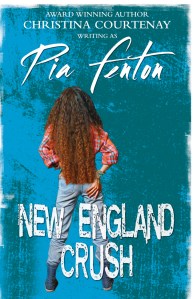
I discovered a while back that I love reading YA fiction – it’s an amazing sub-genre where imagination seems to have no bounds. Then I went to a high school reunion and it really made me think about my own teenage years, both all the fun I had and the angst that comes with being that age. I attended an American high school for three years, which was a bit of a culture clash to begin with and it occurred to me that it would be fun to write a series of books with UK heroines and US heroes and so the Northbrooke High series was born. I have now self-published the second book in the series, New England Crush.
What is next for Pia/Christina?
I have just finished edits for the third book in my Japanese trilogy – sequel to The Scarlet Kimono and The Gilded Fan – which is due out in paperback in August this year. I’ve also started work on a new time slip novel, which is based on the final few months of the English civil war. I love that period in history and was inspired to write about it as there are several ruined castles, destroyed during that time, near where I live. (Both these books are for adults, not YA).
It is the last day of what has been an exciting and challenging year for me. I would like to thank all the lovely people who have followed my blog and watched it grow.
I would especially like to thank all the authors who have been my guests and shared their careers, experiences and writing tips with me month on month. They have been truly inspirational and I will be welcoming more professionals from the industry as 2015 opens up.
Wherever you are, whatever your interests, I wish you all a happy, healthy and successful 2015!
Abigail was rescued as a baby by Lord Edmund Hammond – or so she believed.
Raised as a lady, calling him father, she enjoyed a sheltered life as she grew up and loved her step-brother, Frederick. Life dramatically changes because she has to flee from a forced marriage when Lord Hammond falls ill. With her lifelong maid she travels to the port of Whitby via the beautiful ancient city of York.
To Abigail’s naive eyes Whitby would have been a noisy, bustling place with a myriad of smells from the various industries surrounding the whaling, fishing and boat making industries. Even Abigail’s name, like her situation, has a double irony. Abigail literally means ‘my father’s joy’, yet she does not know who he is. The name is also used commonly to refer to a lady’s maid.
When I explored Whitby I came across a narrow snicket in which was a love old ram-shackled set of buildings I borrowed this setting for ‘Biddy’s Bakery’, placing it next to an old inn like the amazingly well restored White Horse and Griffin and took the extra liberty of placing a laundry opposite. Whitby was so wealthy through the whaling industry that in 1790 there were two street lamps in Church Street outside this original coaching inn.
I had the pleasure of staying in the same room that it is said Charles Dickens once used. It was a lovely friendly place in a fascinating location, and serves excellent food.
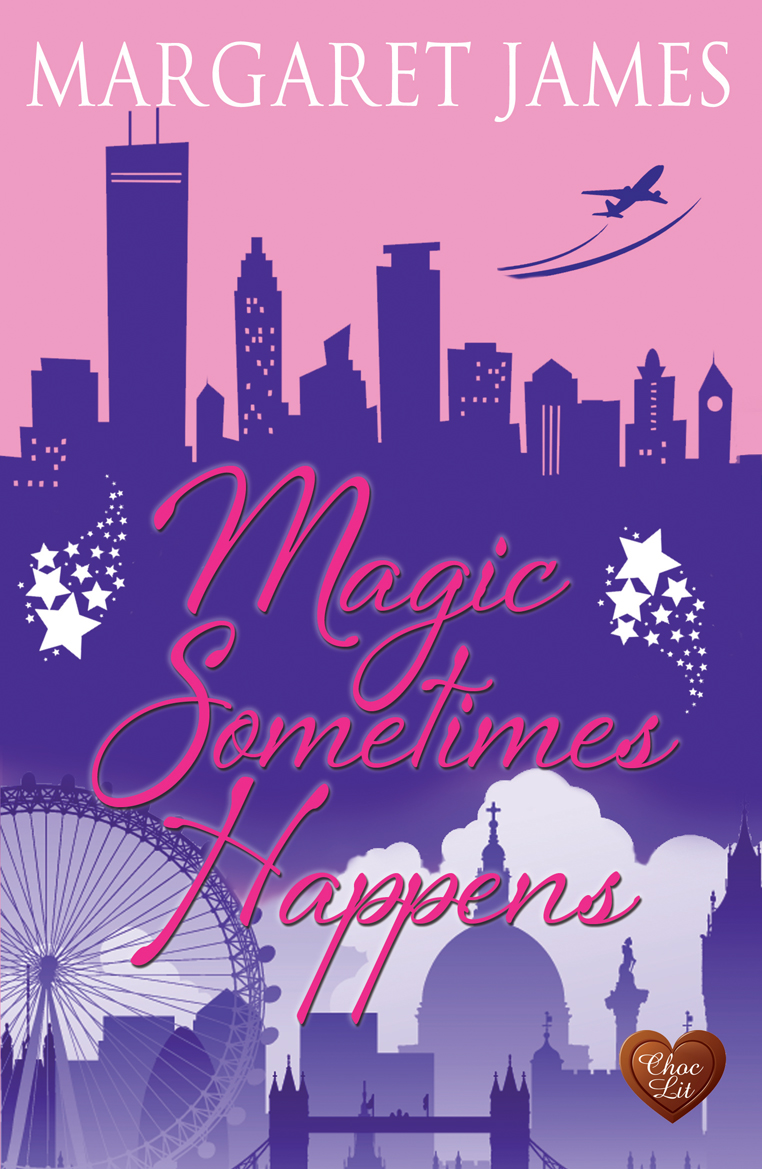
I am delighted to welcome Margaret James back to my blog as she tells us about her enchanting new book Magic Sometimes Happens!
Thank you for inviting me to be a guest on your blog, Valerie. It’s great to be here! Today, I’m going to tell you about the inspirations – music, poetry and places – for my latest novel, Magic Sometimes Happens.
The story is about second chances for both my hero and my heroine. My hero Patrick Riley is married, is the father of two small children and doesn’t expect his wife to leave him for a man she says makes her fly. My heroine Rosie Denham is running away from a bad mistake and needs to learn to forgive herself.
Margaret James
The story starts when Rosie visits Minnesota in the fall, a season which is probably the most beautiful time of year in one of America’s most beautiful states. The whole place seems to turn red and gold almost overnight as the trees change colour. But fall is a very short season. Minnesota’s long, harsh winter will soon be on its way, and the whole place will be frozen solid for almost six months until spring makes a brief appearance before the next sweltering summer comes around.
So yes, Minnesota has an extreme climate. But it’s place that is full of extremes. The Twin Cities of Minneapolis and Saint Paul are divided by the Mississippi River, which winds between limestone bluffs and through various locks and channels to join the Missouri before flowing on to the Gulf of Mexico. There are quiet, very beautiful stretches of river very close to the urban hearts of Minneapolis and Saint Paul. But some parts of the Twin Cities are very built up. Minneapolis is home to the Mall of America, the biggest shopping centre in the western world. But there are also hundreds of parks, lakes and playgrounds dotted between the buildings, and – in spite of the dozens of high-rise buildings and skyscrapers in downtown Minneapolis – the whole place has a countrified feel to it.
Most American schoolchildren are probably familiar with Henry Longfellow’s narrative poem, The Song of Hiawatha. It’s the story of a Native American warrior and his bride Minnehaha and it’s set in Minnesota. When you visit the Twin Cities, you can’t help but be aware of the influence of Longfellow on place names. You’ll come across Minnehaha Park, Hiawatha Avenue, the Hiawatha Clinic and many more. My fashion PR consultant heroine Rosie is a British girl who has never heard of Longfellow, but American-born Patrick knows long stretches of the poem by heart.
As for music – although Patrick is a professor of IT and very science-oriented, he is in love with music, especially American classical music by the likes of George Gershwin, Aaron Copland, Leonard Bernstein, Samuel Barber – Pat listens to them all. But his absolute favourite is Gershwin who wrote, among many other compositions, Rhapsody in Blue and An American in Paris. So, when Rosie takes him to Paris, Patrick can’t help but be enchanted and magic is surely bound to happen!
Maybe have a listen and see if you’re enchanted, too?
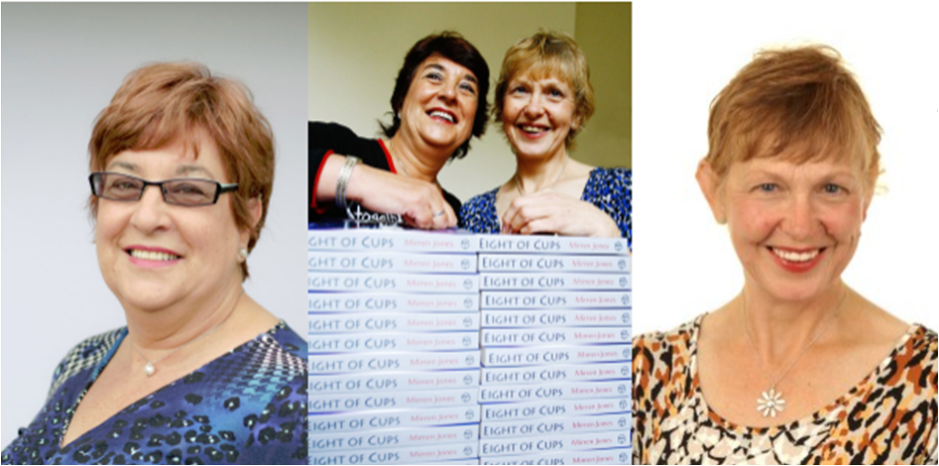
‘Mirren Jones’ is a unique partnership of writers Marion Duffy (left) and Elaine Atkins (right).
Did your partnership form and grow through the collaboration as writers or did your published work evolve as a result of your friendship?
A bit of both! In 1999, we had co-authored two books of non-fiction, published by Radcliffe Medical Press (‘Facilitating Groups in Primary Care’, and ‘Facilitating Organisational Change in Primary Care’), while employed by The University of Dundee. That activity, along with several years of co-tutoring and joint research and consultancy, developed our working relationship and eventually led to our being friends as well as boss and junior!
Our fiction writing partnership – and ongoing friendship – is something newer and different, as we are no longer in a formal work situation. We’ve been writing and working together for 16 years in total and are still great friends, despite now living 500 miles apart.
Please tell us something about ‘Eight of Cups’?
The novel is certainly not chic-lit, and is not intended to be literary; rather it fits the genre of well-written contemporary women’s fiction, although many male readers have told us they’ve enjoyed reading it and learnt a lot about women’s minds in the process! It’s a saga spanning over thirty years, beginning in 1972, as the six main characters arrive at Edinburgh as new undergraduates. After leaving university, their roads lead to England, Wales, Ireland, America and the Middle East; lives intertwine and paths cross.
The story is told from two perspectives. One, from the first-person narrative of the primary character, the rather too selfless (as becomes evident) Scottish lass Diane. The other, third person narrative interlocks all six characters in a brindled strand of narrative priorities. The women are all very different personalities: Nancy, the risk-taking country-loving girl from Yorkshire, Alix, the hedonist from Aberdeen, Carys, the studious one from the depths of West Wales, the quietly anxious Lesley, from Cardiff, and bossy, religious Patricia from Dundee.
The book explores the effects of the various attachments each character possesses on their lives: dreams, ambitions, pleasures, plans, obsessions and fears, and asks the question, “What will it take to set them free?”
Where or who did the inspiration and desire to write the novel come from initially?
Marion (Mirren) describes the impetus as being a combination of challenge and opportunity, with a significant event in her social life providing the seed for the story. She was moving to live part-time on the Isle of Lewis in Scotland when her husband took up a post there in the island dental services. He was concerned that she would be bored (does he really know her??) and challenged her to ‘write that novel you’ve been banging on about for years’. Co-incidentally, she attended a reunion of old university friends where one of her old pals divulged a shocking secret to the group. That set her thinking of how life affects plans and attitudes. On hearing of Mirren’s novel-writing plans, Jones was very keen to join in, making a strong case that if we were able to write non-fiction successfully then we ought to be able to do the same with fiction! So after discussion and negotiation, Mirren Jones was born and ‘Eight of Cups’ quickly began to take shape.
Do you split tasks when you approach producing a novel or do you write alternate chapters, swap them and then smooth out the writing style in redrafting?
We work in a highly iterative way – creating, structuring, planning, revising, over and over again until we are happy with the product. Interestingly, we always sit down together and read through all the dialogue before signing off the final draft – this does give unique insights. In the end, the finished work is an amalgam of our ideas, plot lines, character development and physical writing (Mirren’s straight on to computer, and Jones on paper first), critiqued and then polished according to our own standards and preferences, as well as feedback from selected trusted reviewers.
You both have had careers dealing with people within the health sector. Do you think this experience has helped you to feel deeper empathy for the characters you create?
Our work in the NHS, in academia and as organisational development consultants has required us to be attentive listeners, adept at interpreting information from others via all our senses, able to feedback sensitively and imagine ourselves in others’ shoes. We have gained experience over many years of the effects of ill-health on people, and how life impacts on well-being. Hopefully our innate vein of empathy has been enhanced by our real-life experiences which then give us insight that we can apply to our characterisation. Perhaps being co-writers has an advantage over writing solo, in that with our combined life and work experiences we are able to bring a very wide range of knowledges and contexts to our writing, thus giving credibility to our characters and their settings.
How do you keep up the much needed energy and momentum for the projects you start when living so far apart and having such varied commitments and interests?
We put no pressure on each other in terms of deadlines and accept that life will get in the way, as it has done since we became Mirren Jones. We try to fulfil our promises to each other, and to ourselves as best we can, and both would love to have more time to write. Neither of us are the kind of writers who can squeeze in an hour before bedtime, or get up early and write before going to work. But what does help is if one progresses the story and reignites the flame for the next chapter to be written.
Please tell us something about your next novel, ‘Never Do Harm’.
It is a psychological drama about two doctors, friends since childhood, living in the same part of Scotland, but operating in very different settings. Alan is a GP in a busy medical practice, Hugh is a senior hospital consultant in a big teaching hospital. Professional in their working lives, they are rivals as well as friends in their personal life. Alan’s French wife Simone, a sculptress, is the third player in their relationship. Her presence will generate the potential for harm, something the two men promise never to do in their role as doctors, but which doesn’t of course apply outside of work. Our old NHS colleagues will be more than a little worried that we’ve used some real-life experiences to fuel our writing of this novel – and they may well be right!
What is next for Mirren Jones?
Finishing ‘Never Do Harm’ is our immediate aim – we are committed to reaching this goal before the end of the year. Then we have to navigate the world of Indie publishing which has changed considerably since we produced ‘Eight of Cups’, with the advent of digital books on multiple platforms, and embrace marketing with renewed enthusiasm!
As for the future – we have no problem generating ideas for stories, so when we decide to work on a third novel, it will probably progress much as this one has – in a stop-start fashion, with many twists and turns in both the writing and the lives of the writers. Given our personal experiences to date, we can anticipate unexpected changes which might throw up a range of other possibilities. In the meantime, Mirren continues in her role as Practice Manager in her local health centre, and Jones with her work as an Energy Psychology practitioner (humans and horses) / MD of CareandCompare.com – a charitable insurance price comparison website.


 As Valentine’s Day approaches can you share with us some of the major changes you have seen in the last couple of years within the world of romance?




 The novel is certainly not chic-lit, and is not intended to be literary; rather it fits the genre of well-written contemporary women’s fiction, although many male readers have told us they’ve enjoyed reading it and learnt a lot about women’s minds in the process! It’s a saga spanning over thirty years, beginning in 1972, as the six main characters arrive at Edinburgh as new undergraduates. After leaving university, their roads lead to England, Wales, Ireland, America and the Middle East; lives intertwine and paths cross.
 Our work in the NHS, in academia and as organisational development consultants has required us to be attentive listeners, adept at interpreting information from others via all our senses, able to feedback sensitively and imagine ourselves in others’ shoes. We have gained experience over many years of the effects of ill-health on people, and how life impacts on well-being. Hopefully our innate vein of empathy has been enhanced by our real-life experiences which then give us insight that we can apply to our characterisation. Perhaps being co-writers has an advantage over writing solo, in that with our combined life and work experiences we are able to bring a very wide range of knowledges and contexts to our writing, thus giving credibility to our characters and their settings.
 valerie holmes, author