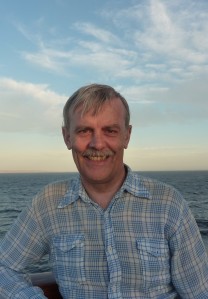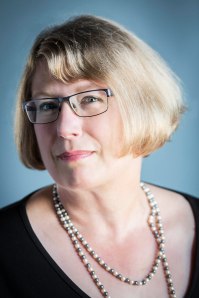
An Interview with Martin Edwards

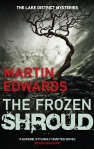
The Frozen Shroud

Martin on Thomson Dream Aug 2012

July’s special guest is award winning crime writer and consultant in a law firm, Martin Edwards. I first heard Martin give a fascinating talk at last year’s CWA conference in the Lake District and could tell that he was not only an authority on the genre, but was passionate about it.

Martin recently won the inaugural CWA Margery Allingham award at the Bristol Crimefest. Congratulations! 

You are an accomplished legal consultant and crime writer. When did this love of law turn into the desire to write crime novels?

The love of crime fiction definitely came first. As a small boy, I became fascinated by the idea of telling stories. Once I discovered Agatha Christie at age nine, the die was cast, and I determined to write detective stories. However, we didn’t know anyone who wrote books, and my parents were rather concerned about my ambition of becoming a detective novelist. So they encourage me to get a ‘proper job’, and that’s where the idea of studying law at university came in. I found that I relished the academic challenges of law, and later I enjoyed the practical side of employment law. I’ve been lucky with my legal career, and it’s introduced me to fascinating people and places. But now I’m aiming at long last to focus on my first love. After thirty years as a partner in my firm, I’ve retired to become a part-time consultant. Yippee!

Would you say that your legal work, involving meeting individuals in pressing circumstances and dealing with their problems, has given you a greater empathy and insight into human relationships and conflicts, which can help with fictional character development?

Jobs, and employment issues, are all about human relationships. After a few years as a lawyer, it dawned on me that this was why employment law appealed to me in a way that subjects like conveyancing did not. Of course, the more people and human dilemmas that you encounter, the more you develop an understanding of people’s behaviour – good, as well as bad – that is definitely helpful when you write fiction. You’re not writing about the people you meet, but about the issues that people have to confront in their lives.

New editions of your Harry Devlin novels have been released. Can you share with us how this Liverpool lawyer came to be created?

My first – and never published, or even fully typed – novel was a football thriller. After that, I wanted to write a book that could be published. When I went to work in Liverpool, it seemed like a wonderful setting for a crime series. I didn’t know any cops or private eyes, so I decided that my hero would be a lawyer, like me. Not really like me, though. He would be a criminal lawyer, and have a tough life in various ways, as well as being rather braver than me. To this day, I’m very fond of Harry, and I’d like to write about him some more one day. In the meantime, I’m excited that the novels are now available again as ebooks, and two have actually been republished successfully as mass market paperbacks, as “Crime Classics”, no less…

For your next series you set the first novel ‘The Coffin Trail’ in The Lake District and introduced your readers to Detective Chief Inspector Hannah Scarlett. What was most challenging: moving from a protagonist who was a lawyer to a DCI or from a ‘Harry’ to ‘Hannah’?

The Frozen Shroud UK editionI was moving from one viewpoint character to two – Hannah and Daniel Kind, the historian who gets to know her in The Coffin Trail. I always intended that the series should be about their developing relationship, but Daniel was the starting point. I saw him as the key character, but when Peter Robinson read the book, he said he thought Hannah was the one I was really focusing on, and I saw at once that he was right. By that point, I’d was writing my ninth novel and I was ready and very willing to tackle story-telling from the perspective of a female character. It was a fresh challenge, and one that excited me. It still does.
You have many projects ongoing simultaneously between your two careers as well as being a critic, an anthologist, a contributor to many non-fiction works as well as keeping your very helpful blog updated. Would you describe yourself as an exceptionally disciplined and driven writer/worker?

TMBA Kindle artworkI admit to being driven, in that I feel very conscious that life is short and that there are a lot of things I want to achieve. To my mind, being ambitious is a good thing, as long as one tests oneself against one’s own self-imposed standards, rather than against other people, or the standards set by others. However, although to some extent I’m self-disciplined, I sometimes wish I were better organised. I do tend to set myself very demanding targets that I fail to meet with monotonous regularity. Perhaps – in a not very coherent way –that’s the method that works best for me, and even if sometimes I feel I could have achieved more, perhaps this helps to drive me on to do better in future.
In your ‘Writing tips’ you advise: ‘Plan the story before you start’. Once this has been done, would you ever amend or change a plot as you begin writing the first draft?

Yes, I’ve done this from time to time. The great thing about writing is this – you can always improve what you have written. A plan works well for me – not everyone is the same, of course. But even the best laid plans are sometimes capable of being changed for the better. So far, I’ve never changed the original solution to any of my novels, but I’ve tinkered with many other elements of my stories.

Your work as an archivist for the CWA and The Detection Club has been widely praised. Could you please tell us something about The Detection Club?

The Detection Club was founded in 1930 by that wonderful and under-rated writer (and rather strange man) Anthony Berkeley Cox, who wrote innovative whodunits as Anthony Berkeley and superb psychological crime novels as Francis Iles. It was the world’s first social network for crime writers, and attracted the likes of Christie, Sayers and Margery Allingham. The aim was for an elite of crime writers to raise the literary standards of the genre, but above all they liked drinking and chatting together. The extent to which their literary aims were achieved is debatable, but the books produced by the Club – for example, the round robin mysteries The Floating Admiral and Ask a Policeman – remain very readable to this day, and have been very successful in new editions in recent years. I’ve written intros to a couple of them, most recently The Anatomy of Murder, an intriguing book of essays about real life murders. The Club is and always has been in essence a sociable dining club. Membership is by election – there is an annual secret ballot – and the Club flourishes to this day.

As a collector of rare crime novels, is there one particular book you would like to own and, if so, what makes it so special to you?

Now you’re asking! I’d love to own a Sherlock Holmes book, signed by Conan Doyle, but alas, I’m sure that’s an impossible dream…

In ‘Dancing with the Hangman’ you explore the question of ‘justice’. In your crime novels do you enjoy being able to write the conclusion that you personally approve of, wherein your legal career the verdict is, to a degree, beyond the legal representative’s control?

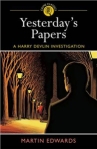
Yesterday's Papers ArcturusIntriguing question, and I’m not quite sure about the answer. When I was fighting legal cases in the employment tribunal, I always wanted to win, but on the whole I felt that the right result was usually achieved in most cases. With fiction, I like to see some form of justice done at the end, but this doesn’t always mean the conviction of those who are technically guilty. I think it’s good if a novel reaches a conclusion that affords “satisfaction”, but the forms that satisfaction, and indeed justice, can take are many and various. Christie understood that – consider the finale to Murder on the Orient Express.
Could you share with us some of the delights included in the latest anthology that you have edited for the CWA?

Guilty Parties contains more stories than usual, and I really enjoyed reading them. It would perhaps be invidious to pick personal favourites, but my aim was to showcase the variety and depth of the crime genre, and it’s a book that I’m very pleased to be associated with.

What is next for Martin?

I’m currently working on my seventh Lake District Mystery and I have two or three short stories coming out in the near future. Recently I finished a history of detective fiction between the wars – The Golden Age of Murder – which I would love to see published in 2015, as it’s a book I’m really proud of, and I’ve put a huge amount of effort into it over a good many years. At present I’m editing two anthologies of vintage crime fiction for the British Library, a collection of Sherlock Holmes stories, and a book of true crime essays for the CWA. I’m also working on a book that brings together all Dorothy L. Sayers’ reviews of detective fiction from the Thirties. All of which is quite enough to be going on with!

More from Martin

Website: martinedwardsbooks.com
Facebook: Martin Edwards
Twitter: @medwardsbooks

An Interview with Eileen Ramsay

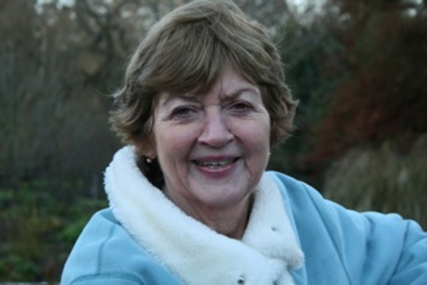
Eileen RamsayThank you, Eileen, for taking the time out of your busy schedule to be my guest this month.

You have had a fantastic breadth of life experiences from teaching the children of international politicians and celebrities in the USA to working in Migrant Education. What lasting impressions did this contrast leave you with?
One fact that has remained with me through all my years of teaching is that, no matter the social position of the parents, the wealth or lack of it, education or lack of it, ALL good parents want the best for their children. Another is that poor parents – and I’m not talking finance here – come from every strata of society. I have had extremely wealthy parents leave seriously ill children in hospital while they jetted off to join some celebrity at a ski resort and I have had really poor Mexican parents turn up at my door begging for “Trabajo ahora?” whenever there was a school outing that cost a little money. They didn’t want a hand-out, they wanted to work to earn the money.

What is it about Mexico that appealed to you so much?

I visited Mexico often and studied Spanish language and Mexican music there. I love its fascinating and sometimes sad history. It is incredibly beautiful. The people are proud and they are generous and full of humour and you have just given me ideas for articles!

Would you agree with the observation that despite having lived with the lifestyle of the very privileged, you always seem to have kept your focus on what is important in life – family and reality?

You’re right, I did enjoy some incredible experiences and my upbringing was certainly not among the privileged but one wonderful woman in Washington DC reinforced all my early lessons. I had just met the man who was to become my husband and I wanted to impress him – shallow person that I am – with my ‘new’ family. I was taking him to lunch – to be introduced – and we walked into the house to see the lady of the house on her hands and knees washing a floor.  It turned out that the resident ‘cleaning lady’ wasn’t feeling well and had been sent to bed.

‘But why are you washing the floor?’ I asked.

She looked up at me and laughed. ‘Dirt,’ she said, ‘is no respecter of persons.’

My husband, of course, fell in love with her on the spot.

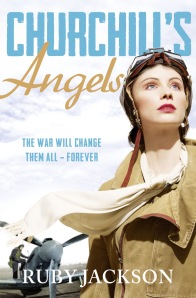
Churchills AngelsWhen did you break away from teaching to develop a career in writing?

Teaching and writing marched together for years. I wrote stories for Sunday School magazines and I wrote reading materials for primary schools. I was able to use knowledge of Native Americans I had gained while living in the US to write something a little different – Bud and the Hunkpapas was a favourite. For a few years I wrote from 4am to 6am but resigned when our younger son went to university.

Are you a very disciplined writer in the way you organise your day?
Organise?  I can already hear the laughter of those who know me.
I am disciplined. If possible I write every day; some days I write all day and well into the evening – that’s research time too. I use a laptop that has no internet because I can’t resist an email pinging in. My husband is learning to cook – our sons and lovely daughters-in-law sent him on a course – and he does one meal a day and he helps with housework – does all the heavy things and brings me a cup of coffee in bed first thing – and so I have 30 mins of ‘fun’ reading.

How and when did your first breakthrough as a published writer occur?
I went to a writing conference at USC where the great Michael Shaara, Clive Cussler, and the editor Charles Block were speakers. A friend typed up part of a Scottish Regency novel I’d been writing – I had even fewer technical skills then – and Charles Block read it. He was waiting outside a lecture room for me on the last day, handed me the script and said, “I think this will go but have chapters one and two change places.”

I had introduced the heroine in chapter two and he advised that the heroine should always be right there in chapter one. We returned to live in Britain that summer; I managed to get an agent – long story and sent her the finished, rewritten manuscript. A few days later she called and said she’d attended a party the evening before and an American editor had asked her about the availability of Scottish Regencies.  She showed her the typescript and it was bought! I looked at it a few years ago and it was rather dire – wouldn’t be published today. I rewrote it, correcting errors, and published it on Amazon!

You were established as a saga writer and then made the bold and successful move to writing romances based around the world of opera and music. What inspired this departure?

I had written children’s books, Regencies, Sagas and serials and I wanted to write contemporaries. I went to an artist chum’s exhibition and found myself thinking – What if all these paintings were of one person? The idea stayed and grew like Topsy and I wrote a book about an artist who loved a tenor – my favourite voice!  It was read by several reputable editors and agents but no one wanted it but almost everyone made sensible points. (I occasionally bump into one or two at an RNA party and we chat perfectly happily!)

            At a book launch I found myself standing beside a lovely woman who asked me if I wrote books like those of the superb writer onstage. I said “no” and told her my friend’s publisher had just, that very day, rejected me.

            “I didn’t reject you,’ said the woman and gave me her card. “Send it to me and I’ll have a look.’

            I dithered for days and eventually rang my friend, telling her I felt badly about, even inadvertently, using her launch to contact a very senior editor. She looked at me and said. “Don’t be stupid; if anyone holds out a hand to you in this business, grab it.”

            I grabbed, sent it and received the manuscript back with a “NO” for which she gave her reason. She also told me I really needed a good agent and suggested three. Two had already rejected me but I had not heard of the third and so I had one more go.

            The agent accepted me as a client, and, with her guidance, I rewrote a few scenes. The agent, the brilliant Theresa Chris, sent the manuscript to auction. It went for an amazing amount of money and was then bought by several foreign publishers.

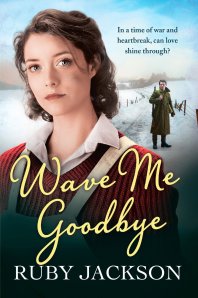
Wave Me GoodbyeLast year, ‘Wave me Goodbye’ was published under the name of Ruby Jackson, which I understand is the first of a series of novels ‘Churchill’s Angels’.  Please tell us something about this new project?
I suppose, like many writers, after five best-selling books, I fell out of favour. Theresa stayed with me, encouraging me, advising me.  A few years ago, she asked if I would like to revisit WW11 and after much thought, I said yes. I did not know, of course, that  an editor at Harper Collins had conceived the idea of publishing a series of books about the courageous women who did everything from catching rats to ferrying Spitfires; the women she calls Churchill’s Angels.  Using the pseudonym, Ruby Jackson, I have now written four books; two have been published so far.  It’s been an enormous privilege. I’ve met land girls, pilots, nurses, etcetera and been awed by every one of them. Their stories need no exaggeration – they were quite simply – superb.

You obviously love historical fiction and research your chosen topic thoroughly. What advice would you give to anyone who was considering writing a historical novel?
Advice would depend on which era and which country but obviously I’d say, find out as much as you possibly can about the person the time and the place. Read everything, especially newspapers of the time, and don’t be afraid to ask questions. Archivists and librarians are great sources and remember there are archivists in famous department stores, in grand hotels and in universities.  They know what you don’t know you don’t know!

What is next for Eileen?

I have no idea; my head is spinning – that way, or that way but I did visit a conductor friend at the Royal Opera House earlier this year. He has been keeping me accurate about conducting and conductors for several years as I have an idea. He asked me about progress.

‘I’m afraid, for the past four years, the poor man has been standing on a rock looking out to sea.’

He shrugged. ‘Well, there are worse places for a conductor to stand.’

Now, wouldn’t you want to discover the worse places?!

More from Eileen

Website: eileenramsay.co.uk
Blog: Eileen’s Blog

Sharing Places – Part 4

Whilst researching social history for my stories I visit some fascinating places. Here are some of the places that have triggered plots, created characters or inspired a mood or a desire to return to the keyboard and write.

4. Whitby, North Yorkshire, England.


Whitby Abbey
Whitby Abbey, an iconic image on the headland.

One of my favourite places to explore on the North Yorkshire coast is the unique, atmospheric town of Whitby. This ancient port situated on the northeast coast of England is famous for many reasons.

St Hilda founded a double monastery (for monks and nuns) here in 657 AD, making it a valued seat of learning. The famous Synod of Whitby was held here in 664 AD.

Whitby became a famous whaling port with such famous seafaring names associated to it as the Scoresby‘s.

Whitby's 99 steps
The famous 99 steps, better going down than up!

The James Cook Museum is housed in the C17 house where he lived as an apprentice. It is an atmospheric place overlooking the River Esk. There is a large car park nearby so exploring this side of the harbour is not a problem if arriving by car. If you walk into the East side of the harbour from here you can wander through the old cobblestoned streets and explore the many yards and snickets.

Passing the old inns and market square you will reach the bottom of the famous 99 steps which lead up to the unique church of St Mary and then to the abbey beyond. The views across the harbour from here are magnificent.

St Mary's Church
The unique St Mary’s church in front of Whitby Abbey has pride of place on the horizon.

To experience staying in one of the original inns, The Whitehorse and Griffin has been lovingly restored and offers excellent food.

Whitby sporadically comes into my stories, either in passing as in Abigail Moor, or as a setting in itself, such as Amelia’s Knight, which is still to be released as an eBook.

Whatever your reason for visiting this fascinating location, being prepared to walk and explore its narrow alleyways, historic places, or the more usual shops and eateries on the west side of the harbour, then there is plenty for everyone to enjoy.

Whitby houses
A glimpse of the red pantile rooves that characterise bay town houses.

For excellent seafood and a great place to eat it, looking back across the harbour to the abbey is The Magpie.

Other places of interest in the area can be found on these helpful websites:


An Interview with Louise Allen

A photo of Louise Allen

When did you first decide to become a writer or discover your love for the written word?

I’ve always had a vivid imagination and loved fiction but I think academic work knocked the urge to actually write it out of me. Then I started for all the wrong reasons – I was a librarian and saw how popular Mills & Boon novels were. I thought it would be easy money – idiotic of me, of course. However, by the time I sorted myself out and took it seriously I was hooked.

What appealed to you about the romance genre?

It is a great genre for exploring relationships, which is always interesting, and when I discovered historical romance, there was no stopping me – two passions in one!

Your research is impeccably thorough. At what point do you take a step back from it and begin to write the book?

Walks Through Regency London Cover LARGE EBOOKThe story and the characters have to come first, always, although some plot lines can be sunk from the start if the historical premise is incorrect – 18thc characters getting an easy divorce, for example or a sub-plot that involves getting from London to York in a day. Generally I know what I don’t know and therefore what to research – politics, for example. I’ve got a huge personal reference library. But once I know I have a plot that will work in a particular historical context then I leave the research until afterwards and go back to it so it doesn’t take over. When I wrote a story set in AD410 during the Sack of Rome (Virgin Slave, Barbarian King) I just left questions in red for bits I needed to check and went back to them to be sure my characters left Rome by the right gate onto the right road and I’d got the layout of a bath house correct and so on.

I also write historical non-fiction – Walking Jane Austen’s London (Shire), Walks Through Regency London (Kindle), Stagecoach Travel (Shire, July) and I’m working on something on the Great North Road at the moment, so I can channel the hard facts somewhere they won’t take over.

You must have visited some fantastic locations and discovered some unusual facts during your research. Could you share some of the most memorable with us?

Finding three of the houses that Jane Austen stayed in when she was in London was a thrill. Only one, in Covent Garden has a Blue Plaque, but I discovered the other two when I found a pamphlet about research that was done after the war which revealed that her brother Henry’s homes in Sloane Street and Hans Place were not demolished by the late Victorians, but simply refaced and had new upper floors added. The originals are still there under the later shell.

Practical research is great too – I took carriage driving lessons, for example and I’m about to go on a practical osteoarchaeology course handling real skeletons. Goodness knows when that will come in useful…

Do you have a strict writing routine?

Yes, or I’d never get anything done! I write every afternoon until I have hit at least the minimum number of words I need to do to make sure I finish a week before the deadline, and hopefully a few more. That way I have some time in the bank for catching flu or unexpected commitments.

How do you balance the need of keeping your work accessible to contemporary readers against your desire for historical accuracy?

I won’t distort history but it is possible to use it to appeal to contemporary readers. For example I tend to write heroines who are older and who have the freedom to act in a more assertive, interesting way. They may be widows, or following one of the career paths open to women at the time. Where there are strong differences in beliefs and norms between the time I am writing about and the present – the fact that many wealthy families in the 18th century owed their fortunes to slavery in the West Indies, for example – I simply avoid putting my characters into those situations. On the other hand, the ‘long Regency’, which is the period I usually write about, saw the beginnings of many of the freedoms we are concerned about now, or at least the fight for them. Education for women, abolition of slavery, prison reform, concern for child welfare can all be woven in to some plots and engage the sympathy of readers.

As the New Writers’ Scheme Organiser for the RNA, what key advice would you give to someone who wanted to break into the romantic fiction market?

Read widely in the genre you are interested in and do so analytically as well as for pleasure. What works, what doesn’t? Why? Then work at developing your own voice – there is no substitute for practice!

Please tell us about your latest release?

UnlacingMy latest book is Unlacing Lady Thea (Harlequin Mills & Boon. April). I got the idea for it when we took a small-ship cruise down the eastern coast of Italy. My heroine is no great beauty, and thoroughly practical with it (and I had some fun with the fact that, unlike many romantic heroines, she doesn’t fool the hero for a moment when she disguises herself as a boy). My hero begins the book seriously the worse for drink and talking to the kitchen cat. He’s so drunk that he agrees it would be a good idea to allow Thea to accompany him on his Grand Tour so she can join her godmother in Venice. By the time he sobers up, it is too late and he is stuck with escorting his childhood friend for whom, of course, he has no amorous feelings… None at all, he tells himself.

What is next for Louise?

Scandal’s Virgin is out in June and Beguiled By Her Betrayer, which is set in Egypt in 1801, is released in August. Stagecoach Travel comes out in July.

Currently I’m working on book three in a trilogy, provisionally called Battlefield Brides. Book one is by Sarah Mallory and book two by Annie Burrows. The three books are set before, during and just after the battle of Waterloo and will be released to coincide with the bicentenary of the battle in 2015.

More from Louise

Website: louiseallenregency.com
Blog: janeaustenslondon.com
Twitter: @LouiseRegency

An Interview with Cindy Kirk

My guest this month is prolific American author Cindy Kirk. Cindy is a writer who loves romance and has written many special editions for Harlequin.

When did you first discover the joys of story-telling or writing your own stories down?

I’ve loved books and stories for as long as I could remember.  If I didn’t like a book’s ending, I’d make up my own.  The same held for movies or televisions shows.  For a long, long time I thought that everyone made up different endings.  I wrote my first “book” when I was thirteen.  It was a romance, of course, with a happy ending!  I let one of my teachers read it and I could tell she didn’t think it was very good.  It was a devastating blow to my young writer’s soul.

Which novels inspired you, or you would rate as your all time favourites?

LaVryle Spencer’s Bitter Sweet and Separate Beds; Susan Elizabeth Phillips’s Dream a Little Dream and Nobody’s Baby But Mine; Lisa Kleypas’s Travis Series, Julia Quinn’s Bridgerton Series.

Could you share your journey to becoming a published author with us?

I wrote five books, it was the fifth that sold, 3 years after I started writing in pursuit of publication.  The book that sold won a contest.  The first prize was a critique of the entire manuscript by Harlequin editor, Patience Bloom.  She not only read it, she bought it.  And 15 years later, she’s still my editor!

What advice would you give to a new writer who has not made it into print yet?

To continue to hone your craft.  When I started writing, I began attending regional conferences for writers. Every year I attend the Romance Writers of America‘s National Conference and soak in all the wonderful information on how to write a better book.

Why romance?

I love a happy ending!  Not only in books but in movies.  I want to cheer for the hero or heroine, see them become stronger, learn life lessons, then be rewarded.

How did the ‘Jaunty Quills‘ develop?

I was writing also for Avon (Harper Collins) when a group of Avon authors decided to get together and start a blog.  At the time I was the only contemporary author.  The group has morphed over time to include authors from all different romance genres and publishers.  It’s been fun every step of the way.

What is the essence of a Cindy Kirk novel?

It’s a fun, enjoyable read with a dash of humor.

What is next for Cindy?

More books in my Jackson Hole series for Harlequin.  A return to Harper Collins with a novella that will release in December 2014.  And, who knows? That’s the beauty of writing.

More from Cindy

Sharing Places – Part 3

Whilst researching social history for my stories I visit some fascinating places. Here are some of the places that have triggered plots, created characters or inspired a mood or a desire to return to the keyboard and write.

3. Ormesby Hall, North Yorkshire, England.

DSC04426DSC04400
This interesting Georgian mansion belonged to the Pennyman family for nearly four centuries and is now open to the public. It is nestled in its own grounds hidden away from the busy modern environment surrounding it.

I was delighted to be shown around the servant’s passageways when I visited. They thread through the house so that the daily running of the hall did not get in the way of the family who lived there.

The Victorian launderette is not as grand as the larger hall of Beningborough near York that gave rise to Chloe’s Friend, but the estate is a joy to walk around. You can visit the local church further up the lane and the stables which are used to this day by The Cleveland Mounted Police.

Also, there is a permanent exhibition for the model railway enthusiast and fine cakes in the tea room.

Sharing Places – Part 2

Whilst researching social history for my stories I visit some fascinating places. Here are some of the places that have triggered plots, created characters or inspired a mood or a desire to return to the keyboard and write.

2. Saltburn Gill, North Yorkshire, England.

67113_135084629972080_1860012131_n534704_137209683092908_823309552_n

A ten mile, fine sandy bay sweeps between Huntcliffe and the mouth of the River Tees on the once remote northeast coast of England. The town of Saltburn nestles in the shadow of the headland and has a fascinating historical connection with smuggling in the region.

I borrowed the location for some of my nineteenth century titles. Saltburn became ’Ebton’ and the headland ‘Stangcliffe’. The location of the actual Ship Inn was used as the heart of the old fishing village. The Saltburn Gill, which runs through an ancient natural oak and ash woodland behind Cat Nab, has a rich undergrowth of Holly and Hazel and a myriad of flowers and wild birds that vary throughout the seasons making it a vibrant and beautiful place to visit at any time of the year.

It was a route used in times past by smugglers and my version of it appears in such stories as Phoebe’s Challenge and many other titles of my back list, many are yet to be converted to their eBook format.


Sharing Places – Part 1

Whilst researching social history for my stories I visit some fascinating places. Here are some of the places that have triggered plots, created characters or inspired a mood or a desire to return to the keyboard and write.

 1. Nunnington Hall, North Yorkshire, England.

Blog1Blog2

Twenty one miles north of the beautiful city of York is the historic estate of Nunnington Hall. Its history stretches back from Tudor times through the family’s sympathies with the Jacobite’s cause to modern day.

Built on the banks of the river Rye, it is a beautiful location to explore where peacocks roam free. I loved exploring the period rooms and also the old servant’s rooms and attic where the hall houses a fine miniature collection. The views are magnificent. It feels as if the hustle of modern day life has been left behind as you explore this beautifully preserved walk through history.

An Interview with Janet Gover

Janet Gover

My guest author this month is an experienced novelist, TV journalist, and short story writer, as well as an award-winning Australian author, Janet Gover. She has graciously taken time out of her busy, globe-trotting schedule to answer some of my questions and share her vast experience with us.
 
Welcome, Janet!

How did your childhood fuel your love of books, travel and adventure?

Hi Val – thanks for having me here on your blog.

I grew up in a tiny bush town in Queensland. There were only 18 buildings in Bowenville back then – I know this because I counted them. There was no-one else my age in the town, and my school was many miles away. I took a bus there each day – which meant I didn’t get to hang out with the other kids after school. Our nearest ‘big’ town was Toowoomba. It had movies and shops and things – but it was quite a drive to get there and we didn’t go often. I guess would have been lonely without my ponies and my books.

My Dad was a great reader and he taught me to love books as he did. It was such a great escape. I rode to the stars with Ray Bradbury, solved mysteries with Sherlock Holmes and fell in love with many a knight in shining armour.

Books were full of people and places that were such a long way from my tiny bush town. They fired my imagination. And the really great thing is – I have managed to visit some of those places I read about – although I have yet to go into space…

On January 10 2011 floods hit Brisbane and Toowoomba. Has Toowoomba changed greatly from the place you grew up in as a result of the devastation caused?

I was in Miami, Florida, working, when those floods hit. I woke up in the morning and turned on the TV news – and was shocked by the pictures I saw. It was so hard to understand how Toowoomba, a town on the top of a mountain could have a flood. I lived and worked in Brisbane as a young journalist, and that day in Miami I saw pictures of one of my favourite restaurants being washed away.

Floods are not uncommon in Australia – and people fight back. If you went there now, you wouldn’t know what had happened.

One of the things I am very proud of is my involvement with a book called 100 Stories For Queensland. I donated a short story to this project – as did many other writers. All the proceeds from sale of the book went to help flood victims. I was pleased to be able to help, even in such a small way.

You have written stories from an early age, but when did you make that initial breakthrough into print as a fiction writer?

I was a journalist for many years – working mostly in TV. I thought it would be easy to switch from writing fact to writing fiction – but I was very wrong. It was really hard.

I tried my hand at a novel when I was still working as a journalist – and it was really bad. Seriously bad! Some years later, I moved from being a journalist to a more managerial role – where I wasn’t writing daily news stories any more. Something inside me needs to write – and that’s when I seriously started to write fiction.  It took a while to change my style. My first efforts were rejected.

A holiday in Wales changed everything for me. I was very inspired by the places we visited – the fabulous scenery, the people and their history… the dragons.  I wrote a short story called The Last Dragon. It was my first published fiction (and I still love it).

I wrote short stories for a year or two – and each taught me something else about the art of writing. And every one that was published gave me a bit more confidence. My first novel, The Farmer Needs A Wife was published in 2009, and owes a lot to those short stories.

Janet, you travel widely with your work. Do you develop plots/characters for your novels as you journey, being inspired by new experiences?

I love people watching. Everywhere I go, I look and listen and learn. People are endlessly fascinating.

One thing I have learned in my travels is that whatever the cultural differences, deep down people all over the world want the same thing – they want to find someone to share their lives with. They want a home and a family. They want to give their children a good start in life. That’s why I write the sort of books I do.

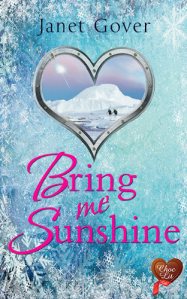
I feel most comfortable writing about places I have been – I do like to properly capture the essence of a place. As I travel more, some of that is sneaking into my work. A boat cruise around the tip of Norway in mid-winter helped me to write Bring Me Sunshine. A trip to Iraq was the key to writing a troubled ex-serviceman as a hero. Living in New York has given me a heroine – we won’t meet her for two more books, but she is waiting there for me.

What places, of the many you have visited really stand out as memorable and why?

Wow – that’s a hard one. Very place has its own magic. Even though I write contemporary novels, I am a big history buff. I have visited the ruins of Carthage, of old Constantinople and Pompeii. I walked the Great Wall of China – I had a terrible cold at the time and pretty much collapsed at the end of the day, but loved it all the same. I love the ancient feel of places like this – and wonder a lot about the people who lived there.

The other thing I love is wild places – the central Australian desert, the Everglades. A frozen lake in Norway. The Rocky Mountains. Nature is beautiful and powerful…

And, I have to say – my favourite city in the world is London. I just love walking across Waterloo Bridge as the sun sets over the Thames. Beautiful!

What top tip would you give to new writers?

Be passionate about what you write. If you don’t love your story and your characters … no-one else is going to.

And respect your reader – never give them anything but the very best book you can write.

Flight to Coorah Creek, the first in a series based in the Australian outback is out in paperback this month. Could you tell us about this exiting new series?

Flight To Coorah Creek

I am loving writing about Coorah Creek. It’s a fictional town – in the far west of Queensland. Very close to the desert. In this series, I am trying to capture the feel of the small outback towns I have known all my life. These towns are a long way from the sort of amenities we are all used to. There are no shopping centres, or cinemas. Not much in the way of hospitals or schools either. Often, they hover on the brink of collapse. Coorah Creek is a mining town – if the mine was to close, the town would die.

People who live in these towns become very close to each other. They form very tight knit communities. The books are all romances – with new hero and heroine in each one. But the town and the people of the town appear in each book. It’s a chance to see the life the characters live when they move off the centre stage.

I hope to the readers, each new book will feel a little like coming home to a place you know well and to people you love.

By contrast Bring Me Sunshine was set in a much cooler environment. This was quite a change. Where did the inspiration for this story come from?

Bring Me Sunshine - small

Bring Me Sunshine is set in as wild a place as I could image – Antarctica. Well, on a cruise to Antarctica. The book was inspired by my sister-in-law – who went there with her mother… who at the time was well into her sixties. What a journey for a woman of her age!

I couldn’t afford to go there myself, but my sister-in-law helped with the research. I did take a cruise to the Arctic by way of research – which was a lot of fun.

I didn’t realise until after I had finished it – but this is the first (and so far only) book I have written that doesn’t have horses in it. There are, however, several million penguins – and who doesn’t like penguins?

It’s also the first (and so far only) book I have written with a wedding in it – which is a bit strange for a romance writer.

What is next for Janet?

I am almost finished writing the second Coorah Creek book – it has a lot of horses in it. And a fabulous hero who was inspired by a trip to Iraq.

There is a third Coorah Creek novel in the back of my head – a New York girl is just desperate to go and visit the town. But she’ll have to wait until I finish book two.

I am also planning another lighter novel – set on an archaeological dig…

And then there is this tropical island – where three sisters organise dream weddings…

And the story about the circus… (which will probably have horses in it too).

I’m not sure what order I’ll be writing these books in – one this is certain though – I am not about to run out of ideas…

More from Janet

Meet Janice Rosser

Janice OAPschat

I am happy to welcome the creator of Oapschat.co.uk – a website with a mission to help the community it serves.

Could you tell us something about yourself?

Hello Valerie and thank you so much for inviting me. My name is Janice Rosser, (please call me Jan!) I was born and bred in Hereford, where I still live fifty plus years later. I have one sister, the author Margaret James. On leaving school, I had a career in banking, followed by a few enjoyable years working as a book keeper in a local Veterinary Surgery. I took a career break to look after my two sons. I then spent twelve years working in various Pharmacies. Since 2010, I have looked after my elderly mother full time.

What inspired you to start Oapschat?

A family conversation around the dining room table one lunchtime. We realised there were not many online community pages for the people approaching the silver and golden years of their lives. So, I started a Facebook page in April 2013 and began posting and commenting on various topics to do with the over fifties age groups.

How did you visualise the concept of Oapschat initially?

I thought I would see how the FB page took off and then write a weekly blog to see if any interest was generated. It quickly became clear that people were very interested and commented and posted daily. I was mentioned in The Daily Mail and once I reached 300 plus members on FB, I decided the time was right to launch the website in November 2013.

You encourage interaction between the readers and contributors to the site. Have you found it encouraging to see the response and also the number of sponsors that support it? 

I find it extremely encouraging to read the various viewpoints and comments and to know that I am helping people engage in online conversation. I do not have sponsors as such, I have had various companies and individuals that have donated raffle prizes for me which is fantastic and I also have fifteen contributors to date who have written their own articles for the website.

Did its success surprise you, or were you aware of a need for such site for this age group? 

The website is building very nicely after launching on November 1 2013 and the Facebook page now has 408 members. I realised last year that there is a real need for this age group after the Facebook launch in April 2013.

Being a carer and developing a website are both demanding activities. What do you see as the next step forward for Janice and Oapschat? 

Caring is indeed very demanding. It can also be very tiring and isolating. Oapschat is hard work, but extremely satisfying and rewarding. I want to see it grow and develop in order to reach out and help many people who may be in a similar situation to myself. I receive many messages of support from people who are living alone and they say that it is a good way of interacting and realising you are not on your own. It is a great way to make new friends and develop my writing skills. Oapschat is my baby and I shall nurture it for many months and hopefully, years!

Thanks you for taking the time to answer my questions and I wish you every success in your very worthwhile venture in reaching out to others.