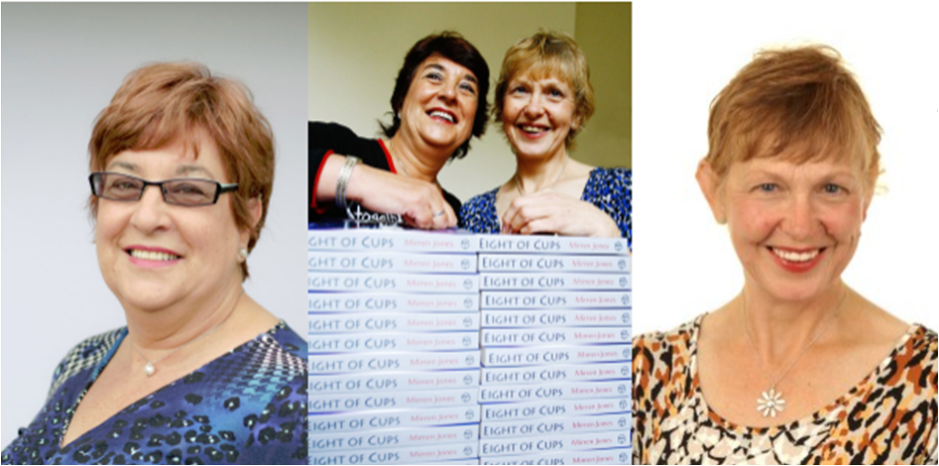
An Interview with Elizabeth Chadwick

Welcome to my blog, Elizabeth. From the moment you began writing manuscripts you never gave up on your goal of becoming a published writer. How long did this take?

I decided I wanted to write for a career when I was 16. This was after I had spent a year hand writing my first novel. Prior to that I’d always told myself stories verbally as imaginative fun. It wasn’t until I was 15 I wrote anything down, but having done so, I decided that writing novels was what I wanted to do for a living. It took another 16 years for me to realise that dream. Part of that time was taken up by growing up, entering the world of employment, getting married and having a family. During that period I learned to touch type and as technology advanced, transferred from manual typewriter to computer – in those days the Amstrad green screen. I always hoped to get published, but I figured it didn’t matter if I didn’t because this was my hobby and storytelling had been a part of me since I first had language, so I wasn’t just doing it for the fame and fortune (!), I was doing it for me.

Your big break came when Carole Blake became your agent after reading The Wild Hunt. How quickly did your world change as a result of this?

Not immediately because it takes time for contracts to be arranged and for money to begin flowing through so I didn’t give up the part-time day job immediately. When I was first offered a publishing contract, my children were aged six and three, and I was staying at home looking after them during the day and going out to work the twilight shift in a local supermarket at night while my husband took over the childcare. So although I was offered a publishing contract in the summer of 1989, I didn’t give up the job until late autumn of the same year. While my first contract wasn’t exactly enough to move to Millionaire’s Row, it allowed me to be a stay at home mum and write in the spaces between the children. In those early days it was still very much a part time income, but enough to get by when added to my husband’s full-time wage.

Do you look back at your early work affectionately or critically?

Both. I think any writer worth their salt is always learning and seeking to improve. I know I have moved on since my early days, but my early novels were still strong enough to be published and short-listed for awards in a very competitive market. I have since had the great opportunity to overhaul those early novels in the light of experience gained and it was interesting to go back and look at the learning curve. But I am very fond of my early works because they are the foundation stones on which my career has been built.

I totally agree with you. What advice would you give to an author who is about to make the step into the world of an agent and publishing deals?

Be professional. If you don’t know something and it’s genuinely out of your range, then ask. But do some homework first and make sure that it’s not something you can’t answer for yourself. Talk to other writers and professionals who have knowledge of the publishing industry and get a range of opinions. Go to events and network. The more you know the better you will be able to make decisions. You might even decide to go the route of self publishing, but you need to know all the ins and outs of what this entails and be realistic about expectations.

Your love of the medieval period began when you watched your TV hero on screen in the 70’s adventure series Desert Crusader. Which of your heroes/heroines would you love to see televised to inspire a new generation?

Without a doubt it would have to be the great William Marshal and his family. They win hands down! He was a man who took the helm of the country in a time of great upheaval during the early 13th century. Without his political, military and people skills, the pages of England’s history would probably have looked very different.

I would love to see William on TV.

You are renowned for your detailed research and historical accuracy. How has this deepened or broadened over the years since you started writing?

When I began writing it was at the more romantic end of historical fiction and the research books I was using were often fairly general in their outlook although I did even at that time possess a core number of books from university presses. By the very nature of time I gained experience, adding layer upon layer as each successive novel came out. I bought more books; as my knowledge levels increased so did the complexity of my reading. These days I mostly buy my research books from specialist publishers and university presses and my research has become more academic. I am now sometimes asked to give talks at universities and heritage sites – something I couldn’t have envisaged 20 years ago. My research has also become multi-layered. The Internet is obviously a fabulous resource and primary source documents are now available online that couldn’t be obtained when I first began writing. Even so one has to be careful because there is an awful lot of mediocre rubbish out there and all writers need an inbuilt drivel alarm! As well as research reading, I also re-enact with a living history society called Regia Anglorum. This helps me to get a feel for the period by working with replica artefacts and not just reading about how things were done, but having a go – see the next question. I also visit sites mentioned in my novels where possible, and this helps to give a feel for the lie of the land, although Google Earth is also your friend.

Regia Anglorum has obviously been an important part of understanding life within medieval England. What is your favourite artefact/garment that you have had recreated, through knowing the experts associated with the group?

I have a dress. It’s made from woollen fabric especially commissioned and woven to an 11th century pattern using the same loom width that a person of that period would have used. I’m rubbish at needlework and a bit awkward when it comes to cutting out patterns, so I had someone I know make the dress for me. This particular person has degree level knowledge of textile archaeology and mediaeval costumes and was able to design the dress to an 11th/12th century spec. It was then all handsewn using mediaeval stitch techniques. It’s the nearest I’m ever going to get to fully authentic!

In all the places you have been and the artefacts you have studied during your research, do you have a particular favourite(s) that has inspired you or left a lasting memory?

I absolutely love trawling museums, and the London ones are fabulous if one is in the capital. I would say that one of my favourite places to go is the Museum of London which has some terrific exhibits in the mediaeval gallery many of which are ordinary everyday objects and not just the stuff of high aristocracy. There are things like 14th century spades, fish traps, a wonderful little tinned mirror case, a terrific money box that looks like something out of the 1970s! They have a codpiece too!

For a single one I’d have to say the effigy of William Marshal at the Temple Church in London. I always go and see him and honour him when I visit London. He gave me my first New York Times bestseller and he has touched so many people, myself included. He has a life beyond his mortal life, and it always makes my throat tighten with pride when I go to the Temple Church.


What appealed to you most about the character of Eleanor of Aquitaine, inspiring your critically acclaimed trilogy?

I think it’s not so much a case of appealing. It’s more a case of downright curiosity. I had written about her and several novels and at first had followed the usual path of the biographers when I needed to put her in a story. But that came to be not enough. I began to ask questions; I began to see anomalies in her story that didn’t agree with the biographies or what was being accepted as historical veracity. I began to think about Eleanor in a bit more detail. What was she really like? What could she tell me that she hadn’t told anyone else? And the more I researched the more I found out and the more biographical discrepancies came to light. For example you will find her biographers describing her variously as an olive skinned black eyed beauty with a curvaceous figure that never ran to fat in old age, as a saucy blue-eyed blonde, as a humorous redhead with green eyes. And the thing is there is not one single physical description of Eleanor recorded anywhere. Even the supposed mural of her in the chapel of St Radegone in Chinon, is now thought by a leading art historian who has examined the mural in detail, to be a man. A recent academic work on Eleanor titled “inventing Eleanor” by Professor Michael R. Evans, investigates these odd ideas about her appearance, and actually quotes my research into the biographers’ notions about Eleanor’s appearance.

Non-historians also have some strange ideas about Eleanor – that she was a feminist and way ahead of her time, both of which are false assumptions. So I felt I wanted to explore my own version of Eleanor and see if I could discover the 12th century personality behind the detritus of the centuries.

What is next for Elizabeth Chadwick?

First I have to finish and hand in THE AUTUMN THRONE, but when that’s done I strongly suspect that William Marshal is going to be riding again as there are aspects of his story still to be told.

Thank you for taking the time out of your busy schedule to give us an insight into your fascinating career and love of history. Have a lovely Christmas and every good wish for further success in 2015!

An Interview with Sue Moorcroft

Sue M Portrait 300px

Sue Moorcroft is an amazingly versatile writer and tutor who has taken time out of her busy schedule to share her world with us. 

Welcome to my blog, Sue!

Thanks for inviting me.

Do you have a very set and organised working week or, with your busy and diverse writing commitments, do you work to ever evolving priority lists?

Both, I suppose. I have deadlines to meet for novels, serials and my monthly columns for Writers’ Forum, and also sometimes for other work including promo. To fulfill those deadlines I have a fairly long working day, often devoted to working with students in the morning and writing in the afternoon. In that way, I keep fresh for both. I punctuate most days with a class such as yoga, Zumba, FitStep or piano. These seem to see to my physical and mental health as I do most of those classes with friends.

Sometimes I have a teaching commitment that takes precedence or I go somewhere for research purposes. I enjoy spots on local radio, too. Variety is the spice of my life.

When did you first make your first breakthrough as a published author?

I sold my first short story, to The People’s Friend, in 1996. It was April 1st and I just hoped it wasn’t someone’s idea of an April’s Fool joke… I stopped counting at 130 short stories so that first one was quite important. The short stories led to serials but it wasn’t until 2004 that I sold a novel.

How important a role has the RNA played in your writing journey to date?

Very. It helped me to make the transition from short fiction to long. I was actually at a party thrown by a short story agency that placed some of my work when somebody told me about the RNA’s New Writers’ Scheme. Then I saw that Marina Oliver was appearing at a library about 20 miles from my home so I went along to that and asked her about the RNA, as she was then (and for many years) a committee member. I applied the next day.

Margaret James was the NWS co-ordinator then and she took a personal interest, including introducing me to someone who became my agent for the next seven years. I left that agent for personal reasons that affected my career in 2009 but have just signed with another, Juliet Pickering at Blake Friedmann.

The RNA members also gave me a ‘can do’ attitude. I’d be at a conference chatting to someone in the lunch queue and realise that they were the author of dozens of novels. But they just seemed ordinary aside from that … It made me realise that it’s hard work, education and talent that makes a writer, rather than some mystical power endowed to people other than myself. And, of course, the RNA gave me a massive number of writing friends.

What can a reader expect from a Sue Moorcroft novel?

A dauntless heroine and an irresistible hero to create sizzle, a contemporary setting, an entertaining read but meaningful subjects explored. Readers say that I make them fall in love with the hero, which is only fair because I fall in love with them all, too!

What have been the 3 stand out highlights of your writing career to date?

When I got ‘the call’ from my agent that began, ‘I have an offer for you.’

When I won Best Romantic Read Award for Is this Love? at the Festival of Romance.

And when a customer at a bookshop signing saw my display, picked up All That Mullarkey and asked, ‘Her! Do you write anything like her? This is what I’m reading at the moment and I love it.’ I squeaked, ‘I am her!’ It turned out that the lady was very ill and had been in hospital a lot. She was reading in the afternoons while she rested and any book that ‘grabbed’ her had become a lifesaver. She bought all of my books apart from Want to Know a Secret? because it had a hospital in it. I felt privileged to have made her illness a little easier to live through.

Sue M Wedding ProposalPlease tell us about your new book The Wedding Proposal and the inspiration behind it?

It’s set in Malta, which is a place I love as I lived there as a child. Because I like to read them I wanted to write a reunion book and that turned out to mean a lot of extra plotting. It was getting the balance right. The reason Lucas and Elle parted four years earlier had to be plausible yet they had to get over it in order to come together when they met again. Lots of backstory plotting required! One of the flats I lived in as a child overlooked a marina so I set the book there, ie I put Lucas and Elle together on a small boat for the summer. I thought it would make it hard for them to avoid one another. (I was right.)

Elle and Lucas have both mellowed while they’ve been apart. Lucas has made his hobby, scuba, into his job, by qualifying as a divemaster. Elle has been made redundant from her whizzy corporate life in IT and in a complete change of direction has begun to volunteer in a drop-in centre for young people. Lucas’s little brother Charlie is loveable but crazy so I brought him on stage to have an accident with far-reaching consequences. Elle still has secrets and Lucas still doesn’t like secrets, so that ignites the plot nicely.

What is next for Sue a) as an author and b) with your upcoming writing events/courses?

I’m writing two things. One is a three-part serial for My Weekly, scheduled to be published over Christmas and New Year. The other is a novel called The Twelve Dates of Christmas which is about dates and Christmas but also revenge porn, hats and ovarian cancer. I know the plot and I’m about one-third of the way through the writing. I’m not sure how I’ve ended up writing about Christmas twice as I actually love summer!

I’ll be at the Festival of Romantic Fiction in Leighton Buzzard on the 13th of September, at the book fair 10am-3pm and the Traditional Afternoon Tea at The Green House 4-5.30pm. I will be at the Romance Readers Awards at Leighton Buzzard Theatre in the evening because I’ve just heard that The Wedding Proposal has been shortlisted for the Best Romantic Read Award!

Next year I’ll be running a week-long writers’ holiday for fabulous Arte Umbria 22-29 July (already filling up) and hopefully one for equally fabby Chez Castillon but I don’t have the dates yet.

Thank you so much for taking the time out of your busy schedule to share some of your writing experiences with my readers.

And thank you for having me.

Sue Moorcroft writes romantic novels of dauntless heroines and irresistible heroes. Is this Love? was nominated for the Readers’ Best Romantic Read Award. Love & Freedom won the Best Romantic Read Award 2011 and Dream a Little Dream was nominated for a RoNA in 2013. Sue received three nominations at the Festival of Romance 2012, and is a Katie Fforde Bursary Award winner. She’s a past vice chair of the RNA and editor of its two anthologies.

Sue also writes short stories, serials, articles, writing ‘how to’ and is a competition judge and creative writing tutor.

Sue’s latest book The Wedding Proposal is available as an ebook from 4 August 2014 and as a paperback from 8 September.

 TWP_RGBpackshotMore from Sue:

Website: www.suemoorcroft.com

Blog: http://suemoorcroft.wordpress.com/

Facebook: sue.moorcroft.3 and https://www.facebook.com/SueMoorcroftAuthor

Twitter: @suemoorcroft

An Interview with Mirren Jones

Mirren Jones
‘Mirren Jones’ is a unique partnership of writers Marion Duffy (left) and Elaine Atkins (right).

Did your partnership form and grow through the collaboration as writers or did your published work evolve as a result of your friendship?

A bit of both! In 1999, we had co-authored two books of non-fiction, published by Radcliffe Medical Press (‘Facilitating Groups in Primary Care’, and ‘Facilitating Organisational Change in Primary Care’), while employed by The University of Dundee. That activity, along with several years of co-tutoring and joint research and consultancy, developed our working relationship and eventually led to our being friends as well as boss and junior!

Our fiction writing partnership – and ongoing friendship – is something newer and different, as we are no longer in a formal work situation. We’ve been writing and working together for 16 years in total and are still great friends, despite now living 500 miles apart.

Please tell us something about ‘Eight of Cups’?

front cover high resolutionThe novel is certainly not chic-lit, and is not intended to be literary; rather it fits the genre of well-written contemporary women’s fiction, although many male readers have told us they’ve enjoyed reading it and learnt a lot about women’s minds in the process! It’s a saga spanning over thirty years, beginning in 1972, as the six main characters arrive at Edinburgh as new undergraduates. After leaving university, their roads lead to England, Wales, Ireland, America and the Middle East; lives intertwine and paths cross.

The story is told from two perspectives. One, from the first-person narrative of the primary character, the rather too selfless (as becomes evident) Scottish lass Diane. The other, third person narrative interlocks all six characters in a brindled strand of narrative priorities. The women are all very different personalities: Nancy, the risk-taking country-loving girl from Yorkshire, Alix, the hedonist from Aberdeen, Carys, the studious one from the depths of West Wales, the quietly anxious Lesley, from Cardiff, and bossy, religious Patricia from Dundee.

The book explores the effects of the various attachments each character possesses on their lives: dreams, ambitions, pleasures, plans, obsessions and fears, and asks the question, “What will it take to set them free?”

Where or who did the inspiration and desire to write the novel come from initially?

Marion (Mirren) describes the impetus as being a combination of challenge and opportunity, with a significant event in her social life providing the seed for the story. She was moving to live part-time on the Isle of Lewis in Scotland when her husband took up a post there in the island dental services. He was concerned that she would be bored (does he really know her??) and challenged her to ‘write that novel you’ve been banging on about for years’. Co-incidentally, she attended a reunion of old university friends where one of her old pals divulged a shocking secret to the group. That set her thinking of how life affects plans and attitudes. On hearing of Mirren’s novel-writing plans, Jones was very keen to join in, making a strong case that if we were able to write non-fiction successfully then we ought to be able to do the same with fiction! So after discussion and negotiation, Mirren Jones was born and ‘Eight of Cups’ quickly began to take shape.

Do you split tasks when you approach producing a novel or do you write alternate chapters, swap them and then smooth out the writing style in redrafting?

 We work in a highly iterative way – creating, structuring, planning, revising, over and over again until we are happy with the product. Interestingly, we always sit down together and read through all the dialogue before signing off the final draft – this does give unique insights. In the end, the finished work is an amalgam of our ideas, plot lines, character development and physical writing (Mirren’s straight on to computer, and Jones on paper first), critiqued and then polished according to our own standards and preferences, as well as feedback from selected trusted reviewers.

You both have had careers dealing with people within the health sector. Do you think this experience has helped you to feel deeper empathy for the characters you create?

alyth town hall - CopyOur work in the NHS, in academia and as organisational development consultants has required us to be attentive listeners, adept at interpreting information from others via all our senses, able to feedback sensitively and imagine ourselves in others’ shoes. We have gained experience over many years of the effects of ill-health on people, and how life impacts on well-being. Hopefully our innate vein of empathy has been enhanced by our real-life experiences which then give us insight that we can apply to our characterisation. Perhaps being co-writers has an advantage over writing solo, in that with our combined life and work experiences we are able to bring a very wide range of knowledges and contexts to our writing, thus giving credibility to our characters and their settings.

How do you keep up the much needed energy and momentum for the projects you start when living so far apart and having such varied commitments and interests?

We put no pressure on each other in terms of deadlines and accept that life will get in the way, as it has done since we became Mirren Jones. We try to fulfil our promises to each other, and to ourselves as best we can, and both would love to have more time to write. Neither of us are the kind of writers who can squeeze in an hour before bedtime, or get up early and write before going to work. But what does help is if one progresses the story and reignites the flame for the next chapter to be written.

Please tell us something about your next novel, ‘Never Do Harm’.

It is a psychological drama about two doctors, friends since childhood, living in the same part of Scotland, but operating in very different settings. Alan is a GP in a busy medical practice, Hugh is a senior hospital consultant in a big teaching hospital. Professional in their working lives, they are rivals as well as friends in their personal life. Alan’s French wife Simone, a sculptress, is the third player in their relationship. Her presence will generate the potential for harm, something the two men promise never to do in their role as doctors, but which doesn’t of course apply outside of work. Our old NHS colleagues will be more than a little worried that we’ve used some real-life experiences to fuel our writing of this novel – and they may well be right!

What is next for Mirren Jones?

Finishing ‘Never Do Harm’ is our immediate aim – we are committed to reaching this goal before the end of the year. Then we have to navigate the world of Indie publishing which has changed considerably since we produced ‘Eight of Cups’, with the advent of digital books on multiple platforms, and embrace marketing with renewed enthusiasm!

As for the future – we have no problem generating ideas for stories, so when we decide to work on a third novel, it will probably progress much as this one has – in a stop-start fashion, with many twists and turns in both the writing and the lives of the writers. Given our personal experiences to date, we can anticipate unexpected changes which might throw up a range of other possibilities. In the meantime, Mirren continues in her role as Practice Manager in her local health centre, and Jones with her work as an Energy Psychology practitioner (humans and horses) / MD of CareandCompare.com – a charitable insurance price comparison website.

More from Mirren Jones

Website: www.mirrenjones.co.uk

Blog: www.mirrenjonesblog.com

Twitter: @MirrenJones

Facebook: Mirren Jones

Google+: +Mirren Jones

Pinterest: http://www.pinterest.com/mirrenjones/

Kindle worldwide: http://authl.it/1qs

Happy, Healthy and Successful 2014!

2014 is already over a week old. New Year resolutions have been made. If starting a creative writing project is one you are considering. Enjoy your writing, whilst experimenting until you find your own voice within your chosen genre.

To get you started here are some top-tips given by a selection of my author guests of 2013.

Margaret James: Stick at it and believe you have something interesting to say. There will be times when the going gets hard and you’ll need to be able to convince yourself that it’s worth going on. Make friends with other writers face to face and online, via Twitter, Facebook and their blogs. Read other people’s novels because then you will absorb good practice and realise there are many different ways in which you can tell a story.

Freda Lightfoot: I put my heart and soul into my stories, which is absolutely essential. You must lose your inhibitions and be entirely sincere, but yes, it does take hard work and dedication. I’d say it demands the three p’s, which stand for practise, persistence, and passion for your craft.

Trisha Ashley: There’s too much temptation now to rush out your first novel yourself as an e-book, so if you take that route I’d advise you to have your novel independently edited, and consider the constructive criticism you receive very carefully.  You want your novel to be perfect and whole, not some poor, half-formed creature, and with a first novel you aren’t going to spot what’s wrong with it yourself.

Jean Fullerton: If it took me three years to become a nurse, another two to qualify as a district nurse and a further three to become a lecturer, why on earth would I think I could learn the craft of writing overnight?  Very few first books are of a publishable standard. Mine wasn’t. Learn your craft and persevere!

Gwen Kirkwood also stresses the need to persevere: Try to write a little every day, even if it is only a couple of sentences. Keep a notepad handy. Consider the strengths and weaknesses of your characters, or improve your plot, while you are travelling, ironing, peeling the vegetables. Thinking time is important too. Listen to the advice of agents and editors, not friends. If you do self-publish pay a reputable copy-editor to check your work first.

Whilst Gwen advocates writing a little every day, Christina Jones, points out it is not essential: Don’t feel you have to write every day. Write the way that suits you. Some people write 10,000 words a day, others write 500. Some (like me) know that if the words aren’t there then it’s best to forget writing until they are and go and scrub the kitchen floor or go for a walk or chat with friends or read or watch telly, whatever – be yourself and do what’s right for you. Just don’t feel pressurised to be like everyone else.

Linda Mitchelmore, the author of many short-stories and now novelist advises: The same premise of ‘person, problem and plot’, with a ‘beginning, middle and an end’, is the same for short stories and novels. The only difference is the time it takes to tell the story. Whilst Valerie-Anne Baglietto reminds us: You can never please everyone, so above all please yourself and write something you feel passionately about. It will show if you don’t.

More advice is offered within the interviews.

If you love creating fictional worlds, have a strong desire to commit them to paper and share them with others, then enjoy the whole process and good luck!