Love the Adventure

To-Love-Honour-and-Obey-267x400Fifty novellas ago, I began writing love stories each wrapped around an adventure, set against the rugged beauty of the North Riding of Yorkshire. These found their home in the Commonwealth library market and from this base a further six novels have evolved.

When To Love Honour and Obey published by Sapere Books, was reviewed by a fellow author, he described it as ‘Where Poldark meets Heathcliff’ – I was delighted.

I have always loved reading both fiction and non-fiction exploring the Regency period. I enjoy the romance whether written from the perspective of the rigid society of London’s ‘Ton’, so beautifully portrayed by Georgette Heyer and more recently Julia Quinn, or the melodrama of the darker more menacing shadows of Daphne du Maurier’s Jamaica Inn.

Basically, my tastes cross genres within the period, from Jane Austen’s and the Bronte’s classics to E.V. Thompson’s20240126_161100 Cornish sagas, or Bernard Cornwell’s action and adventure series about the rifleman who rose from the ranks, Richard Sharpe.
I have worked as a creative writing tutor for years and one piece of advice commonly given to authors starting out, is to write about what you know. That does not mean that you must know everything first – no one can, especially where murder and mayhem is involved. Without a time-travel machine, a writer today cannot depict a bygone age with total accuracy capturing the language, attitude, beliefs, habits, understanding of people centuries ago when travel and knowledge were limited.

Research is the key! Whatever the genre; romance, crime, thriller, horror, fantasy or any other preferred, the author must accrue enough knowledge beforehand to write their story and make it credible and believable to today’s readership. Jane Austen was of course writing in her own time; about the world she knew.

Research can be all encompassing when it is focussed on a topic you are enthusiastic about. In first drafts ‘info-dumps’ can creep into a manuscript, slowing the pace of the story. Which is where an editor’s skills are needed to take out the non-essential information, as the author will always know more that the reader needs to about their created ‘world’.
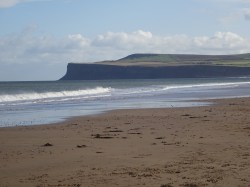
DSC03023When I began writing I thought about the ‘write about what you know’ advice and started exploring my home area. The North Yorkshire Moors and the bay towns from Whitby to Saltburn provided a dramatic backdrop for many of my stories.

Saltburn-by-the-Sea had its own infamous ‘King of Smugglers’ John Andrew, who in 1780 was landlord of the unique Ship Inn, which nestles to this day under the shadow of the 110m high Huntcliff. My fictitious Ebton is based on Saltburn, my Coble Inn nestles in the shadow of Stangcliffe, the headland based on Huntcliff.

 “We’re on Stangcliffe, the headland!” Joshua exclaimed, as realisation hit him harder than the force of the wind. He was inches away from a sheer drop to the sea below where sharp-edged rocks hid under each of the crashing waves…

To Love, Honour and Obey Sapere Books
To Have and To Hold
Book 3

This Jurassic coastline encompasses rugged high cliffs and sweeping flat sandy bays. The wild moor inland would have been crossed by locals along small tracks for centuries by the Regency period. The dales, areas of fertile farmland and woodland, dropped down from the moors, with ancient abbeys and small villages of stone-built cottages nestled  within – but cottage industries were being replaced as manufacturing developed in the growing towns causing population shifts, consequently impacting livelihoods, Secrets, due to the Industrial Revolution, a theme resonated in To Have and To Hold, Sapere Books.

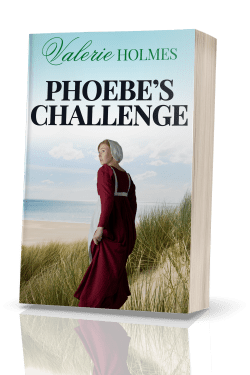
Unrest was growing nationally, the Luddite movement triggered fear in Parliament that revolution would happen in England as it had in France. In Phoebe’s Challenge, brother and sister are hunted as machine-breakers – punishment was  anything from a fine, to hanging or transportation to Australia.

secrets front
Friends & Foes Book 2

My books are not dark, but touch on the darker side of human-nature and society, Betrayal, ultimately showing that love and justice will win the day. In real life things may not always work out that way, but in fiction – which is a form of escape from reality – in my stories at least, things do.

The world of Valerie Holmes has the tagline ‘Love the adventure’ – a sentiment that I hope my readers will share.

Beyond the book cover, plot and protagonist, which has a greater influence on your choice as a reader: the physical setting or the period in which it is set?

Please share your thoughts and preferences.

If you are interested in writing, and want to create your own fiction, but need some professional guidance or support, please contact me via my manuscript appraisal page.

I am delighted to announce that Discovering Ellie is now available in Large Print Paperback for those who cannot manage an eReader – just click here
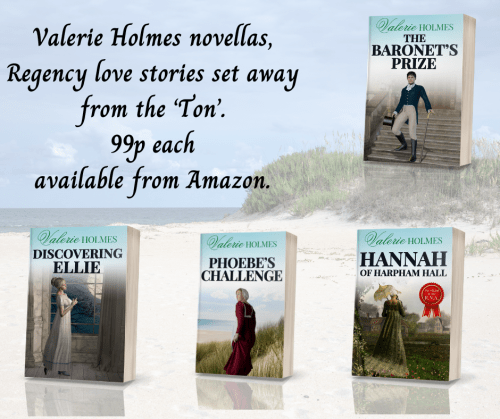
Valerie Holmes novellas. 99p each available in

Smuggling, treason and espionage.

Smuggling in Regency times was rife in the rugged and isolated ‘bay towns’ of what was the North Riding of Yorkshire. Although the skill and daring of those involved in the trade can be admired, there was a dark and far-reaching side to their activities.

20181026_145817

In my books there is a recurring element of smuggling showing how it could have affected the lives of those within the region and, inadvertently, helped Napoleon in his war against our own nation.

Being an island, smuggling had been prevalent for many years within the coastal communities nationwide. With a much smaller population than today, most of the inhabitants of these places would be either involved, or at least aware, of contraband being stored or moved through their communities.

This extract from Rudyard Kipling’s’ poem A Smuggler’s Song captured it beautifully:

If you wake at midnight, and hear a horse’s feet,
Don’t go drawing back the blind, or looking in the street,
Them that ask no questions isn’t told a lie.
Watch the wall my darling while the Gentlemen go by.

The reasons the trade existed were complex but huge import taxes applied to certain consumables made brandy, tobacco, tea, silk and many other desired goods far too expensive for most people, instantly creating opportunity to fill a demand illegally.

Napoleon Bonaparte had no wish to lose the income France received from this illicit trade. So, he ordered the French Channel ports be kept open for business. This also created wealth for the organiser of the smuggling gangs’ pockets, some of which were part of the British landed gentry. Their subordinates lower down the chain of command were often unaware of the identity of the ‘top man’ who could only be known by a select few.

This trade was open to being used for further nefarious purposes, as free traders earned even more money by selling government secrets. This shared intelligence could cover troop deployments/movements/logistics, coastal patrols and the names and responsibilities of important people. This information had its value in coin, which Napoleon desperately needed to fuel his war effort. It was aiding treason.

phoebes-challenge

Government agents tried to uncover such traitors. In Phoebe’s Challenge Rev. Matthew Fenton provides information to uncover the local gangs. In The Friends and Foes series, Lord Farrington is a semi-retired Intelligence Officer who has been given the task of unearthing a traitor in Betrayal, but his role is concerned with insurgence and threats to the government at home too. This is a time of hardship and much perceived threats, externally from France and her allies and internally from those deeply affected by the loss of livelihood and the industrialisation, which was bringing huge wealth to a new ‘middle-class’ and displaced communities from the countryside to town and mills.

Revolution on our shores was a fear.

dscn0347Lord Farrington discusses the situation with  Dr. Samuel Speers,  in Betrayal
“I already know they are involved in the business of financing the trade in contraband. But what else? Lord Bagby has influential friends who he meets in his clubs – does he pass on information to our enemies as well as coin? Is he a traitor through and through? These facts I must seek out.”

Samuel looked up, quite shocked. “You think they are traitors. Many people locally dabble in smuggling to eke out their meagre livings…” 

Farrington leaned forward. “Stop my friend if you wish to remain so. Smugglers give coin to Napoleon’s war effort – they help our enemy and our men die. I do not debate the taxes set, but the way they fund our enemies for selfish gain. Do not be so naïve. I shall bring down the Bagby’s and this man Jed Webb who eludes our Riding Officers.”

 Villagers could earn some coin to supplement their meagre incomes by hiding contraband in amazingly inventive places or help to convey goods on arrival from larger vessels at sea in their own fishing boats to hide them on land. Tubmen were men paid to convey the goods from delivery to their next destination. They needed to be strong, often landsmen, who knew the area and walked the trods and snickets that linked the bay towns and crossed the open moors.

IMG-20181103-WA0006

The northeast coast leant itself perfectly to this. Many of these coastal villages have long, flat beaches of fine sand, where the local ‘cobles’, the shallow draught fishing boats could be easily drawn up and the villagers knew how to avoid the scars, the vicious fingers of rocks that extended from the shore. Fishing was the main source of employment on the coast. Whitby and Robin Hood’s Bay are well known for their smuggling links but the coast between Saltburn and Redcar was almost as notorious towards the end of the eighteenth century. The bay towns in my books of Ebton and Allunby are fictitious villages based on the sweeping bay of Saltburn to Coatham, where I grew up and hold a strong affection for.

Three organisations were created to try and stop this trade. The Revenue Cruisers, the Riding Officers and the Preventive Water Guard.

Revenue Cruisers patrolled offshore in ships that with full sail could often overtake smaller vessels once located. The problem they faced was locating ships amongst the many who sailed along the German Ocean, and also the honesty of the crews who were on occasion known to work with some of the smugglers in exchange for a cut of the goods, made discerning their whereabouts even harder.

Riding Officers were based around the coast, living near the suspected communities and riding the coast to try and prevent the collusion between land and sea. A nearly impossible task.

The Preventive Waterguard was established in 1809. They had houses around the coast – Watch Houses, and smaller boat crews which would patrol their stretch of coastland.

Between all three branches the tide was slowly turning in the governments favour. In 1822 they were incorporated into one force, The Coast Guard, charged with stopping the import of these highly taxed goods. They employed ex sailors, strong, tough and knowledgeable who needed employment after the end of the Napoleonic Wars.

This led to a gradual decline of demand and consequently causing the amount of smuggling that was committed throughout the first half of the nineteenth century to dwindle.

Before this happened though the battles fought to catch the smugglers and traitors lay the seed of many a good tale, some yet to be told.

Thank you for taking the time to visit my page. If you like the article please hit the like button and share where you are visiting from in the comments below.

Best wishes

Valerie

The Yorkshire Saga standalone series published by Sapere Books


series insty (1)