An interview with Gwen Kirkwood

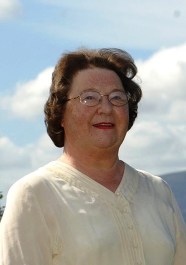
Welcome, Gwen!

Your warm-hearted family sagas are based in rural Scotland. When and where did your love affair with Scotland’s beautiful country and history begin?

I have three Scottish grandparents so I had a yearning to see Scotland for myself. I came to Dumfriesshire to work as a milk officer, inspecting dairy farms. The work was not as I had expected but the people were very friendly and I loved the warmth of the red sandstone buildings and the beautiful landscapes with fresh green hills and glens and lots of trees. I have never wanted to leave, especially not after I met and married my husband, a Scottish dairy farmer.

Are any of your wonderful characters based on real people or are they all purely of your own creation?

My characters are all fictional but I think writers must be influenced by people they have met, even if it is only subconsciously. I had a wonderful mother-in-law so a few of my older characters may have some of her kindness and wisdom. We can read of bad characters every day in the newspapers. I have three adult children who keep me up to date with the opinions of their generation. My grandchildren are of varying ages and I often include children. Writers keep on learning and developing and so do the characters but I have never written about a real person.

You took a six year career break. When you returned to your writing did you feel as if your work had changed at all?

I don’t think my writing changed. I still wrote another series of four in a family saga following the generations. My books are shorter, 100,000 words or less now, but that is due to the policy of different publishers.

To date, what has been the most memorable or significant event within your writing career?

I had written four short romances but it was a tremendous boost to my confidence when an agent sold my first long saga to Headline in a very short time. A good editor can have a big influence and Jane Morpeth helped me a lot.

Secondly, I rarely enter competitions but after a long gap from writing it was a lovely surprise to win the Elizabeth Goudge trophy in 2000 when it was resurrected by the RNA for the millennium. It was judged by Richard Lee of the Historical Novel Society.

What top tip would you give new writers wanting to become published writers in today’s market place?

Persevere. Try to write a little every day, even if it is only a couple of sentences. Keep a notepad handy. Consider the strengths and weaknesses of your characters, or improve your plot, while you are travelling, ironing, peeling the vegetables. Thinking time is important too. Listen to the advice of agents and editors, not friends. If you do self-publish pay a reputable copy-editor to check your work first.

You have seen many changes within the publishing industry. What do you think of the new emphasis on social networking and Internet presence?

Honestly? I hate it – well some of the time! I want to be left in peace to write, BUT writing used to be an isolated occupation so I am pleased we now have opportunities for keeping in touch with other writers, getting and giving help, as well as marketing. Networking has become essential so I do my best, but it can take up a lot of time.

Your new book Darkest Before the Dawn has a very strong cover. Can you tell us something about this novel and what inspired you to write it?

This is the fifth in a series of 5 novels beginning with Dreams of Home at the end of World War II. Darkest Before the Dawn brings the series up to present day with the third generation of the Caraford family. Two of the characters are quite young with problems belonging to their generation so it could almost be a young adult novel, although I did not set out to make it that way. However, it also brings farming up to date with robots for milking cows, arguments between the generations about changes, as well as an unexpected and rather satisfying love affair for two of the older characters.
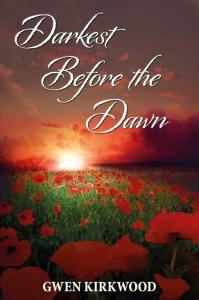
Darkest Before the Dawn

Joe Lennox becomes bitter and deranged and blames Billy Caraford when his son is killed in a car accident, but Billy has lost his best friend and is badly injured himself. Despite the misgivings of his parents he is still determined to be a farmer. He summons his courage to go to university but privately he regards himself as a cripple now. He is convinced no woman could love him or want to be his wife.

Kimberley is orphaned when her father dies. She moves to Scotland with her aunt but she is nervous about changing schools until Billy helps her find new friends. Both Kim and her aunt become involved in the affairs of the Caraford family and as Kim grows into a lovely young woman she finds the strength of character to confront problems and fight for the life and the love she craves.

What is next for Gwen Kirkwood?

I am going back to the 1800’s and this will be a single novel rather than a series. It has less emphasis on farming but is still set in Scotland. No title yet.

My thanks for taking the time to answer the questions in such an honest and open way. I shall look forward to reading Darkest Before the Dawn when it is available later this month!
More by Gwen:

Betrayal of Innocence

Buy and read now!

US Readers: Kindle / iTunes / Nook

UK Readers: Kindle / iTunes / Nook

Early nineteenth century North Yorkshire, England.

Lydia works hard as a servant at Bagby Hall to keep her father, an ailing tenant, from the poorhouse. She is horrified and wracked with guilt as she discovers her friend, the gentle fallen Georgette, being used by Lord and Lady Bagby. Lydia longs to aid Georgette as she fears her life may be in danger – but how? The arrival of the mysterious, Dr Samuel Speer, adds to her dilemma, as Lydia’s concern grows. Does she risk her father’s wellbeing and reveal the truth or remain forever silent and therefore, guilty…

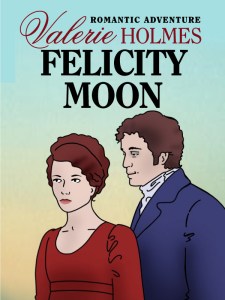
Felicity Moon

Felicity Moon KEC

Buy and read now!

US Readers: Kindle / iTunes / Nook

UK Readers: Kindle / iTunes / Nook

Early nineteenth century North Yorkshire, England.

Felicity Moon strikes the Lord of the manor in self defence and is forced to leave his household. Squire Moon, her father, is in gaol charged with bank-rolling smugglers and storing contraband. Felicity has one last chance to save herself from ruin in the form of a reference to Mr Lucas Packman, a man her father dislikes intensely. She has an impossibly stark choice to make: trust Packman or her obey her father. 


An interview with Linda Mitchelmore

LINDA WRITING ROOMI am delighted to welcome prolific short story writer and successful Choc Lit author, Linda Mitchelmore.

When did you first realise that you wanted to be an author?  
I did things rather back to front. I didn’t consciously start out to be a writer. One Christmas – back in the day – there was a short story writing competition in Woman’s Own. On Christmas Day evening, my family were all glued to the TV – something I don’t get a huge lot of pleasure from as I am deaf. So I thought I’d have a go at the short story competition for something to do. To my utter amazement my short story was short-listed  and published. And I was paid for it. The old cash registers behind my eyes started to ring and I thought, hey, I could make money from all the ‘stuff’ that goes around in my mind…

Your stories have sold internationally. How many have you had published to date? 
I’ve lost count of the exact number of short stories I’ve had published but it is definitely 300+ now. I’ve also had a story broadcast on radio – the irony of that not lost on me.

Writing short stories and longer fiction involve two very different disciplines. What attracted you to short fiction initially, and how much of a challenge was it making the switch to longer fiction? 
Short fiction is just that – short. 750 word stories are quite popular with some magazine editors. I tend to write 1000 word or 2000 word stories as they’re the lengths that tend to fit into most magazine slots. When working on a short story I don’t have to think too much about viewpoints – I only ever write one character’s viewpoint into a short story. I don’t have to have sub-plots, and foreshadowing is something that – depending on the story – doesn’t raise its head much. So they are much quicker to write. When I first started writing I had two teenage children at home, a husband (still got him!) and a part-time job as well as ageing parents and parents-in-law to be doing things for. Short story writing was easier to fit in around all that. Writing longer fiction – 80,000 words or so – seemed a natural progression for me once I had more time to write it. The same premise of ‘person, problem and plot’, with a ‘beginning, middle and an end’, is the same for short stories and novels. The only difference is the time it takes to tell the story.

Your novel, the first of a trilogy, ‘To Turn Full Circle’ is set in your beautiful home county of Devon. Please tell us something about the inspiration behind it? 
The seeds of To Turn Full Circle were sown when I was helping my husband research some family history. We discovered that his great uncle, George, had fished out of Brixham. George had had two trawlers. One of them was lost to the sea in a storm (although with no loss of life) and George had a bad accident on board the other one which meant he had to come off the sea and lost his livelihood. He had to move his wife and daughter back in with his mother. I had a ‘What If’ moment! What if it wasn’t a man who had lost his home because of circumstances, but a young girl? And ‘What If’ the sea still controlled her struggle to survive? And so, To Turn Full Circle was born.
When you begin a new project does your initial idea start with a character, situation, place or theme or does it vary? 
For me a story always starts with an emotion or a feeling – something deep inside my main character. In To Turn Full Circle’s story it was Emma’s determination to survive which drives the story.

You have two more novels to write to complete this trilogy. What do you see as the next challenge for Linda Mitchelmore? 
Writing the next two books is keeping me busy at the moment. I do, however, have a contemporary novel under consideration – the heroine is older than Emma. The feeling driving this story – tentatively called Red is for Rubies – is regret. Most of us have them and in Red is for Rubies, my hero and heroine have lived – apart – with their own regrets for a long time. Will they get a chance to redeem themselves?

Also, I have now signed a contract with Choc Lit for a novella – Hope For Hannah. It will be an e-book initially and out in the close future.

My thanks for a very insightful interview, Linda.

More by Linda:

CHOC LIT LOVE MATCH Layout 1

Dead to Sin (A Penn Mystery Book 1)

Dead to Sin KEC_1Buy and read now!

US Readers: Kindle / iTunes / Nook / Kobo

UK Readers: Kindle / iTunes / Nook / Kobo

The first Penn Mystery: When duty alone is not enough…

1812 North Yorkshire, England.

Nicholas Penn is summoned to Gorebeck Gaol to visit a man accused of the rape and murder of five wenches. Having been found holding the body of the last victim in his arms his plight seems sealed.
Nicholas is torn between a sense of duty and his feelings of hurt and disgust when being in the presence of the accused. The tables turn abruptly, and Nicholas becomes the incarcerated, duped and incensed he is sworn to find the man, Wilson, before another victim dies and honour can be restored.

Bethany’s Justice

Bethany's Justice KECBuy and read now!

US Readers: Kindle / iTunes / Nook

UK Readers: Kindle / iTunes / Nook

Early nineteenth century North Yorkshire, England.

If you cannot trust your closest friend, then who can you? One young woman is about to find out. When Bethany and Kezzie excitedly walk to a neighbouring village fair, Bethany discovers how fickle her friend is once they meet up with womaniser, local shepherd, Bill Judd. Deserted on the open moor road, Bethany’s feelings are hurt, but she is determined to continue her journey. In her anger she makes a life threatening decision, cutting through a wooded estate, she is shot at, wounded but her rescuer changes her life forever.


Truth, Love and Lies

Truth, Love & Lies KEC

Buy and read now!

US Readers: Kindle / iTunes / Nook

UK Readers: Kindle / iTunes / Nook

Florence Swan escapes before she is forced to work in a cotton mill. Naïve and ambitious, she ventures out into the world alone believing she can work her way up the hierarchy of servants within a manor house or hall.

Major Luke Stainbridge returns to his beloved estate in England after being a prisoner of Napoleon only to discover he has been replaced by an imposter.  Two lives are in chaos. Two destinies combine. Will the love of truth be enough to destroy a sinister network of lies?

The Captain’s Creek

TheCaptain'sCreek KECBuy and read now!

US Readers: Kindle / iTunes / Nook

UK Readers: Kindle / iTunes / Nook

Early nineteenth century North Yorkshire, England.

Maggie Chase discovers an injured stranger fleeing for his life on the isolated beach near her secluded cottage in the nearby wooded gill. Her father, Captain Chase is away at sea, leaving her on her own. Trusting her instincts, she helps the man, Montgomery, to evade capture by a press gang. Little does Maggie realise that this rash act will threaten her reputation, jeopardise her own heartfelt plans to open up a village school and risk her life. Maggie soon sees that the handsome stranger is a dangerous man led by his own private ambitions for justice…

Chloe’s Friend

Chloe's Friend KECBuy and read now!

US Readers: Kindle / iTunes / Nook 

UK Readers: Kindle / iTunes / Nook

Early nineteenth century North Yorkshire, England.

Chloe is hidden in the lowliest place in Hall’s service – the laundry. Here, away from prying eyes she is expected to work until her father sends word that all is safe for her to resume her more privileged life. Mr Thaddeus Poole, the estate’s groundsman, watches her. He is handsome and strong. Chloe is grateful that he has helped her when she weakened. However, Chloe does not know if he will betray her, or become her most trusted and loyal friend or more…

Abigail Moor

Buy and read now!

US Readers: Kindle / iTunes / Nook

UK Readers: Kindle / iTunes / Nook

Early nineteenth century North Yorkshire, England.

To avoid a forced marriage, Abigail has to escape from Beckton Manor by order of her ailing guardian Lord Hammond. With her maid, one bag and three mysterious letters, Abigail heads to York, seeking help from her father’s legal representatives. Her quest is foiled by Lord Hammond’s son who sends his man to fetch her back. A chance meeting with Captain Rusk ensures that Abigail’s world opens up to reveal more than she could ever imagine. Who should she trust – her lifelong maid or her new found friend?